Code Monger, cyclist, sim racer and driving enthusiast.
10073 stories
·
6 followers

Over A Century Ago, A Man Tried To Reinvent Coastal Transportation With A Train That Was Also A Boat And A Pier

1 Share

Traveling between two points along a coast probably isn’t something that many people have to think much about. Today, you’ll find lots of options like trains, ferries, or roads. But not every solution has been so straightforward. Back in 1896, the Brighton and Rottingdean Seashore Electric Railway provided service between two points 2.8 miles apart. But it didn’t use a boat or have a train meander a coastline. Instead, the man behind the project, Magnus Volk, invented a bizarre train that rode on stilts above water. But it was more than a train, given its lifeboat, life rings, and a sea captain at the helm. This is what happened to one of the weirdest vehicles that technically counted as a train.

This train, which was given the nickname the “Daddy Long-Legs,” was the work of British-German pioneer inventor and eccentric Magnus Volk. On the surface, Volk’s train solved a pretty simple problem. The jagged and high cliffs along the coastline of Brighton, England, were unsuitable for a rail line. Trains can climb only so steeply, and changing the geography to permit the construction of a rail line is costly and time-consuming. Instead of carving his way through the rock to build a rail line, Volk took a more creative path. What if the train ran on rails through the surf, bypassing the rugged terrain entirely?

That was only one of the ideas behind the Brighton and Rottingdean Seashore Electric Railway. On paper, this 2.8-mile railway was supposed to be a bunch of vehicles and objects all in one. The train was like a boat that you couldn’t get seasick on, and in a way, it was also sort of like a moving pier. But the whole experiment didn’t last particularly long, and there hasn’t been a train quite like it ever since.

18655599dd472d634d859300a9b282e5
Ellis Kelsey Collection – CC0 1.0

A Railway Pioneer

Magnus Volk is not a name that is uttered often on this side of the Atlantic, but in the United Kingdom, he was a visionary in his day. Volk was born in 1851 in Brighton to a German clockmaker. Just over three decades later, Volk would have his name on one of the first electric train lines in the world. Amazingly, that line, known as the Volk’s Electric Railway, is still in operation today. It holds the distinction of being the oldest operational electric railway in the world. But how does someone even get to this point? In 1937, following Volk’s passing, Meccano Magazine published his biography:

Mr. Volk was only 14 years old when his father died, but the boy took over the clockmaking business. Then he began to make toy telegraph instruments, and became sufficiently prosperous to employ 20 workpeople. Later he added electric bells and shocking coils to his range, and it was soon after this that he became interested in electric lighting. This led to his appoint­ment as electrical engineer to the Corporation of Brighton, and in 1883 he lighted the Royal Pavilion estate electrically. This installation was then the largest of its kind in the country. A large chandelier in the Dome of the Pavilion was wired for 200 lamps, which had carbon filaments, and the 200 gas fittings in it were retained for possible use in emergency. This made Mr. Volk’s work more difficult, for his insulating materials had to be capable of withstanding the heat of the gas flames.

Office Picture Opening Day 1883
Magnus Volk is standing on the left side of the railcar. Credit: Brighton and Hove City Council

In the meantime he had begun to plan the electric railway that was to make him famous. He had made an electric motor for a London firm, which had not accepted it, and with this, a small Siemens dynamo and a 2 h.p. gas engine he carried out some experiments that suggested the great idea to him. He asked the Brighton Corporation for permission to build an experimental line along the sea front, and when this was granted he set to work. His track, of 2 ft. gauge, was made of flat bottomed rails spiked to longitudinal sleepers, with shingle packing, and his first car was a crude one with four wheels. The gas engine and dynamo were installed in a tiny power station under an arch in the roadway opposite the Aquarium. Current was generated at about 50 volts, and was conducted to the motor by means of the wheels. The line was laid and the equipment prepared in the astonishingly short time of 18 days. The track ran from the Aquarium to the Chain Pier, so that it was only about a quarter of a mile in length, and it was opened on 3rd August, 1883. The greatest interest was taken in the event, for there had been many gloomy predictions that it would prove to be a complete failure, and probably many of those in the crowd that assembled for the opening hoped to see something sensational. In this they were disappointed, however, for the car started without a hitch as soon as power was switched on by the Mayor of Brighton, who drove it on this occasion, Mr. Volk acting as conductor.

From that time the line was very popular, in spite of the forebodings of a few obstinate people who saw in it the latest invention of the Devil. About a thousand passengers enjoyed the novelty of a trip on it on August Bank Holiday of that year, when the railway was in operation for 11 hrs. and the little car ran about 50 miles at its regular speed of 6 m.p.h. From then until the end of the year about 300,000 passengers were carried, and the enterprise was so successful that the period for which permission to operate it had been given was extended, and the line was lengthened to Paston Place, and subsequently to Black Rock. Then followed a great struggle. Violent storms wrecked the line four times during one summer, and sleepers, boards and other equipment disappeared from time to time, removed possibly by cabmen, boatmen, and hay and corn dealers who thought the railway threatened their livelihood. Mr Volk fought pluckily against misfortunes of all kinds, however, and he received so much support locally that he was able to keep his line open and to retain complete control of it. On one occasion a stranger offered to provide him with capital without any legal agreement, and on another a local newspaper raised a fund by subscription to enable the whole line to be repaired.
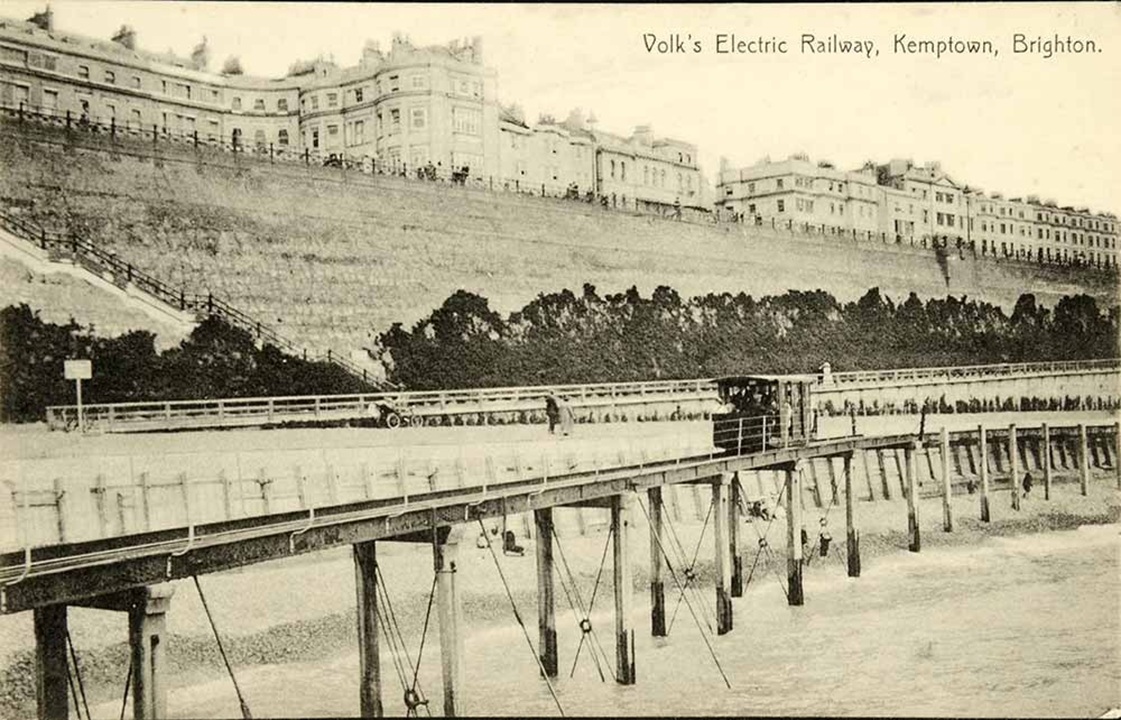
Zspc11 669 48 Volks Electric Rai
The National Archives – ZSPC11-669-48

As the New York Times wrote, it was true that Volk was such a wizard with electricity that his inventions were denounced as the “work of the devil.” But that never stopped him. In addition to building one of Britain’s first electric railroads, he also built a three-wheeled electric car in 1887, another electric car for Sultan Abdul Hamid of Turkey in 1888, and he even invented an egg cup for men whose arms had been amputated.

Volk has also been credited with experiments involving fire-alarm systems and bringing electricity into houses. However, Volk is remembered best for the railway from 1883 that you can still ride today.

A Tall And Awkward Railcar
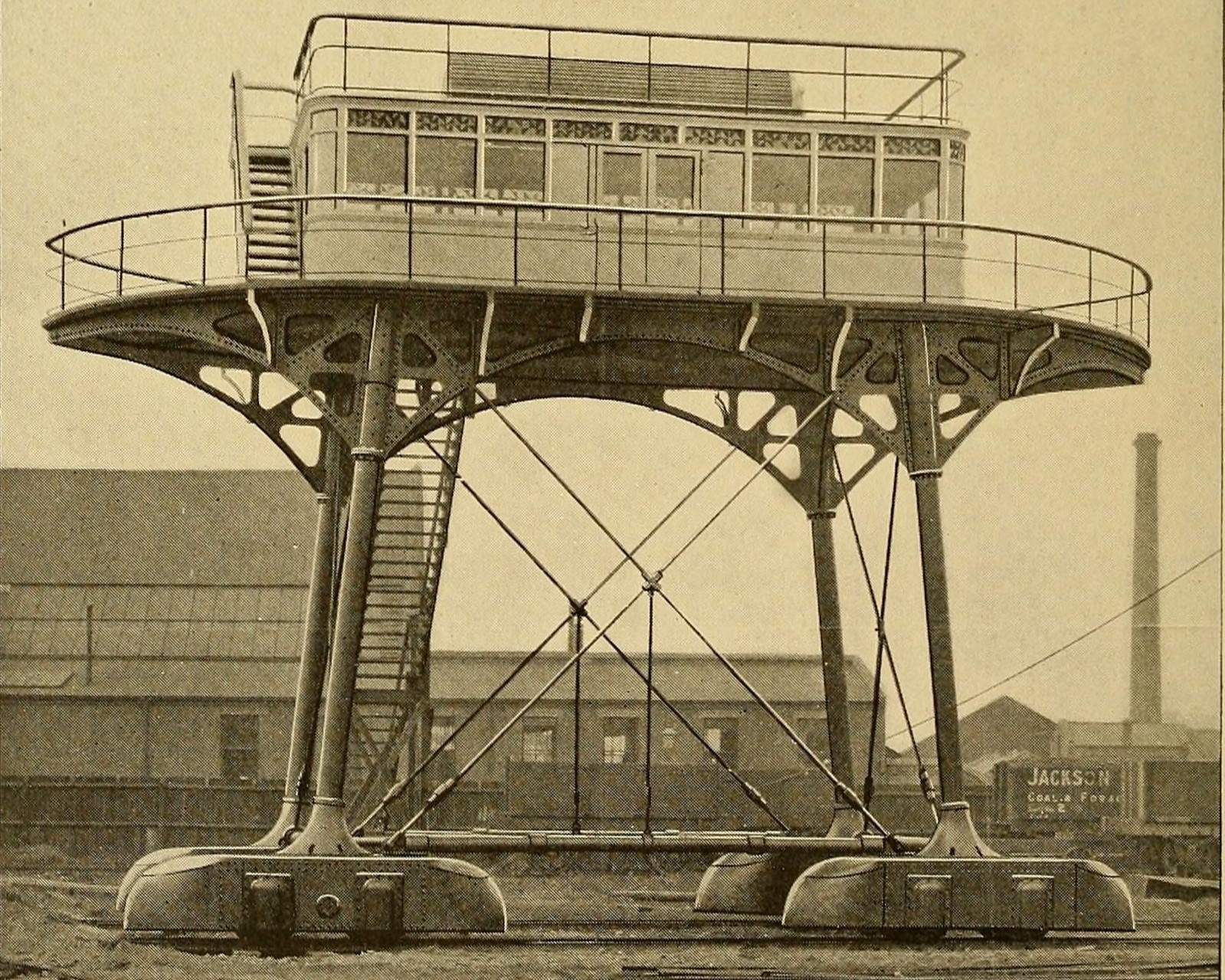
Volkrr2
Magnus Volk – Public Domain

As Meccano Magazine writes, one of the limitations of Volk’s railway was that it was susceptible to being overtaken by crashing waves from the sea. But Volk kept pushing forward. That was until Volk saw a challenge that his rail line couldn’t beat, at least not at first. Volk wanted to extend his train east from Paston Place and Banjo Groyne (a groyne is a kind of wall in a body of water to reduce erosion) to Rottingdean. It was a distance of about three miles as the crow flies or about four miles by land.

There are two versions of the story as to why Volk made a train on stilts. The often-reported story is that the foreshore between the two points was covered in water for most of the day, so taking a typical train through it would be unfeasible. However, the more traditional path would have the train tackling cliffs and rugged terrain along the coastline. Volk would determine that the easier path was to make the train operate over the water rather than try to carve a railway through the cliffs.
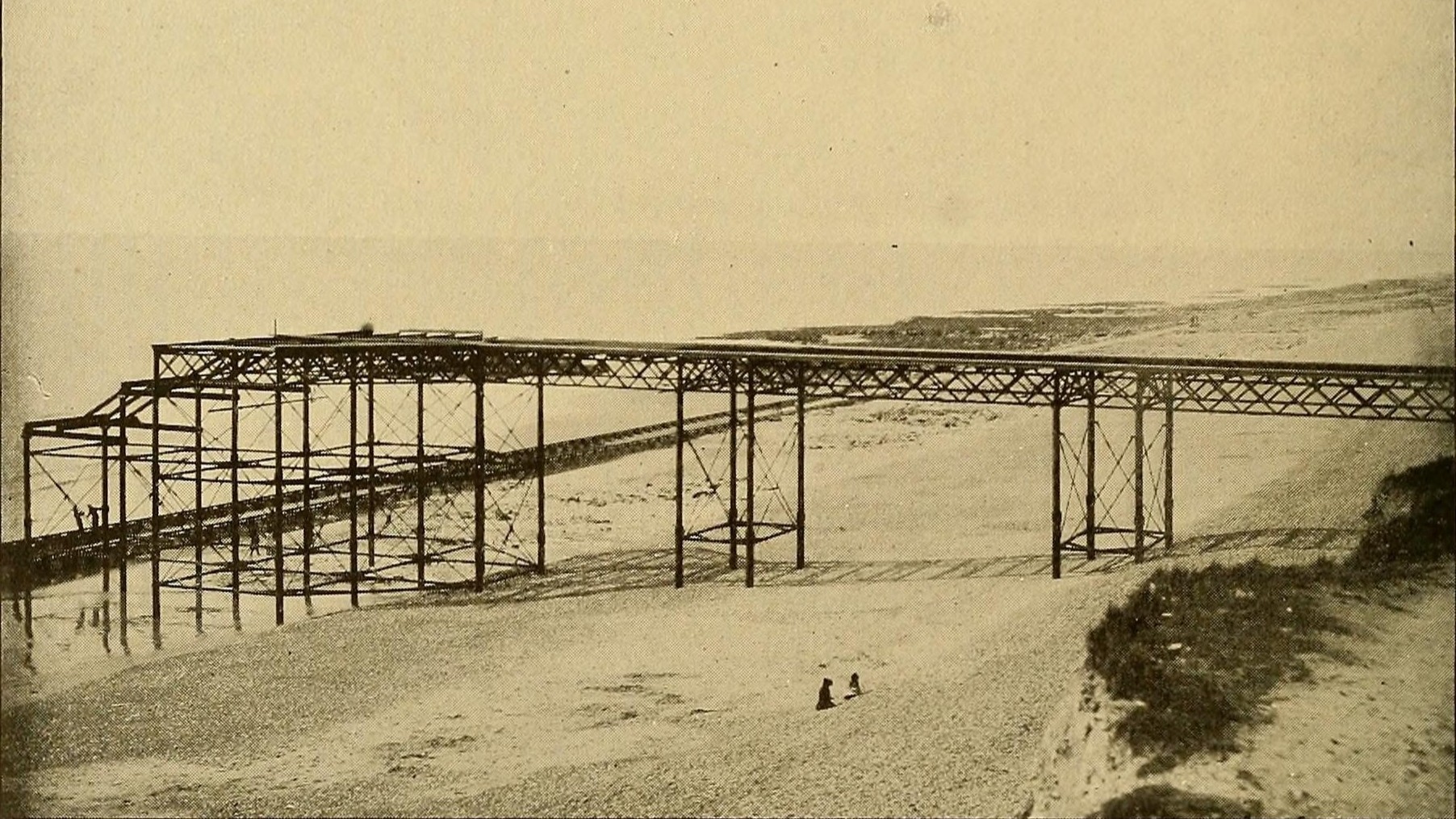
Volkrr1
Magnus Volk – Public Domain

The alternative version of the story, as told by Volk, is that building a train that rolled above the sea would afford visitors the unique opportunity to see the coast, take in the fresh sea air, and experience a short sea voyage without seasickness.

Whatever the reason, Volk’s idea didn’t consist of making a train roll across a bridge, as would be the likely solution today. Instead, he built the train itself to run along the shore and under the water, regardless of where the tide was. Volk says that parliamentary powers for the new line’s execution were granted in the summer of 1893 and that construction started in June 1894. Apparently, additional licensing from the Board of Trade, the Crown, and the Corporation of Brighton was required. Volk then describes how the line was built, via Cassier’s Magazine:
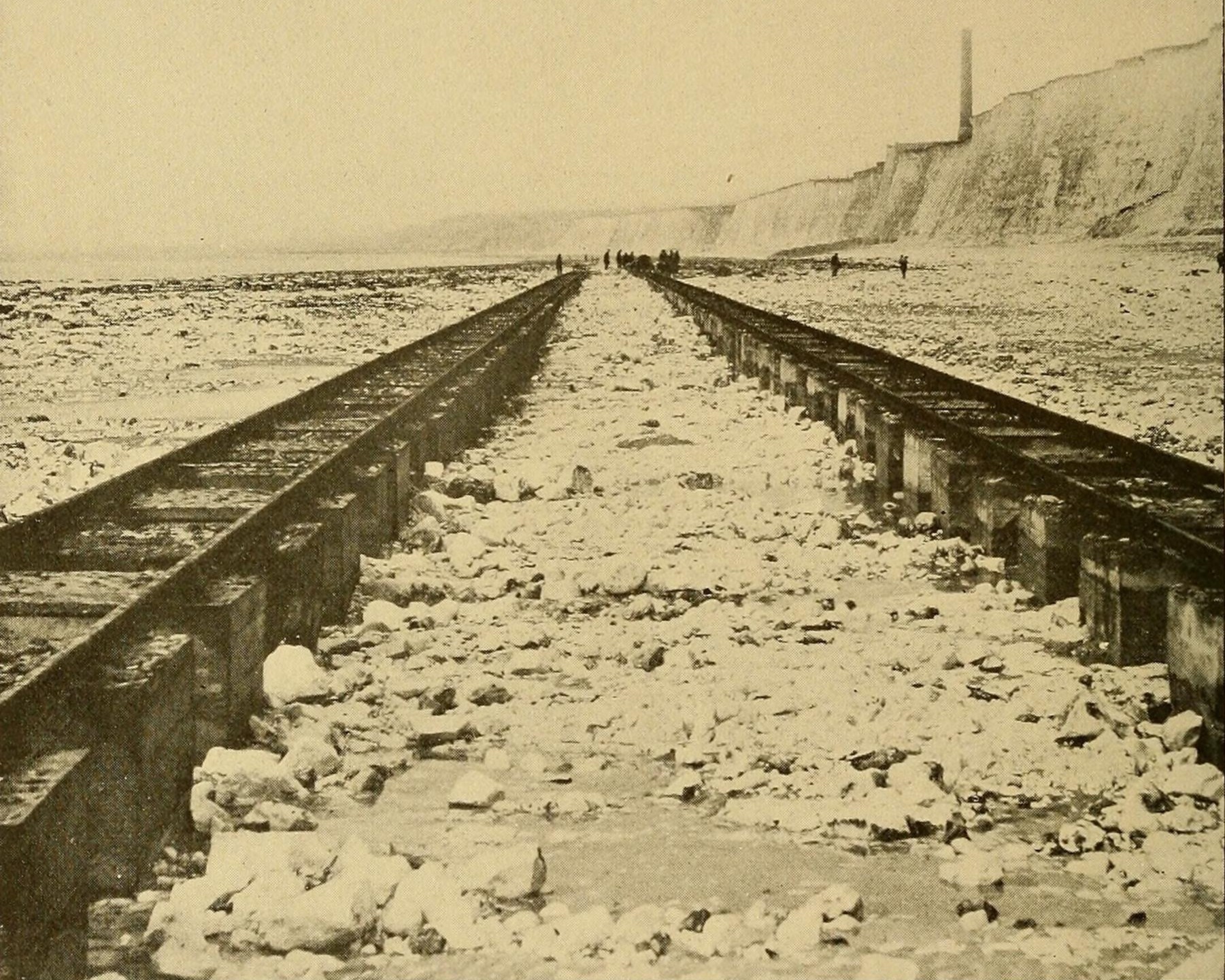
Volkrr
Magnus Volk – Public Domain

The line commences at the eastern end of the Brighton Electric Railway and extends a distance of three miles to the village of Rottingdean, a favourite summer resort. There a small iron pier has been erected for the cars to run alongside the pier being available also for steamer traffic and promenading. At the Brighton end of the line an iron jetty has been erected and a building containing commodious waiting-rooms and offices was built on it.

The coast is bold along practically the whole distance, with chalk cliffs varying from 60 to 120 feet in height, and as the rails are laid a considerable distance from the shore, a fine view of the coast is obtained. The rails rest on concrete blocks, made in situ, about three feet apart, mortised into the sound rock, the height of the block varying with the irregularities of the shore. A shifting sand of very moderate depth covers the rock in places, but the rails were laid sufficiently high to prevent any trouble from accumulations on them. The steepest gradient is one to 300, and the radius of curves, 40 chains (2640 ft.).
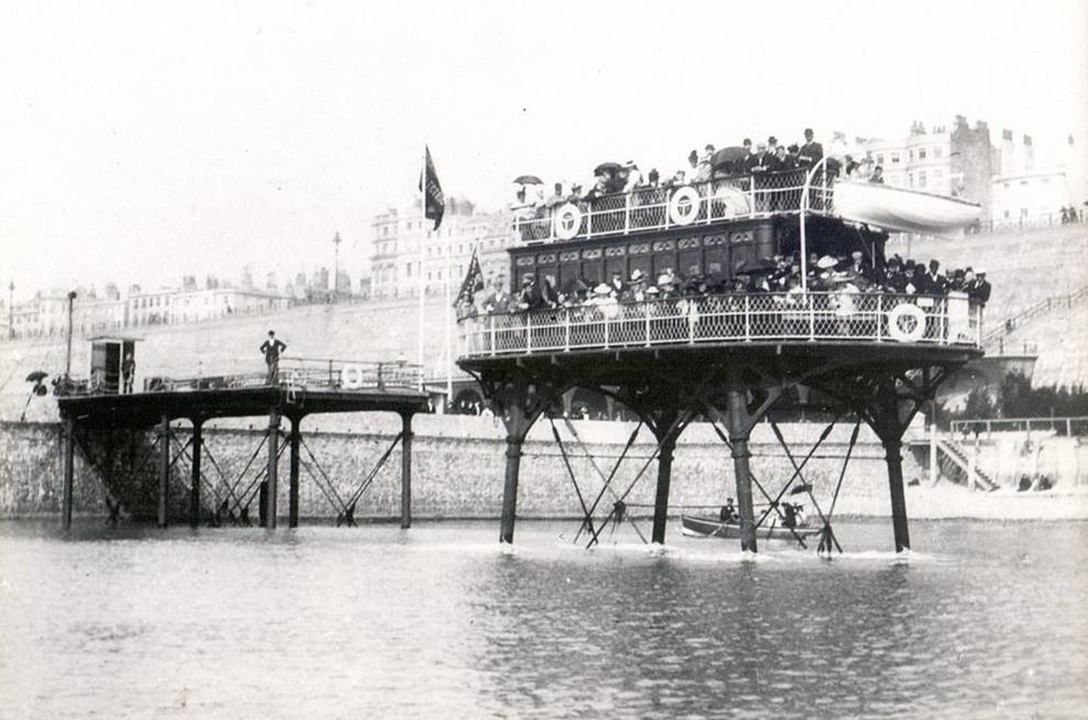
B8e970538e33e1eee8118ecc373387f8
Public Domain

The line consists of four rails (54 lbs. per yard) laid as two tracks of 2 feet 8.5 inches gauge, spaced 18 feet between the outer rails, thus giving an effective gauge of 18 feet, this being rendered necessary to give the required stability to the cars. The rails are secured by steel clips and bolts, the latter being embedded in concrete. Oak blocks, through which the bolts pass, are placed between the rails and the concrete blocks. Tie rods are also used every 10 feet on the straight, and every 5 feet on the curves, and heavy angle fishplates are used for the rail joints, the rail being in 30-ft. lengths.

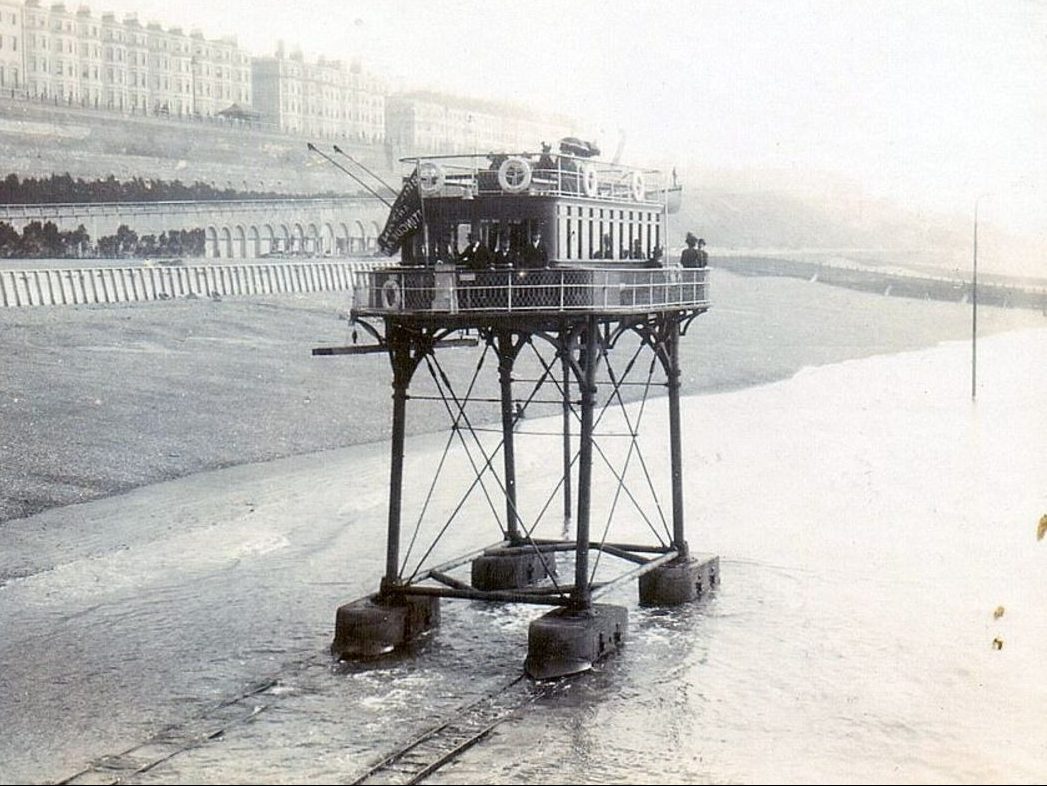
At low tide, the concrete foundations and the tracks are visible. It was possible for people on the beach to run under or alongside the train as it rolled down the track. At high tide, Volk said, the blocks and tracks were submerged under 15 feet of water from the English Channel. Volk noted that the track system survived multiple strong storms during the 1894 and 1895 seasons without any permanent damage and without any accumulation of seaweed or other debris.
Volkrr3
Magnus Volk – Public Domain

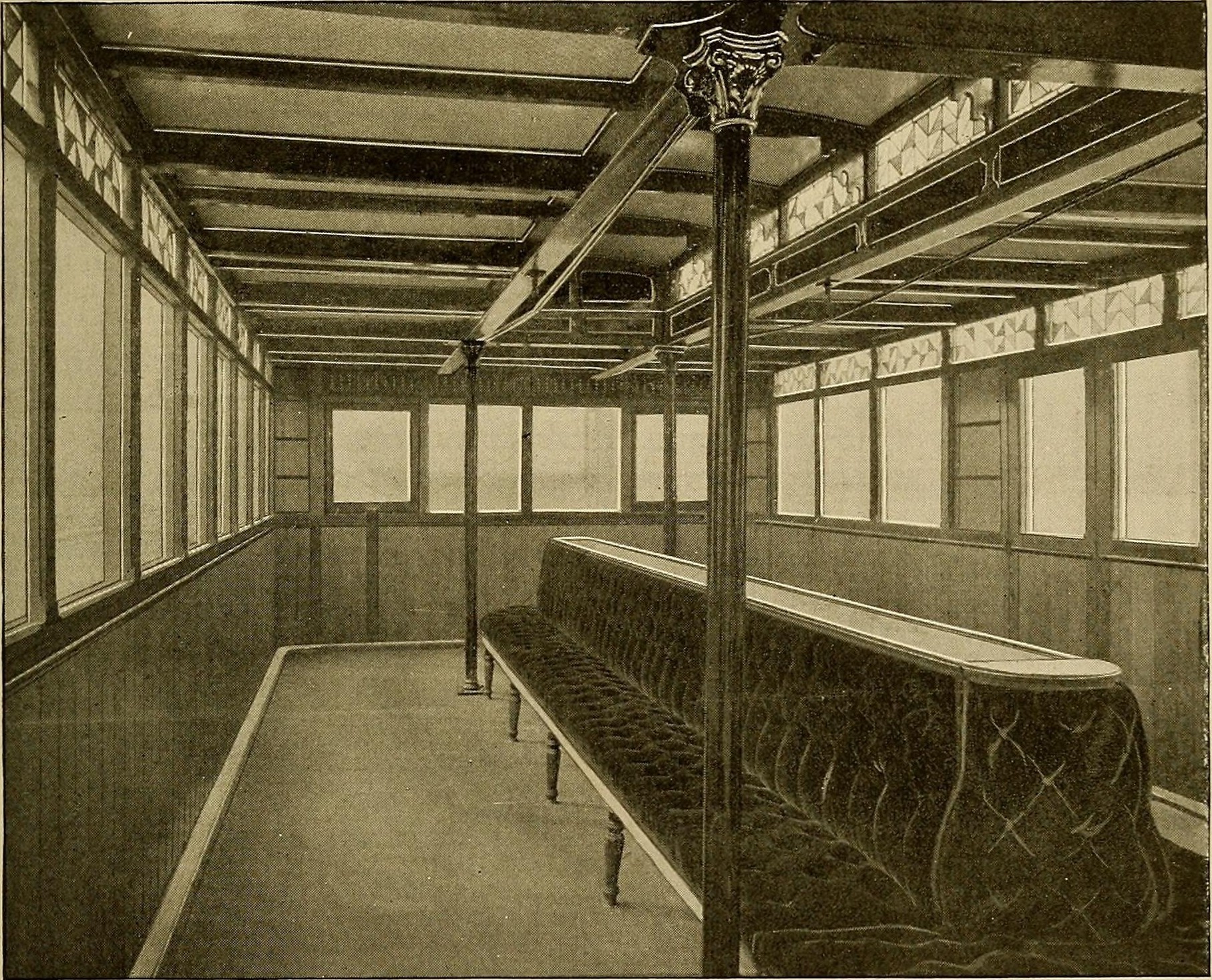
The other part of the equation was the railcar, which Volk also described:

The car, which was built by the Gloucester Railway Carriage Company, is a structure on 16 wheels, each 33 inches in diameter, carrying the passengers at a height of 24 feet above the level of the rails. The four main legs are tubes of drawn steel 11 inches in diameter. At the bottom of each leg is placed a bogie truck, having four wheels, the outside of the bogie being shaped like an inverted double-ended boat to facilitate its passage through the water, and also to remove any obstructions from the rails. The four bogies are firmly held together by steel tubular struts. The wheel base is about 28 feet and with the already mentioned effective gauge of 18 feet, gives great stability.

The tops of the main legs are firmly built into lattice girder work carrying the deck, and the whole structure is firmly secured by cross ties. It is of greath strength, although offering but a small surface to the force of the waves. The main deck appurtenances and erections are carried out exactly as if for a steam yacht, and measure 50 feet in length and 22 feet in width. The railings round the deck are of iron with a wooden top rail and wire netting. An ample supply of seats, with reversible backs, is provided to enable passengers to face the direction in which the car is going.
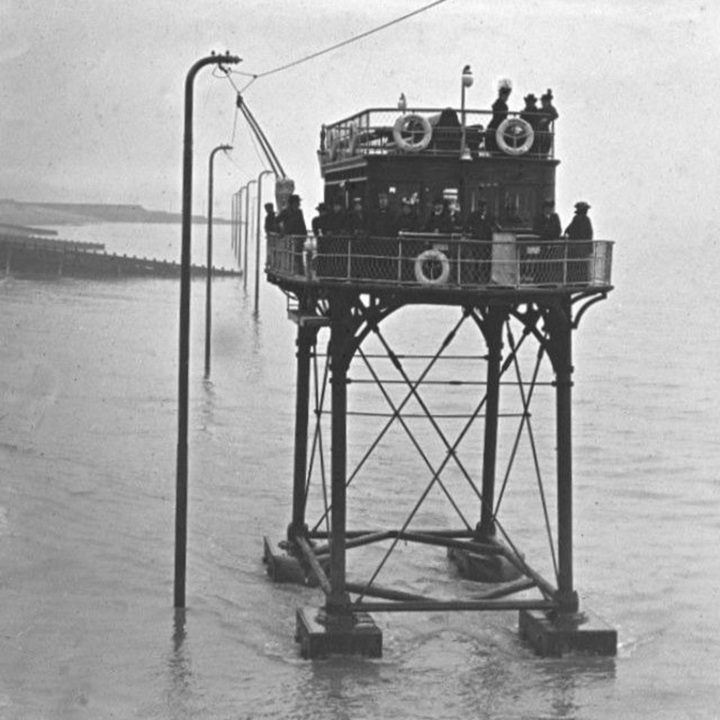
Daddy Long Legs 16
Ellis Kelsey Collection – CC0 1.0

The centre space of the deck is occupied by the saloon, a structure 12 feet wide by 25 feet long, provided with plate glass windows all round and a large central ottoman, fitted with a box between the backs in which are placed palms and flowers. The centre of the ceiling is occupied by a stained glass dome and the interior decorations are carried out in a simple but effective manner. The roof of the saloon is railed round and forms a promenade deck, seats being placed over the glass dome and over the centre of the saloon. On the lower deck is placed the controlling apparatus for driving and stopping the cars. The total accommodation is for 100 to 150 passengers. As the journey is short and will be undertaken more for the sea air than for quickly making the trip, the speed is kept between six and eight miles an hour.

Volk continued that the railcar, which weighed 50 U.S. tons, was powered by General Electric 800 type 30 HP electric motors placed above one leg on both sides. A shaft travels down to the bevel gearing, which turns the wheels at the base. The train did have brakes, which were actuated by rods contained in the remaining two legs that did not have the motors in them. The trucks at the bottoms of the legs contained a total of 16 wheels and were shaped like inverted boats in an effort to plow debris out of the way of the railcar.
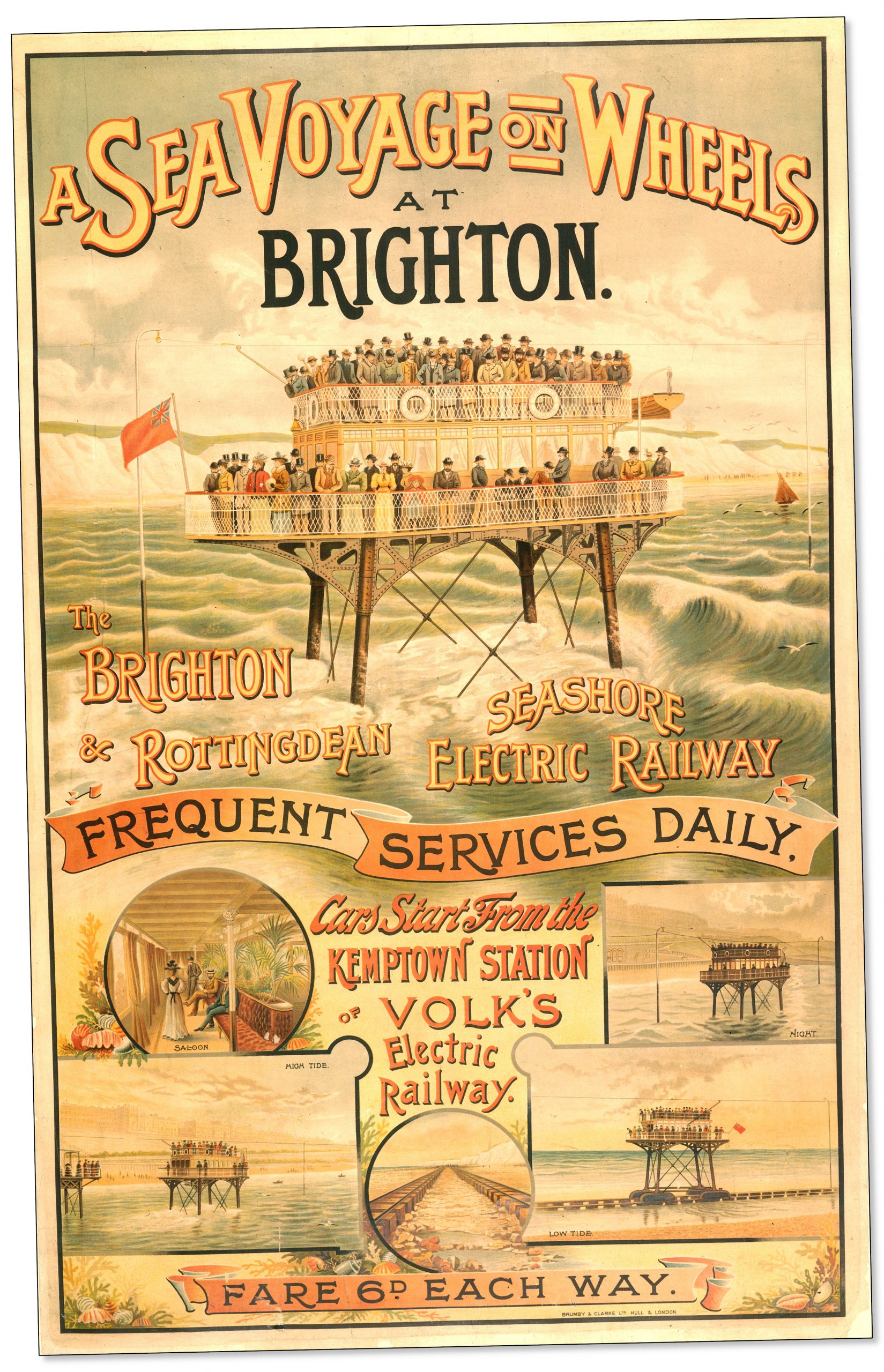
Brightontrain
Brighton and Rottingdean Seashore Electric Railway

500 volts of power came from tall trolley-style poles placed beside the tracks. Power was generated for the car at the Rottingdean-side of the rail line by a 110-horsepower William Sissons and Co. steam engine running a 50 kW General Electric four-pole generator.

Engineering of the rail system was handled by Volk and Mr. St. Geo. Moore. Funding came from Mr. Edward Overall Bleacky, Mr. J. J. Clark, J. P., and Mr. R. L. Pope, J. P. Some other reports said that the four tubular legs of the railcar each had a 25 HP motor. I’ve also seen period reports saying that the machine had only two 25 HP motors. So, the railcar had anywhere between 50 HP and 100 HP, depending on who you asked back then. Apparently, Volk had also considered powering the railcar using the era’s batteries, but that plan did not work out.

The Sea Voyage on Wheels
Daddy Long Legs 7
Public Domain

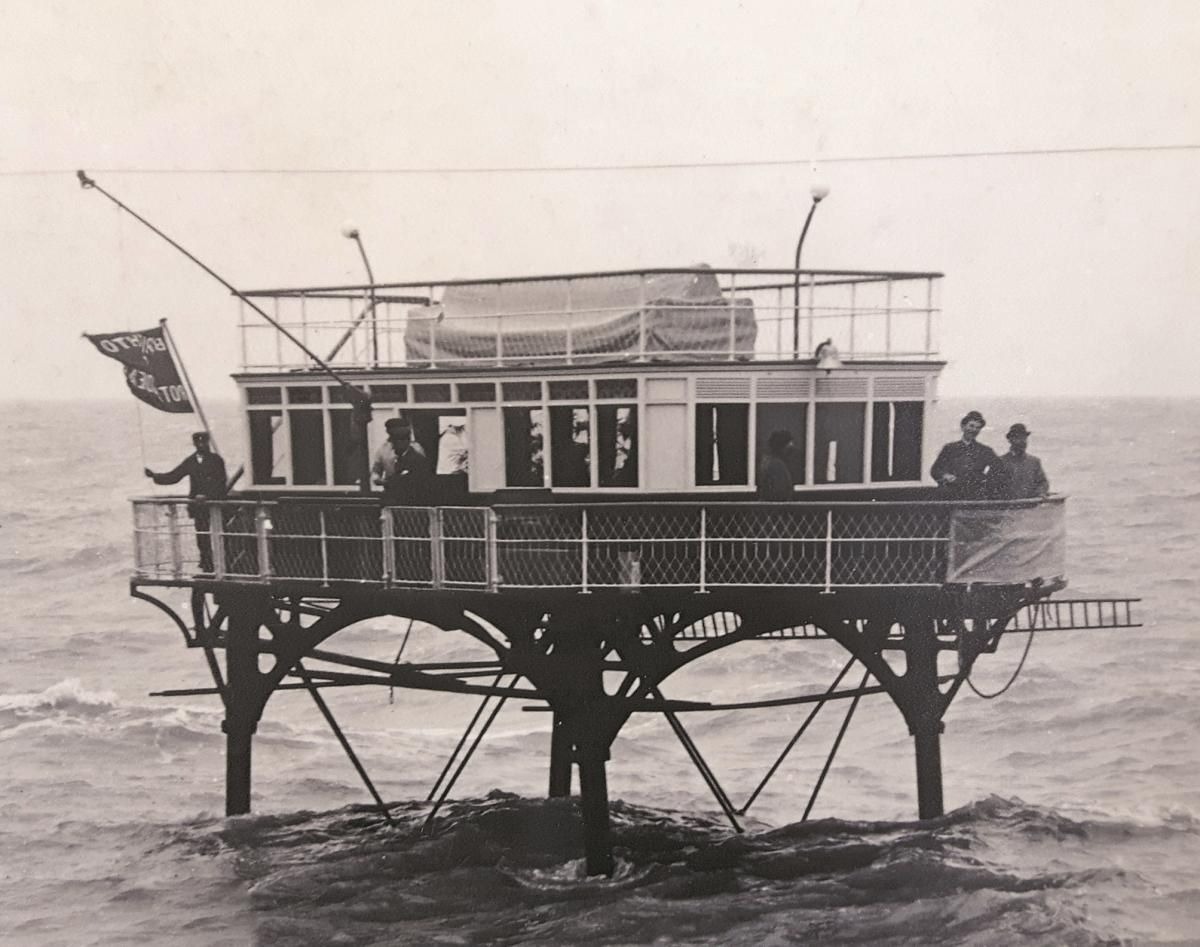
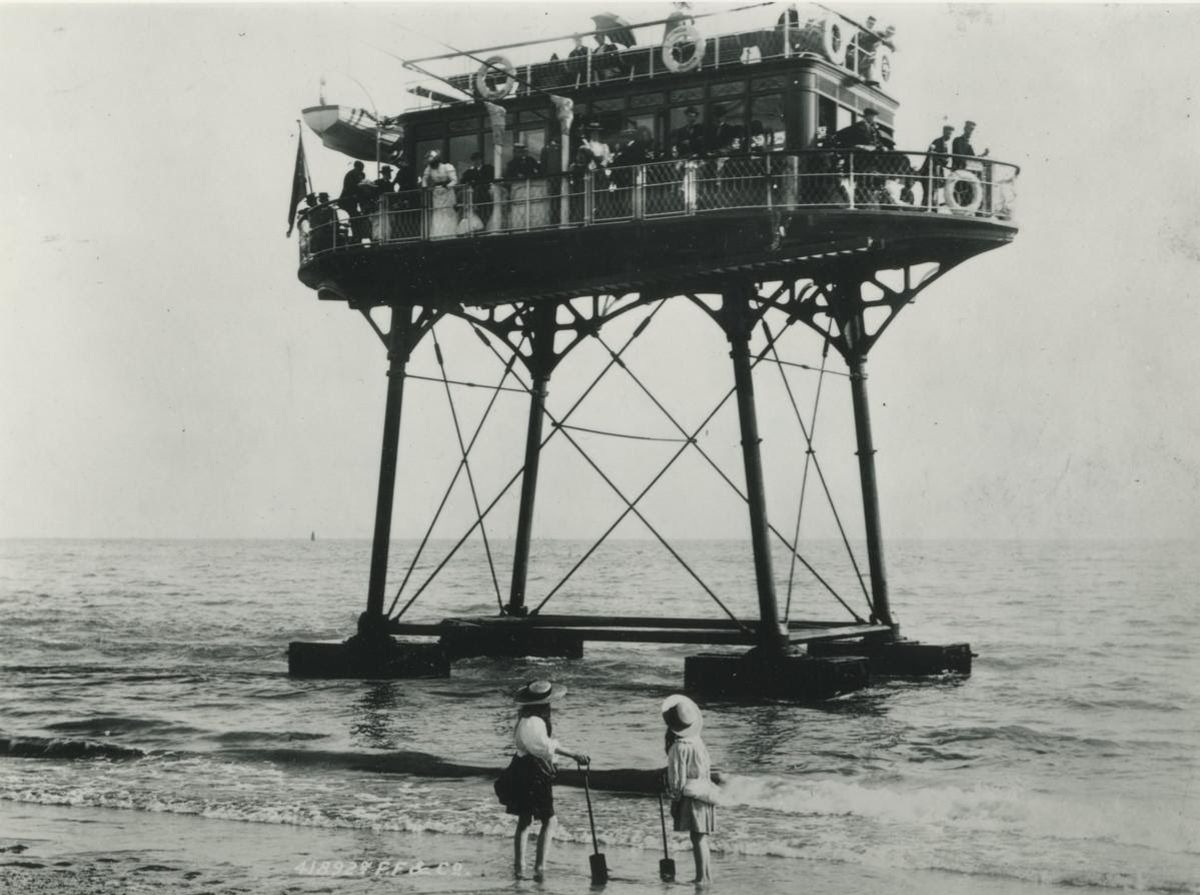
When the line was finished in 1896, the railcar was christened the Pioneer. Scientific American reported that the construction of the tracks, the railcar, and the piers cost about the equivalent of $150,000 back then. The Brighton and Rottingdean Seashore Electric Railway opened on November 28, 1896, and it was a strange curiosity. Since the railcar went out over the sea, it had to be commanded by a sea captain. It also had a lifeboat and life rings. When it went “to sea,” it even flew a flag like a ship.

To drive the railcar, the operator had to climb to the upper promenade deck, where they were presented with the same General Electric controllers that would be found in a streetcar. Volk’s promise of creating a tourist attraction rang true, and the Pioneer became a bit of a destination. Soon enough, it earned the nickname of “Daddy Long-Legs.”
Daddy Long Legs 1
Brighton and Hove City Council

On December 4, 1896, the whole operation nearly came crashing down, literally, when the line was stricken by a strong storm. The gales were so powerful that the Pioneer even toppled over. The building at Paston Place was devastated, three poles were damaged, and a portion of the track was destroyed in one place. Reportedly, Volk spent more than the equivalent of $20,000 to rebuild the rail line and the Pioneer, which was nearly damaged beyond salvaging. In doing so, the Pioneer’s legs were stretched by two feet to further keep it out of harm’s way. The line reopened on July 20, 1897, and by the end of the year, the railway had moved 44,282 passengers along the 2.8-mile route.

Issues plagued the railway almost from the very beginning, however. As the Volk’s Electric Railway Association writes, the railcar was severely underpowered and ran at only walking pace at high tide. After the turn of 1900, two new concrete groynes built east of the railway caused scouring of the seabed and damaged the track bed. Volk had to close the line in July and August 1900 to enact repairs.
Daddy Long Legs 2
Ellis Kelsey Collection – CC0 1.0

While all of this happened, Volk never made back nearly enough money to pay for the line’s construction costs or its repair costs. But then, worse news was to come. In September 1900, the government alerted Volk to its intention to build a beach protection barrier that would go right through the Seashore Electric Railway’s right-of-way. This was a problem for Volk as he would need to move the line into deeper water to avoid the new barrier. However, he just didn’t have the funds to move the line and reengineer the railcar for deeper water.

By January 1901, the government cut up the right-of-way for the barrier, forcing Volk to shut down the line. Volk attempted to raise money to build an over-water viaduct, but this failed. Ultimately, the track, the railcar, and the structures would be scrapped. Amazingly, the concrete beds were not torn down and are still visible today. The Brighton and Rottingdean Seashore Electric Railway was never replaced, but the Volk’s Electric Railway was extended to the beach later on.

The Sea Railway Legacy

16717004 7305509 Image A 26 1564 (1)
Public Domain

While the Brighton and Rottingdean Seashore Electric Railway came to a sad end, it wasn’t really the end of the concept of a train that rides in water. Some water rides at theme parks use a simpler concept of having a train that’s sort of like a boat that rides on submerged rails. In the 1930s, there were also the Dutch “veerwagens,” ferries that were actually self-propelled railcars riding on submerged rails. However, in the case of the Netherlands, the veerwagens were less tourist attractions and more tools for farmers.

Additionally, there was also a single-track railway in St. Malo, France, that used a submerged track. This railway lasted between 1873 and 1923, too. Volk even noted the existence of the railway in France, but said that his was better because the one in France was pulled by a cable rather than being self-propelled.

1937 De Eerste Tocht Van De Rijdende Pont Bij Zeeburg In Het Merwedekanaal
A “veerwagen” Credit: beeldbank.amsterdam.nl – Public Domain

So, Volk’s work wasn’t entirely a dead-end. The concept of a train with an underwater track might not be mainstream, but it has been used in some niches. Volk’s other rail line still operates today, which is something that no older rail line could say because they don’t even exist anymore.

All of that aside, the Brighton and Rottingdean Seashore Electric Railway was just a fascinating engineering project. Instead of carving his way through the cliffs, Volk baked up a crazy idea to carry a train above the ocean. Then, he somehow pulled it off. Sure, making a gigantic railcar-boat-pier thing didn’t really make money, but I bet it must have been amazing to see.

Top graphic image: Magnus Volk


The post Over A Century Ago, A Man Tried To Reinvent Coastal Transportation With A Train That Was Also A Boat And A Pier appeared first on The Autopian.

Read the whole story
LeMadChef
4 minutes ago
reply
Denver, CO
Share this story
Delete

Waymo Incident That Trapped Harassed Passengers In Car Is A Reminder That A Person Driving Is Still A Person, But An AV Is Not, And Why That Matters

1 Share

A strange incident involving a very angry, anti-robot man and a Waymo robotaxi that happened in January is getting media attention now, and it’s one that highlights some interesting and often-overlooked aspects of automated vehicles. Specifically, those aspects are the ones that are less focused on the mechanics of driving and more about the social and cultural aspects of driving, which are deceptively important to the operation of a self-driving vehicle. Cars have always been, after all, people operating a machine. Before AVs, one could always assume that any car on the road was essentially a person in a prosthetic that let them move faster and carry more than they could on foot, but fundamentally, every car was operated by a person who existed within and was part of the surrounding culture, at least to some extent. AVs are changing that, and this incident is a somewhat unsettling example of why this is a topic that needs to be addressed.

The Waymo incident from January involved a 37-year-old San Franciscan named Doug Fulop and two other passengers, who were in a Waymo after a night out. A very agitated man attacked the car, pounding on the windows and screaming about how he wanted to murder Fulop and his friends for “giving money to a robot.”

Technically, anybody who has used a vending machine has done as much giving money to a robot as the Waymo passengers, but we tend not to view the world like that.

“We felt helpless,” Fulop told the Seattle Times. “If he had kept hammering on one window instead of alternating, I’m sure he would have eventually broken through,” Fulop added, which may or may not be true; car windows are pretty tough, but it’s certainly not impossible to break them if you’re determined enough, or have a spark plug handy to throw at them.

Waymo cars are programmed, like most automated vehicles, to stop when a human being approaches them, for obvious safety reasons. While this makes sense in many contexts, it can also be exactly what you don’t want when the human in question is blinded by anti-robot rage or has other nefarious intentions toward the people inside the car.

You may recall an incident in 2024 when a creepy loser stopped a Waymo with a woman passenger inside so he could harass her and fecklessly try to get her number:

There have been other incidents where people have attempted to cover a Waymo’s driving cameras and sensors, effectively disabling the car. There’s no really good, clear solution to this sort of thing, either, because the only solutions to dealing with human bad actors are ones that cause the automated vehicles to have to behave in ways that could be dangerous, which is usually anathema to how we want them to behave.

There are times when you may need an AV to break rules, and possibly even make value judgments about human safety. If people are threatening the passengers of a robotaxi, is a robotaxi within its rights to endanger them to protect its occupants? For a human, there are legal standards for actions that can be taken in the service of self-defense; can we reasonably apply those criteria to a machine?

In Fulop’s case, he did call 911 and Waymo’s own support line; Waymo made it clear that Fulop would not be able to drive the car away manually, nor could the car be instructed to move if a person was standing nearby. The attack lasted six minutes in total, and it was only because a crowd supporting the attacker gathered – which in itself is perhaps a little troubling – that the guy strayed far enough away from the car to escape.

There’s also an interesting parallel in this sort of attack to something that happened almost 200 years ago. In 1829, a steam automobile built and operated by Goldsworthy Gurney was attacked by Luddites as it drove passengers from London to Bath.

Luddites 1829 Gurney

In this case, the attackers were millworkers who had lost their jobs, and they, according to Gurney’s daughter, “burnt their fingers, threw stones, and wounded poor Martyn the stoker.” Two centuries later, the same resentments and fears of automation remain.

All this is a good reminder of just how much more the task of driving is than just the physical act of driving. Driving is really just another way humans interact with one another, especially in crowded locations and contexts like cities. What we see in this particular event is simply another way in which automated vehicles need to learn how to interact with their environment. This isn’t something like learning how to navigate a blind left turn, but it’s potentially just as important.

These “soft” challenges may be potentially more difficult for machines to navigate, because the machine isn’t aware of what it is doing or why. It has no understanding of what it is or how what it is interacts with society at large, and individuals in that society at, um, small.

I do know of a book that brought up a lot of these issues years ago, if anyone at Waymo would like to buy it for their employees, by the way.

I reached out to Waymo for commentary, and will update if/when I hear anything. I think this event and others like it, and ones that are definitely going to happen again in the future, are a good reminder that this social/cultural aspect of automated driving can’t be ignored, and, perhaps more importantly, should not be left up to individual corporations to decide. We, as a society that chooses to have automated vehicles operating within it, need to decide what sorts of behaviors we want these machines to perform.

The parameters for what is acceptable or not shouldn’t be decided by companies focused on profits; these machines are in human spaces, and what we, collectively, decide is appropriate behavior in difficult situations should be codified, and any company participating in this space needs to comply with what we decide.

These are not easy questions; are we okay with an automated vehicle deliberately causing a person harm if it means protecting passengers from harm? How is that determined? Do we want these decisions to be made within the machine, or do we want to have human input? What are the thresholds of danger we want to establish?

None of this is easy, but we can’t ignore these sorts of situations and questions. The longer we wait, the harder it’s just going to get.

Top graphic image: Waymo, Gurney Journey

The post Waymo Incident That Trapped Harassed Passengers In Car Is A Reminder That A Person Driving Is Still A Person, But An AV Is Not, And Why That Matters appeared first on The Autopian.

Read the whole story
LeMadChef
7 minutes ago
reply
Denver, CO
Share this story
Delete

Intuit beats FTC in court, ending restrictions on "free" TurboTax ads

1 Comment

An appeals court invalidated the Biden-era Federal Trade Commission's attempt to punish Intuit for allegedly deceptive ads that pitched TurboTax as free.

Under then-Chair Lina Khan, the FTC determined in 2024 that the TurboTax maker violated US law with deceptive advertising and ordered it to stop telling consumers, without more obvious disclaimers, that TurboTax or other products are free. The FTC’s chief administrative law judge had previously found that Intuit's ads violated prohibitions on deceptive advertising because the firm “advertised to consumers that they could file their taxes online for free using TurboTax, when in truth, for approximately two-thirds of taxpayers, the advertised claim was false."

Intuit appealed in the conservative-leaning US Court of Appeals for the 5th Circuit and got a resounding victory on Friday in a 3–0 ruling issued by a panel of judges. "Following the Supreme Court’s decision in SEC v. Jarkesy, we hold that adjudication of a deceptive advertising claim before an administrative law judge violated the constitutional separation of powers," the 5th Circuit panel said.

The Supreme Court’s June 2024 ruling in Securities and Exchange Commission v. Jarkesy held that the SEC system for issuing fines violated the right to a jury trial. The 5th Circuit panel said the Jarkesy decision confirms that the FTC must pursue deceptive advertising claims in courts rather than its own administrative process.

Intuit says it's "thrilled"

The ruling, written by Circuit Judge Edith Jones, said that dismissing the case against Intuit would be premature because the claims can be tried in court. Jones wrote:

Intuit seeks reversal of the FTC’s cease-and-desist order with instructions to dismiss. Dismissal is premature. We hold that FTC’s enforcement action must proceed in federal court. Several consequences may follow from this: the standard of proof required on remand may be elevated from substantial evidence to a preponderance; the agency will have to explain the necessity of any order, given that Intuit stopped running the offending ads years ago; and the practicability, scope, and longevity of a cease-and-desist order will have to be reconsidered.

Intuit now faces more friendly regulators under the Trump administration than it did under Biden. Trump fired both Democratic members of the FTC, leaving it with only Republican commissioners, and the Supreme Court has so far declined to overturn Trump's action.

The FTC is now led by Chairman Andrew Ferguson, who backed Trump's firing of FTC Democrats and disputed the previous administration's position that the Jarkesy ruling didn't apply to FTC administrative law judges. The Trump administration also ended the IRS free tax-filing service that Intuit lobbied against.

Intuit issued a statement after the 5th Circuit ruling. “I’m thrilled that, once this matter returned to a neutral decision-maker, common sense carried the day,” Intuit General Counsel Kerry McLean said. "From the beginning, we were confident in our case and that, when this matter returned to a neutral body like the Fifth Circuit, Intuit would prevail."

Intuit called the FTC allegations "meritless," and said the tax-preparation firm "has always been clear, fair, and transparent with its customers and we are proud that over the past 12 years, we’ve helped more than 140 million Americans file their taxes for free."

In 2022, Intuit agreed to a settlement with all 50 states to pay $141 million in restitution and stop a specific ad campaign that marketed TurboTax as "free, free, free."

Court calls FTC's Intuit order "remarkably broad"

The 5th Circuit ruling acknowledged that most people can't use TurboTax for free. "TurboTax 'Free Edition' has been part of the TurboTax range for more than a decade, available to taxpayers for what Intuit refers to as 'simple tax returns,'" the ruling said. "Most American taxpayers do not have 'simple tax returns.'... The TurboTax website is designed so that any individual taxpayer can begin preparing a tax return in TurboTax Free Edition, but those who enter disqualifying information are prompted before filing to upgrade to a paid product."

Although the court noted that Intuit stopped the specific ads challenged by the FTC, the ruling said the cease-and-desist order issued by the agency could have far-reaching effects on Intuit marketing. "The cease-and-desist order is remarkably broad: it prohibits Intuit for the next twenty years from advertising 'any goods or services' as free unless specific, extensive, and arguably unworkable requirements are satisfied. The order is not confined to tax-preparation solutions and extends to all products sold by Intuit," the ruling said.

The 5th Circuit said the FTC's deceptive advertising claims are "traditional actions at law and equity and thus involve private rights that demand adjudication in an Article III court." The court rejected the FTC's argument that the claims involve public rights that may be adjudicated by administrative agencies.

"In sum, there is overwhelming evidence that Section 5 of the FTC Act did not create a new duty for merchants to refrain from deceptive advertising," the 5th Circuit said. "That duty long predated the FTC Act and could be enforced by private parties in actions at common law or equity for fraud, deceit, or unfair competition."

FCC power to issue fines also at risk

In Jarkesy, the Supreme Court said that "matters concerning private rights may not be removed from Article III courts. If a suit is in the nature of an action at common law, then the matter presumptively concerns private rights, and adjudication by an Article III court is mandatory."

By contrast, matters involving public rights may be handled exclusively by the executive and legislative branches without a court's involvement. Categories that fall within public rights include: "collection of revenue; aspects of customs law; immigration law; relations with Indian tribes; the administration of public lands; and the granting of public benefits," the Jarkesy ruling said.

The Jarkesy precedent that helped Intuit beat the FTC is also at the center of a case in which AT&T, Verizon, and T-Mobile are challenging the Federal Communications Commission’s authority to issue fines for selling customer location data without their users’ consent. The mobile carriers' fight against FCC punishment is set to be decided by the Supreme Court.

Although current FCC Chairman Brendan Carr voted against the mobile-carrier penalties during the previous administration, the Carr FCC is urging the Supreme Court to uphold his agency's ability to issue fines. The FCC argues that companies it fines can decline to pay and eventually receive a jury trial when the government sues to obtain the fine.

"Forfeitures are among the FCC’s most important enforcement tools," the FCC told the Supreme Court on Friday. "Eliminating them could mean that many vital rules—such as those protecting privacy, combating robocalls, and regulating broadcasting—go effectively unenforced."

Read full article

Comments


Read the whole story
LeMadChef
8 minutes ago
reply
Fuck Intuit.
Denver, CO
Share this story
Delete

Citizens must pursue Suncor because state is too lax, plaintiffs tell US Appeals Court

1 Share

Environmental groups tried to revive their pollution lawsuit against Suncor on Wednesday in federal court, arguing the state of Colorado is too lax amid ongoing violations and the Clean Air Act gives citizens the right to demand enforcement. 

Earthjustice, Colorado GreenLatinos, Sierra Club and others told the 10th U.S. Circuit Court of Appeals that the district court should not have dismissed their 2024 suit, because Colorado is ignoring severe contamination in low-income neighborhoods and highly profitable Suncor considers any fines “the cost of doing business.”

The U.S. District Court in Denver had previously dismissed the environmental groups’ case, agreeing with Suncor that Colorado has been enforcing pollution laws all along and that citizen groups had no right to intervene. The groups then appealed, asking the appellate court to reinstate the lawsuit. 

Citizens should be allowed to act because years of consent decrees followed by continuing Suncor violations show Colorado is not meeting the bar of doggedly prosecuting pollution, Earthjustice attorney Kirti Datla told the panel of three appellate judges. 

“If, after 10 years, Suncor’s pattern of violation hasn’t changed, and neither has the government’s conduct or attempts to solve that problem, then that’s not diligence,” Datla said. “When state and federal agencies have continuously been unwilling or unable to rein in this pollution, environmental justice and climate groups are stepping in to enforce the law and ensure that Suncor does not continue putting corporate profits over people’s health and safety,” Sierra Club leader Ramesh Bhatt said when the lawsuit was first filed.

State actions — multimillion-dollar fines against Suncor’s billions in profits — have amounted to “useless slaps on the wrist,” Bhatt said. 

Suncor attorneys responded Wednesday that “this court should defer to the discretion of the agencies and how they’re tackling this problem.” 

“You have to look at what the agency has done to enforce the consent decree,” Suncor’s private attorney Hugh Gottschalk said. “There are five or six years of agency actions referring back to consent decrees, and that is the due diligence.”

The judges, interrupting each side’s 15 minutes of arguments with questions about past enforcement precedents, poked holes in both lines of reasoning. 

One judge told the Earthjustice attorney that if a convicted criminal is released and commits more crimes, that doesn’t mean the government failed to act. 

Earthjustice responded that if it’s clear over time that a criminal pattern isn’t changing, the government has an obligation to do more. 

Ignoring ongoing pollution “would mean that Suncor can just keep violating, keep paying stipulated penalties that to us seem like it’s a cost of doing business at this point, and our clients will suffer,” Datla said. 

The environmental groups, and past consent agreements between Suncor and state regulators, have said the Commerce City refinery continues to emits benzene, sulfur dioxide and other chemicals above allowed limits, with thousands of violations. 

Judge Paul Kelly challenged Suncor on that front, asking, “How can that be considered diligent, if there has been nothing since a few consent decrees. … What has been done, I want to know, that qualifies as diligent in this case?”

Colorado regulators, Gottschalk responded, are well aware of any problems with Suncor and continue to enforce their past consent decrees. Gottschalk quoted from a past U.S. Supreme Court decision on agency enforcement. 

“If citizens can file suit in order to seek civil penalties that the administrator chose to forgo,” that handcuffs a public official’s discretion to act in the public interest, he said. “That’s exactly why we believe this court should defer to the expertise of the agencies.”  

The appeals court must now decide whether to allow the lower court’s dismissal of the environmental groups’ initial suit, or send it back to the district court for a trial on the merits.

Read the whole story
LeMadChef
16 minutes ago
reply
Denver, CO
Share this story
Delete

Chevron’s $1.5M fine for Weld County blowout will finance improvements to monitoring programs

1 Share
A construction site with heavy machinery, dirt piles, covered ground, and storage tanks, set in a semi-rural area under a cloudy sky.

Colorado oil and gas regulators — with little discussion — Wednesday approved a $1.5 million fine on Chevron Corp. for the largest well blowout in the state in at least a decade. The cleanup is expected to take an additional four years.

About $1 million of the money will pay for a series of programs to buttress statewide enforcement, including a forensic analysis of lab reports submitted by operators and an assessment of old, plugged wells.

Julie Murphy, executive director of the Colorado Energy and Carbon Management Commission, called the settlement agreement with Chevron “very tough but fair.”

On April 4, 2025, while placing production valves atop the Bishop well a loss of control over pressure in the well led to a blowout sending 25,000 barrels of water, sand and oil into the air near Galeton, a rural community northeast of Greeley.

Levels of benzene above health standards — the chemical is a known carcinogen — were also detected in the air by Colorado State University researchers using a mobile air sampling lab. Fourteen nearby families were evacuated and the Galeton Elementary School was closed.

It took until April 11 to get the blowout under control and by then it had impacted more than 7 square miles around the well. It was the biggest blowout since the ECMC began keeping digital records in 2015.

“This was a very difficult situation,” Commissioner Brett Ackerman said. “There have been a lot of sleepless nights over this issue on the part of many, many people, not just those dealing with it from an administrative perspective, but those living in the vicinity. We had a lot of impacted people.”

A small, muddy pond surrounded by tall grasses with buildings and construction equipment visible in the background under a cloudy sky.
Footprints in a pond close to Willow Creek, near Weld County roads 72 and 51 ,on May 6, 2025,, near where Chevron’s Bishop well blew out in Galeton on April 6, 2025. Much of the work around the well involves protecting the creek and other waterways from liquids that spewed from the well for nearly five days. (Tri Duong, Special to The Colorado Sun)

Chevron’s subsidiary Noble Energy was cited for six violations of state oil and gas regulations in June. Murphy told the commission that the penalty was calculated based on a statutory fine schedule plus a “major impact factor.”

The total fine came to $1.7 million, but the company received a $170,000 reduction for agreeing to the settlement. A 10% reduction is offered “as an inducement for settlement and to reflect the avoided costs and administrative burdens that would result from adjudicating this matter,” the order said.

Although the penalty was calculated based on a statutory fine schedule, it has drawn criticism from some environmentalists.

“Galeton residents and Colorado tax payers will pay for this incident for many years to come. Meanwhile, Chevron reported $28 billion in earnings just during the last three months of 2025,” the Fort Collins Sustainability Group said in a statement after the fine was proposed.

Others have supported the levy. “The ECMC fine is significant and it is right that Chevron pays to clean up their horrible mess,” Andrew Kloster, Colorado field advocate for the environmental group Earthworks, said in an email.

“But no amount of money can undo the harm that occurred to a community who had to evacuate their homes or were exposed to dangerous pollutants,” he said.

At Wednesday’s hearing ECMC Chair Jeff Robbins said, “We’ve had folks that have criticized ECMC relevant to enforcement penalties, that we’re not doing enough.”

“What’s your opinion?” Robbins asked Jeremy Ferrin, the ECMC enforcement manager. 

“It’s a tough, but fair, resolution to this incident,” Ferrin said. “We would appreciate it if you could adopt this and make it an order of the commission.”

The ECMC unanimously adopted the settlement.

The commission also received an update on remediation efforts, which are projected to run until 2030.

There have already been thousands of soil, water, vegetation and agricultural-related samples taken and thousands of acres to cover. 

“With over 300 parcels, we are taking a step-by-step approach addressing one parcel at a time to move toward closure,” said Abdul Elnajdi, a commission environmental protection specialist. “It is a large project, so we approach it in manageable steps.”

Read the whole story
LeMadChef
16 minutes ago
reply
Denver, CO
Share this story
Delete

EPA orders Colorado to rewrite six oil and gas pollution permits over venting issues

1 Share

The Environmental Protection Agency has slapped back six oil and gas air pollution permits to Colorado regulators, saying the state failed to require adequate monitoring of natural gas venting in the Garfield County systems and risked letting too much dirty air into the atmosphere. 

The environmental watchdogs who objected to two oil and gas companies’ permits called the rare Trump Administration rejection a victory in their ongoing campaign to force Colorado into more monitoring of gas leaks, intentional venting and flaring. Repeated failures in any of those steps of natural gas gathering release harmful volatile organic compounds and methane that exacerbates carbon buildup in the atmosphere. 

“This is a huge issue. If companies aren’t accurately measuring and reporting the amount of gas vented, then permitted venting is basically a free pass to pollute,” said Jeremy Nichols of the Center for Biological Diversity, which brought the objections. “It would be like the IRS letting people say they paid their taxes without requiring them to file a return.”

While the permits in question now are on the Western Slope, Nichols said, “this is a statewide problem that the Division isn’t ensuring companies are, in fact, fully complying with emission limits.”

In the nine Front Range counties that the EPA has flagged as in “severe” nonattainment of caps on health-harming ozone, Nichols said, “flaring is almost universally used to control ozone forming volatile organic compounds, and companies are regularly granted permission to routinely vent gas. … Inadequate monitoring is likely a key reason why the region continues to fail to meet clean air standards.”

A spokesperson for the state health department’s Air Pollution Control Division said the agency “has received and is reviewing the EPA’s decisions regarding these oil and gas permits. We aren’t commenting further at this time.”

Five of the partially returned permits are for a gas gathering and distribution operation by Bargath, now a subsidiary of Williams Companies. 

“Williams is reviewing EPA’s order and looks forward to working with the Colorado Department of Public Health and Environment to address any concerns identified in the order,” said Williams media relations spokesperson Tom Droege. 

The EPA did not accept the environmental group’s objections to the portions of the permits detailing flaring requirements. The Center for Biological Diversity and other groups say remote flaring operations often fail or are turned off by companies for maintenance, which leaves methane and other gases to be released into the atmosphere without being reduced by burning. 

The permits in question reflect state health department practices requiring monitoring of flaring success only once every five years, the Center for Biological Diversity said. The center is considering its options on continuing to object to the flaring portions of the permit that the EPA is allowing. 

“If a flare is operating ineffectively for just one day, such as a day forecast to have high ozone, it could have tremendous implications,” Nichols said.

The state has 90 days to change the portions of the permit related to gas venting to bring them into compliance with the U.S. Clean Air Act, he said. 

While EPA objections to permits aren’t unheard of, Nichols said, “they are unusual under arguably the most anti-environment administration that is blatantly subservient to the oil and gas industry. It’s shameful the air division is issuing permits that are so bad even the Trump administration has to object,” he said. 

Read the whole story
LeMadChef
17 minutes ago
reply
Denver, CO
Share this story
Delete
Next Page of Stories