Code Monger, cyclist, sim racer and driving enthusiast.
10142 stories
·
6 followers

Cutting air pollutants a new frontier in Colorado air quality fight

1 Share

Colorado has expanded its air pollution-fighting arsenal to an entirely new theater after years of preparation, taking on so-called air toxics like benzene, formaldehyde and hydrogen sulfide from asphalt makers with mandatory control measures meant to protect surrounding low-income neighborhoods. 

State health officials can now monitor emissions and require new equipment and processes for five designated chemicals known to cause higher rates of cancer and other disease. The initial list includes benzene from refineries, ethylene oxide from sterilizers, hydrogen sulfide from asphalt and manure operations, formaldehyde from turbines and combustion engines, and hexavalent chromium from chrome-plating industries. 

Cutting back air toxics adds to Colorado’s other major ongoing air pollution battles: trimming greenhouse gas emissions that contribute to climate change, and capping “criteria” pollutants that permeate the environment at larger scale such as ozone, nitrogen oxide, PM2.5 and volatile organic compounds. Health and environment advocates believe they can make community health progress in minority and low-income neighborhoods disproportionately impacted by industries, through tighter control of a few toxic chemicals from a handful of sites. 

The Air Quality Control Commission earlier this month passed the final rules launching the Air Pollution Control Division into a new regulatory regime for the five chosen chemical emissions. 

“For years, communities living near highways, oil and gas sites and industrial facilities have been exposed to the highest levels of these pollutants — and currently, Colorado does not have strong rules on how much of these chemicals can be in the air,” said Conservation Colorado, after the AQCC vote. “These impacts fall disproportionately on communities of color. Latino people are nearly three times more likely than white people to live in areas with the most harmful air, and Black and Latino communities are more likely to face the worst pollution overall, according to the American Lung Association. This action moves the state closer to changing that.”

Air division director Michael Ogletree said in an interview that issuing the rules directed in a 2022 legislative bill is “really a monumental step in finalizing what we’ve been working on for the past several years, to actually put protections in place for disproportionately impacted communities, as well as Coloradans as a whole, in protections against air toxics.”

Advocates who sought the toxics rules for years say they will watch to see how tightly Colorado enforces the rules, but they welcomed the final steps. 

“This is a meaningful step forward for public health in Colorado. By adopting standards to reduce exposure to the most harmful air toxics, we are moving closer to a future where fewer families are dealing with preventable illnesses linked to pollution. There is still more work ahead, but this action reflects real progress toward protecting the health of our communities,” said Dr. Maria Chansky of Glenwood Springs, family physician and advocate for the nonprofit Healthy Air and Water Colorado.

The 2022 law set in motion a long process at the health department and the commission. The law required the health department to carefully study dozens of toxic chemicals and determine the five that were most hazardous to Colorado’s vulnerable neighborhoods and could also be effectively monitored and controlled. The air division had to pick locations and set up sensitive monitoring devices. 

The toxic substances, causing cancers and many other serious health issues, that were first designated by the new rules include: 

  • Benzene — This petroleum byproduct is a major issue at Suncor in Commerce City, Colorado’s only oil refinery. Neighbors in Adams County and north Denver have been subject to multiple industrial emissions and contaminations over the decades, from refinery pollution to highway exhaust to metal smelting residue. To meet the new benzene limits, Suncor will have to add “maintenance activities that maybe need to be done a little bit more frequently,” said Stefanie Shoup, manager of innovations in planning and air quality data for the health department. “We’re adding in this component of looking for benzene emissions, and increasing the frequency of some of those inspections so that they’re being caught and fixed on an earlier cadence.”
  • Formaldehyde — It can be produced through multiple industrial processes and manufacturing, but Colorado will focus on larger sources from combustion turbines and other stationary engines. “It’s primarily from engines and turbines, but it’s also a complicated pollutant, because it also is generated just in the atmosphere, through normal breakdown of other types of components in the air,” Shoup said. The new rules require testing, monitoring and installation of new controls at some sources. 
  • Hydrogen sulfide — Sources of the toxic emissions include asphalt plants, makers of asphalt roofing tiles, and manure digesters. State health will require industrial sources to employ emission control devices to destroy the gases. Manure digesters will add substances to storage pits that reduce hydrogen sulfide production. 
  • Ethylene oxide — A highly toxic chemical primarily used by medical equipment manufacturers to sterilize life-saving gear before shipment. Recent federal rule tightening has already put Colorado’s ETO users on the path to better compliance, state officials said, and the large manufacturer Terumo in Lakewood has been installing control equipment that it says were ahead of new requirements. 
  • Hexavalent chromium — Yes, it’s the infamously dangerous substance at the heart of the toxic detective work in the 2000 film “Erin Brockovich,” but Colorado’s emissions come mostly from chrome-plating businesses. State officials said the sources “can improve work practices to reduce emissions, conduct additional testing, or switch to less toxic and volatile forms of chromium.”

The air commission can revisit and may add to the list of controlled toxic substances every five years, and the air pollution division staff said they are eager to continue rounding out a new area of health regulation. 

“What we heard very loud and clear is that communities are interested in expanding these requirements wherever we can, and we’re very interested in doing the same,” Shoup said. “While we’ve had four years now, this is also the type of program that can take a decade or more to truly build out to the kind of program that we would like to see. We spent 30 or 40 years building the criteria air pollutant program. And so here we are. I think there’s a lot of good that we can do in the future.”

Read the whole story
LeMadChef
just a second ago
reply
Denver, CO
Share this story
Delete

More than half of all Polymarket "long shot" bets on military action pay off

1 Share

More than half of “long-shot” bets on military action made on Polymarket are successful, according to a new report that suggests prediction markets could pose a bigger threat than previously recognized to the security of sensitive information.

Analysis by the Anti-Corruption Data Collective, a non-profit research and advocacy group, found that long-shot bets—defined as wagers of $2,500 or more at odds of 35 percent or less—on the platform had an average win rate of around 52 percent in markets on military and defense actions.

That compares with a win rate of 25 percent across all politics-focused markets and just 14 percent for all markets on the platform as a whole.

The research is likely to add to growing concerns among regulators and lawmakers about insiders placing bets on the timing and success of military actions, amid fears that this could reveal classified information in advance.

The report, which analyzed more than 400,000 prediction markets settled on Polymarket between January 2021 and March 2026, comes as US prosecutors last week charged a soldier involved in planning the January raid to seize Venezuelan leader Nicolás Maduro with placing Polymarket wagers on the mission that netted more than $400,000.

Gannon Ken Van Dyke, an active duty soldier, is alleged to have made roughly 13 bets worth $33,034 on positions including “US Forces in Venezuela” and “Maduro out” while in possession of classified information. On Tuesday Van Dyke pleaded not guilty.

The charges represent the first US prosecution of insider trading on prediction markets. Earlier this year Israel filed charges against a reservist and a civilian accused of using classified information to bet on the country’s military operations on Polymarket.

Political markets where outcomes can be determined by small decision-making groups, particularly military and defense markets, are “structurally vulnerable to insider trading,” said the ACDC, adding that the dynamic not only threatens information security but also “disadvantages regular bettors.”

chart showing long-shot wager payoff rates Credit: Financial Times

Yassamin Ansari, a Democratic lawmaker from Arizona, has called wagers on military actions “a disturbing national security risk,” while Ritchie Torres, a Democratic representative from New York, has said markets on political and military decisions risk creating “a perverse incentive” for government insiders “to personally push policies that line [their] pockets.”

The report also found that markets on cultural events, such as competition winners or music releases, were disproportionately likely to host suspicious wagers, with 29 percent of long-shot bets in these markets proving successful.

The Nobel Peace Prize organizers investigated a potential leak last year after online betting surged in favour of Venezuelan opposition leader María Corina Machado just hours before she was announced as the winner.

There have also been concerns about market manipulation. France’s weather forecasting service this month filed a police complaint after detecting anomalies in its temperature gauges in Paris, which coincided with a surge in well-timed bets on Polymarket.

Some of Polymarket’s military and political markets have attracted heavy betting. Markets on whether the US and Iran will reach a permanent peace deal have seen $63 million in trading volume, while one on whether China will invade Taiwan in 2026 attracted $23 million. But sports wagers continue to dominate the platform, with trading volume on which team would become the Super Bowl champion earlier this year exceeding $700 million.

Polymarket declined to comment on the report. The company has previously said it prohibits trading on stolen confidential information or by those who can influence the outcome.

In a post on X last week, Polymarket said Van Dyke’s arrest was “proof the system works.” The company said that when it identified “a user trading on classified government information,” it referred the matter to the US Department of Justice and cooperated with their investigation.

The most active Polymarket "geopolitics" markets

Market Total volume ($mn)
Netanyahu out by . . .? 119
Venezuela leader end of 2026? 86
US x Iran permanent peace deal by . . .? 63
Will the Iranian regime fall by April 30? 48
Trump announces end of military operations against Iran by . . .? 39
Kharg Island no longer under Iranian control by . . .? 37
Will the Iranian regime fall by June 30? 35
Strait of Hormuz traffic returns to normal by end of April? 33
US x Iran diplomatic meeting by . . .? 27
Will China invade Taiwan by end of 2026? 23
*Excludes disputed markets **Data as of April 29, 2026 *** . . .? indicates multiple date options

Amid increased scrutiny over suspected insider trading, prediction market platforms have tried to reassure customers and lawmakers that they are cracking down on market manipulation.

Kalshi, Polymarket’s major rival, has heavily promoted its own efforts, including a partnership with market surveillance company Solidus Labs, as it seeks to distance itself from Polymarket and emphasize its credentials as the largest regulated platform in the US.

Kalshi bans what it calls “violent markets, including war and kidnapping”—although it does allow markets on the closure of the Strait of Hormuz—saying that markets should “not incentivize harm,” while it also requires proof of identity. In contrast, Polymarket does not require most users of its international site to provide proof of identity and allows payment using anonymous cryptocurrency channels.

Growing scrutiny has created a business opportunity for a wave of start-ups selling tools to help users profit by copying suspected “insiders.”

“The platforms are creating new rules to try to root them out and make it clear they don’t allow that activity. That to me [ . . . ] proves there is some informed flow in these markets worth following,” said Matt Saincome, chief executive of financial data provider Unusual Whales, which sells a $20-a-month “unusual predictions” tool to monitor suspicious bets on Polymarket.

Another start-up, Polywhaler, promises to help traders “monitor large bets in real-time” for $4.99 a month.

Polymarket has itself published a list of the 10 most-copied wallets in a blog post, including recommendations for traders on strategies to follow and pitfalls to avoid when copy-trading.

The company and Kalshi have long argued their platforms harness collective wisdom to accurately forecast events. But another recent study has found prediction markets reflect the “wisdom of an informed minority” rather than the “wisdom of crowds.”

Only 3 percent of all accounts generate the bulk of price discovery, according to a study led by Roberto Gómez Cram, assistant professor of finance at the London School of Economics.

These are traders whose accounts predict prices and react quickly to breaking news, making outcomes more accurate for markets on Polymarket, the platform studied by the researchers.

The rest do not “produce wisdom,” the study said, and therefore are more likely to lose money. Instead, they fund skilled traders by generating most of the volume, “but little of the information, and their losses flow as profits to the informed minority.”

© 2026 The Financial Times Ltd. All rights reserved. Not to be redistributed, copied, or modified in any way.

Read full article

Comments


Read the whole story
LeMadChef
24 seconds ago
reply
Denver, CO
Share this story
Delete

The great American data center divide

1 Share

In Tazewell County, Illinois, Michael Deppert depends on a natural pool of water beneath the sandy soils of his farm to irrigate the pumpkins, corn, and soybeans growing in his fields.

So when a data center was proposed about eight miles away, he feared it would tap the same aquifer, potentially eroding crop yields and profits.

Deppert, who is also the president of the local farm bureau lobby group, says locals were also “nervous” about how a data center would affect the “good, clean drinking water.” Residents launched a fierce opposition campaign, packing city council meetings and mounting petitions. After several months, the project, led by developer Western Hospitality Partners, was scrapped.

“You just can’t lay down and let everybody do whatever they wish,” Deppert says.

It is just one of the many pockets of resistance opening up across rural America, where a backlash against the explosive growth of the infrastructure for AI and cloud computing is at its sharpest.

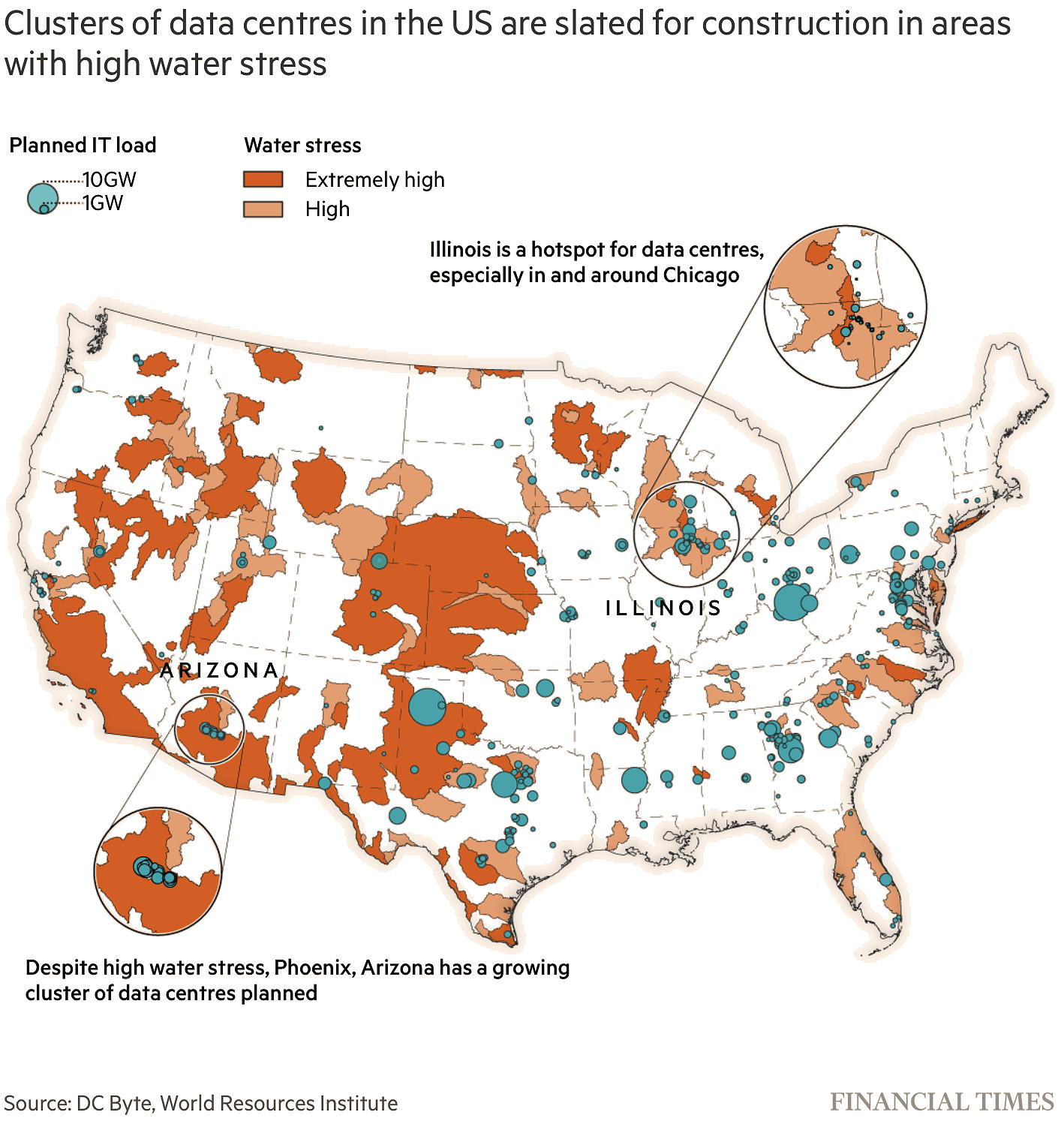
Data centers, once clustered around cities and towns, are moving into farm country in search of cheap land and tax incentives. According to Pew Research Center, 67 percent of planned data centers are in rural areas, while 87 percent of existing data centers are in urban ones.

“Rural communities have become a target,” says Miquel Vila, lead analyst at Data Center Watch, a research project run by AI security company 10a Labs. More than 160 new AI-focused data centers have been built across the US in the past three years, a roughly 70 percent increase on the total, according to Bloomberg data.
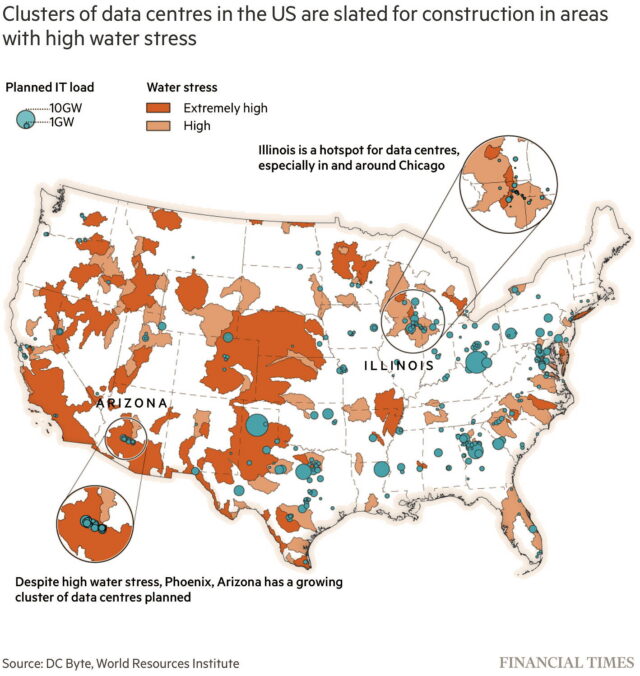
Credit: Financial Times

As the industry has expanded, public opinion has hardened against it. Pew research found that Americans are far more likely to view data centers as harmful than beneficial in terms of environmental impact, domestic energy costs, and quality of life in nearby communities.

The issue is awkward for President Donald Trump and his party. Republican strategists are increasingly wary that the administration’s support for AI could trigger a backlash among key voter blocs, including farming communities, ahead of November’s midterm elections. Around 78 percent of US counties dependent on agriculture voted for him in 2024, according to analysis of election data by Investigate Midwest.

In rural areas from Illinois to West Virginia, new data center proposals have led to packed public meetings and organized opposition as residents push back. In Indiana, shots were fired at a local lawmaker’s home and a note left on his doorstep reading “no data centers.” Democratic politicians have called for tighter regulation, and Republicans in several states have campaigned against new developments, reflecting the backlash.

Even in solidly Republican Texas, agriculture commissioner Sid Miller has argued that projects should be directed towards less productive land, warning that the “unchecked spread of data centers onto prime farm and ranch land is a real and growing threat to our food supply.”

But the picture is mixed for farmers. While some worry about the industrialization of once-agrarian communities, others welcome the opportunity to cash in on soaring land prices or to generate additional income.

The debate has reverberations far beyond America’s farm belt, pitting two visions of the country’s economic development against each other. In the view of the White House and much of Big Tech, the data centers will help the US maintain its lead in AI. Expectations about the growth the infrastructure will deliver underpin everything from sky-high share valuations to state and federal tax breaks granted in the hope of new jobs and investment.

But rural communities, along with many Americans, worry about the immediate impact of data centers on water and power costs and the broader disruption they represent for people’s way of life.
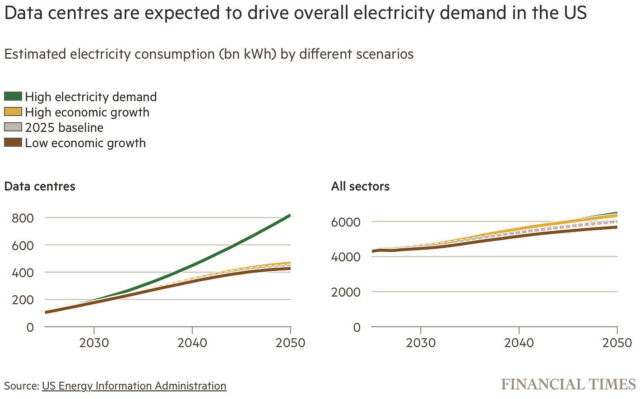
Chart showing electricity demand in the US over time Credit: Financial Times

Environmental groups say there is a lack of transparency. Of the four data center projects that the Sierra Club in West Virginia is tracking, none have disclosed detailed water plans and most intend to build their own gas-fired plants, raising concerns about air pollution as well as water use.

For rural communities already wary of outside development, the combination of secrecy and scale has deepened resentment. Jim Kotcon, chair of the conservation committee for the West Virginia chapter of the environmental lobby group the Sierra Club, is “not opposed to data centers per se,” but argues they must be “done right.”

Otherwise, he says, rural counties risk being left with depleted aquifers, new sources of pollution, and, if the boom proves short-lived, stranded assets with no obligation on developers to clean them up.

Three hours’ drive north of Deppert’s farm in Illinois, Jamie Walters points toward a cluster of vast pale concrete buildings rising from the prairie outside the town of DeKalb. “That’s Meta,” he says. “And that’s only half built.”

Ponds for retaining cooling water, electricity substations, and high-voltage lines cut across a landscape where the Walters family has farmed for five generations. Soon the farm itself will be ringed by data centers and infrastructure.

But Walters is sanguine about it. He has leased hundreds of acres for solar panels and is under contract to supply renewable power for the data centers. Where corn might net $100 an acre in a good year, he says, an acre given over to solar can generate thousands.

Although he runs a whiskey distillery—for which pure water is vital—Walters says he is “cautiously optimistic” after a second data center developer, Edged, promised to use a closed-loop system, which uses less water, to cool its servers.

“It’s change,” he says. “But I’d rather be inside the process than standing on the outside saying no.”

America’s tech giants are relying on willing farmers like Walters as they race to build the backbone of the AI revolution they believe will transform productivity and deliver big financial returns.

Data centers have already emerged as a significant driver of economic expansion in the US, accounting for 80 percent of private sector growth in the first half of 2025, according to S&P Global.

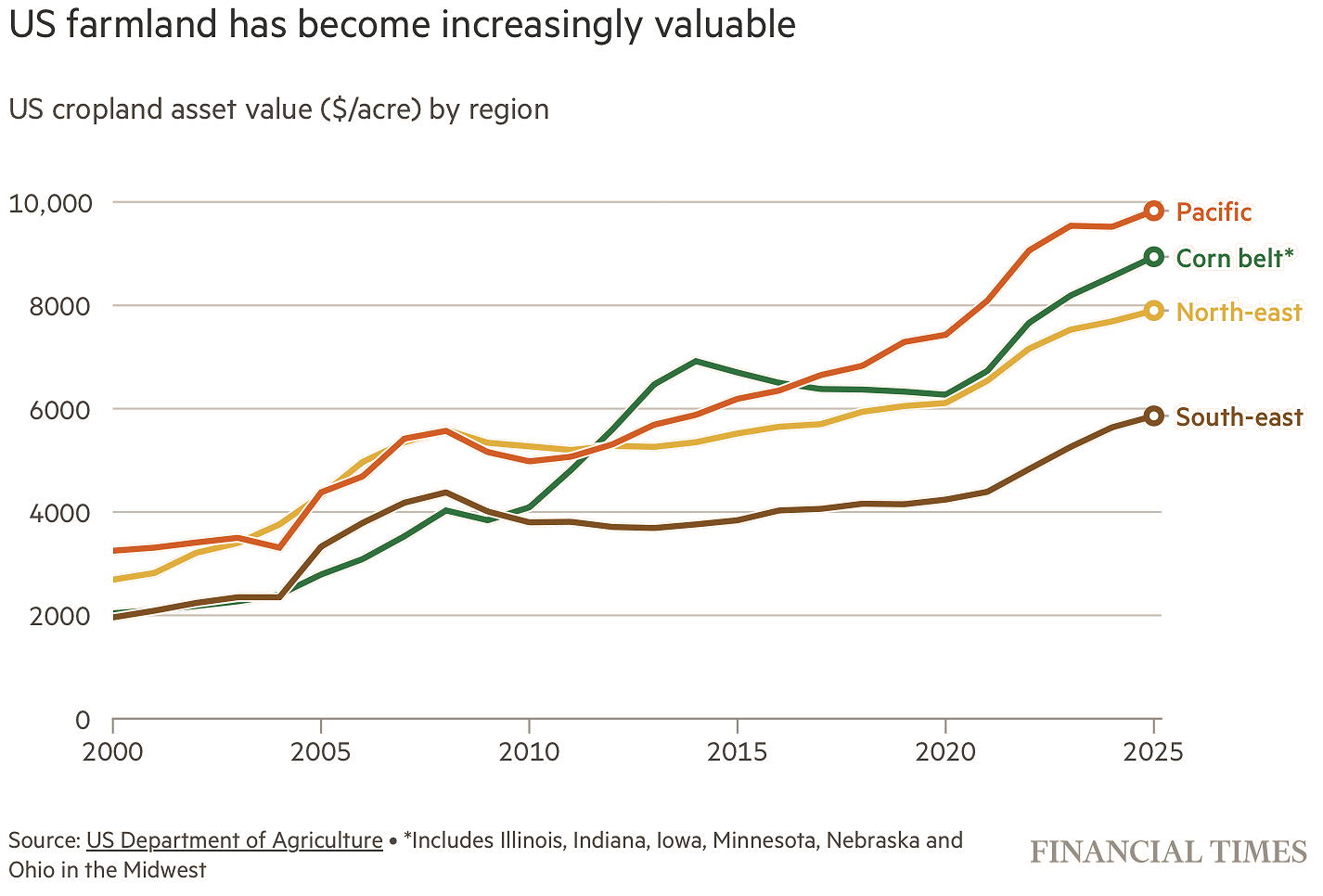
The rush for sites is beginning to reshape land markets, but often in highly specific pockets that are well connected to electricity grids. “Anywhere there’s a path to power... that’s where data center developers are flocking,” says Jason Bell of real estate group JLL.

He notes that land with sufficient capacity, for example in New Jersey, can sell for five to 10 times more than similar land without power access but that there is a wide range of estimates.

Curt Covington, a senior director at land financing group AgAmerica, agrees that developers are often “bidding up the price” for farmland. He adds that while some farmers will not dream of selling land they have worked for generations, others take a more pragmatic view if they are situated in would-be development corridors. “If [they] can get 1.5 times what this property is worth... they’ll part with their land.”
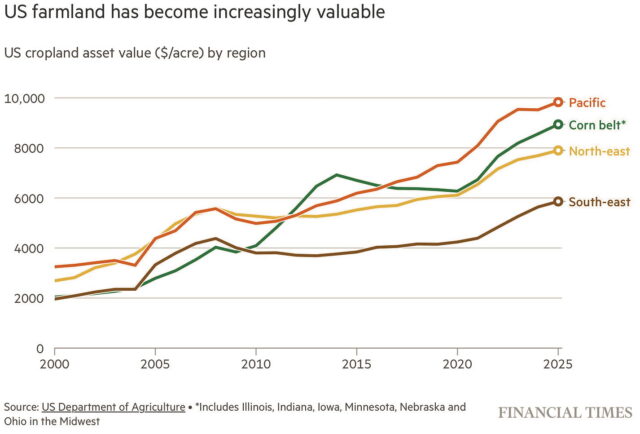
Chart showing value of US farmland rising over time Credit: Financial Times

But not all farmers see the opportunity. In Yorkville, on the outskirts of Chicago, Bob Stewart, who farms corn and soybeans, says “it’s sad to see” the region’s rich black soils “get turned into development.”

Large-scale farming requires ever more acreage to remain viable, he says, as thin margins force farmers to spread rising input costs over more land. Soaring land prices driven by data center development make it harder for those who want to keep farming and expand.

“If we want to buy more [land], so that my kids can take over, we’d like farm prices to stay kind of where they’re at,” he says.

For data center developers, a vast tract of land is just the first necessity. Spare grid capacity is also vital given an up-and-running center’s energy demands.

This means that many developments are being constructed in sparsely populated states that also experience periodic and severe drought, such as Arizona and Texas. Around two-fifths of all US data centers are located in areas of high water stress, according to S&P Global.

Heather Cooley, director of research at the Pacific Institute, a research group, says that energy and water consumption at data centers peaks during the summer months, just as it does in agriculture. “Adding another large load at peak capacity puts a lot of strain on the system and adds cost,” Cooley adds.

In DeKalb, a city of around 40,000 people, water demand averages just over 3 million gallons a day, rising to in excess of 4.5 million gallons at peak. The latter figure is broadly comparable to the needs of a single large AI data center.

Meta has a small data center in DeKalb and is permitted to consume 1.2 million gallons of water each day, according to a developer agreement. Meter data from the site shared with the FT shows on average it draws around 40,000 gallons each day, though this average obscures peak figures.

DeKalb’s mayor, Cohen Barnes, argues that Meta’s consumption is not as high as many might think. “Compare [Meta’s consumption] to a dormitory when the university is in session,” he says, noting that the tech giant’s consumption is lower than nearby Northern Illinois University’s student housing complex.

Barnes says that the Meta facility has brought broader benefits. “The data center itself pays an enormous amount of property taxes, and in the state of Illinois, our school system is funded primarily by property taxes,” he says. He adds that a $33 million elementary school was recently constructed in one of DeKalb’s most disenfranchised neighborhoods due to funding he attributes to Meta.

But the data centers of today are not the colossal data centers planned for tomorrow. Researchers at the Lawrence Berkeley Laboratory forecast that so-called hyperscaler data centers will consume anywhere between 60 billion and 124 billion liters (16 billion and 33 billion gallons) of water on-site each year in 2028. This figure excludes the indirect water use tied to electricity generation, which the lab previously forecast could be as much as 12 times higher than direct consumption.

It is numbers like these that have people up in arms in the mountains of Tucker County, West Virginia.

There, a complex of gas-powered data centers has been proposed near the small town of Davis. Residents have filed “literally hundreds” of comment letters and petitions with state agencies, according to Kotcon of the West Virginia chapter of the Sierra Club.

Tucker County sits high on the ridge, with no rivers flowing into it and limited water storage. The town’s treatment plant can produce about 250,000 gallons a day and, Kotcon says, ran dry during a recent drought, forcing farmers to rely on the local fire department to truck in water to keep their cattle alive.

Against that backdrop, the prospect of a single large data center requiring “millions of gallons a day,” several times what the plant in Davis can produce even in optimal weather, has become a focal point for increasingly bitter opposition. “When the well runs dry, we learn the value of water,” Kotcon says.

Data center operators are pushing back against protests by stressing the growing efficiencies at their facilities.

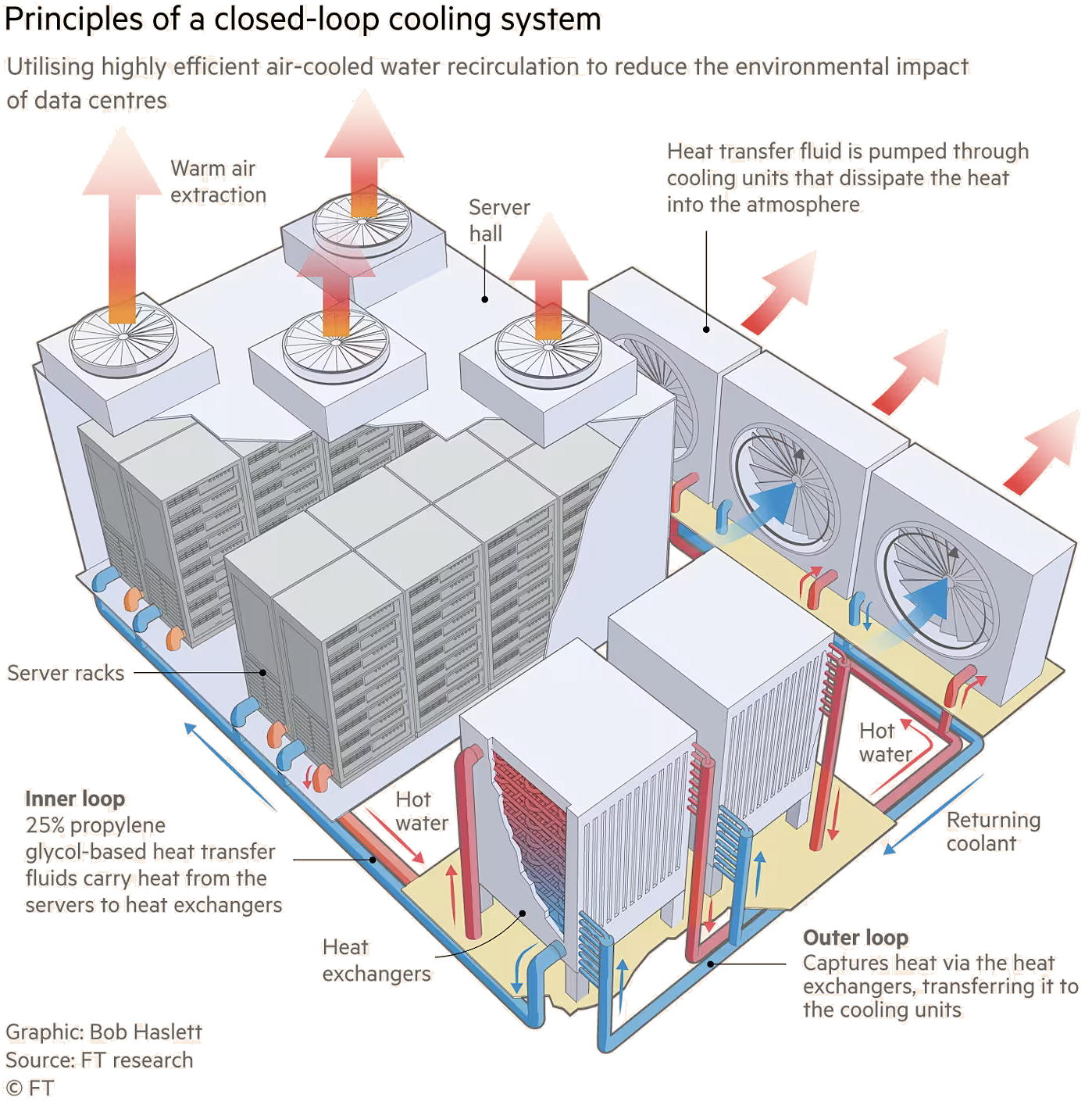
The most frequently touted is the introduction of “closed loop” systems. These pump coolant through pipes to dissipate heat from servers rather than evaporating water as has been the case in the past. Chipmaker Nvidia says it has also developed more energy-efficient chips that require even less cooling.
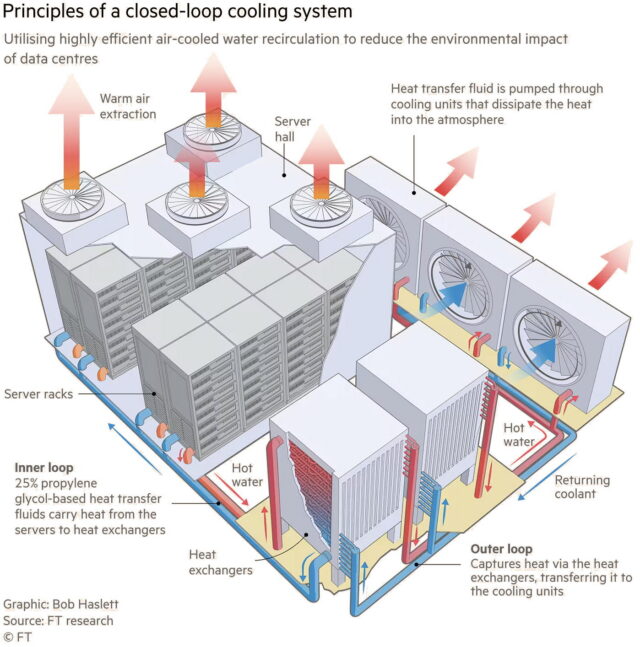
Diagram showing how data center cooling can work Credit: Financial Times

These systems are not without issues. Shaolei Ren, a researcher at the University of California, Riverside, who studies data center infrastructure, says operators using alternatives to water-based cooling use “25-35 percent more electricity” in summer, in effect shifting pressure from local water systems to regional electricity grids.

But industry executives argue that the trade-off between water and energy is often misunderstood. Doug Adams of NTT Global Data Centers, the world’s third-largest data center operator, says closed-loop systems can reduce overall energy demand. “It’s more costly to build up front, but in the long run it’s more efficient to use [coolant] to evacuate heat,” he says.

OpenAI chief Sam Altman—whose start-up has committed to spend $600 billion on infrastructure by the end of 2030, according to people familiar with the matter—recently bristled at the suggestion that data centers consume huge amounts of water. Appearing at the India AI summit in February, he said that concerns about AI’s water consumption were “totally fake,” arguing that evaporative cooling was a problem of the past.

Yet the sheer scale of the projects planned for the next five years by hyperscalers and others means that water consumption is expected to surge.

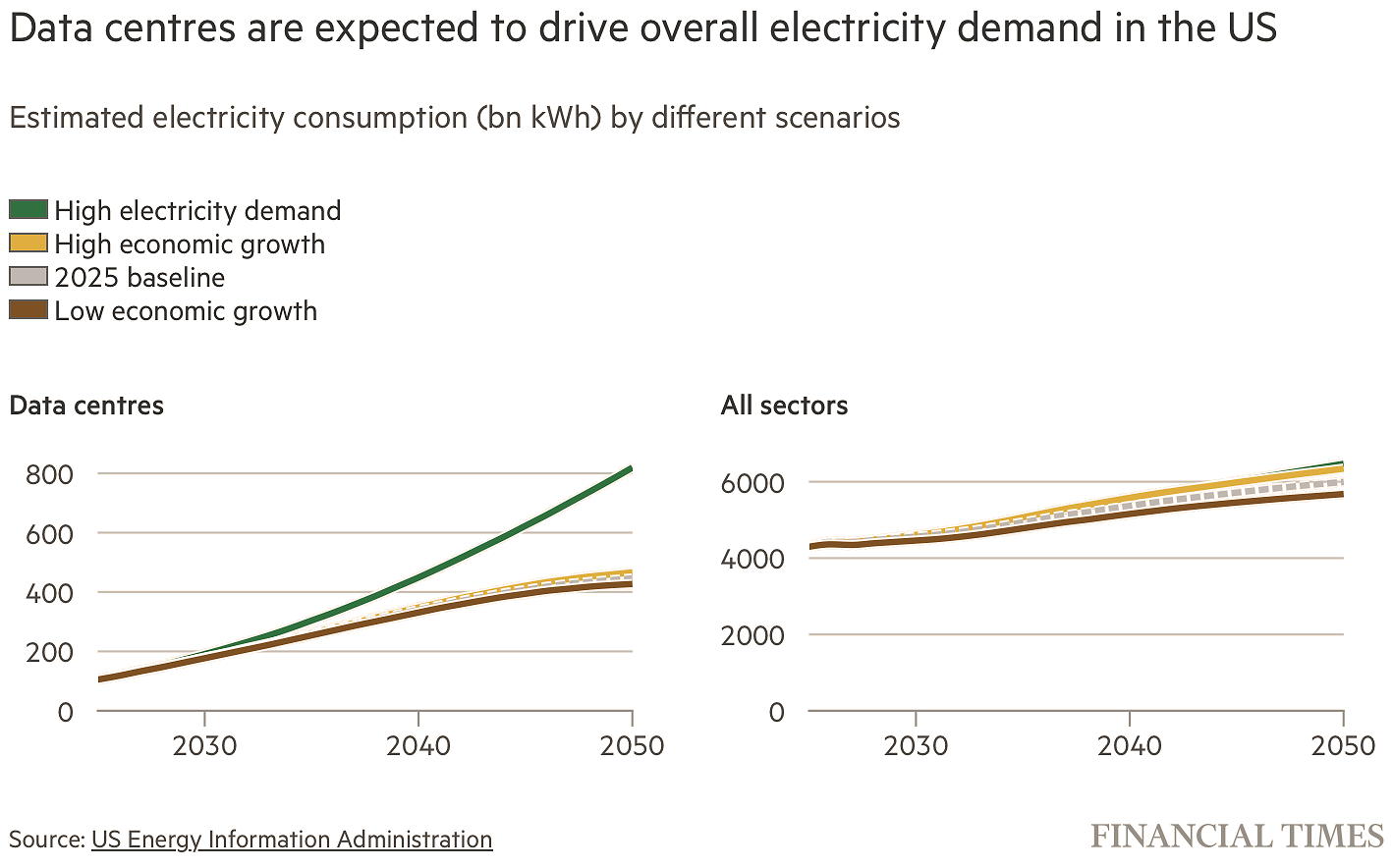
Compounding fears is a suspicion that AI facilities are driving up energy prices. On average, American bill payers—including residential, commercial, and industrial customers—paid over 6 percent more for electricity year on year at the end of 2025. This increase was starkly higher in the mid-Atlantic states that house a large number of data centers, such as Pennsylvania and Virginia, where bills rose by 19 and 10 percent, respectively.

Of the roughly 100GW of additional electricity capacity that the US is projected to need at peak times by 2030, roughly half will be used by data centers, according to the Department of Energy.

In Illinois, Deppert says rising energy demand is feeding into already tight margins for farmers. “Everything we do is energy intensive,” he says. “If those costs keep going up, that comes straight off the bottom line.”

Tech executives have sought to allay such fears, committing last month to “build, bring, or buy new-generation capacity for data centers and pay the full cost of infrastructure upgrades required to support their operations.”

Increasingly, however, popular resistance is having an impact. Amazon was forced to abandon a proposed data center project in Tucson, Arizona, after residents raised concerns over water and energy use, while Microsoft faced opposition in Caledonia, Wisconsin, over similar issues.

Small towns across the US are also skeptical of the industry’s promised economic benefits. “Technology companies talk about a sense of urgency. This is only the case because they’re in an arms race,” says Jonathan Koomey, a former project scientist at Berkeley Lab. “Is there a social urgency? I’m not sure there is one.”

© 2026 The Financial Times Ltd. All rights reserved. Not to be redistributed, copied, or modified in any way.

Read full article

Comments



Read the whole story
LeMadChef
36 seconds ago
reply
Denver, CO
Share this story
Delete

Palantir employees are talking about company's "descent into fascism"

1 Comment and 2 Shares

It took just a few months of President Donald Trump’s second term for Palantir employees to question their company’s commitments to civil liberties. Last fall, Palantir seemed to become the technological backbone of Trump’s immigration enforcement machinery, providing software identifying, tracking, and helping deport immigrants on behalf of the Department of Homeland Security, when current and former employees started ringing the alarm.

Around that time, two former employees reconnected by phone. Right as they picked up the call, one of them asked, “Are you tracking Palantir’s descent into fascism?”

“That was their greeting,” the other former employee says. “There’s this feeling not of ‘Oh, this is unpopular and hard,’ but ‘This feels wrong.’”

Palantir was founded—with initial venture capital investment from the CIA—at a moment of national consensus following the September 11, 2001, attacks, when many saw fighting terrorism abroad as the most critical mission facing the US. The company, which was cofounded by tech billionaire Peter Thiel, sells software that acts as a high-powered data aggregation and analysis tool powering everything from private businesses to the US military’s targeting systems.

For the past 20 years, employees could accept the intense external criticism and awkward conversations with family and friends about working for a company named after J. R. R. Tolkien’s corrupting all-seeing orb. But a year into Trump’s second term, as Palantir deepens its relationship with an administration that many workers fear is wreaking havoc at home, employees are finally raising these concerns internally, as the US’s war on immigrants, war in Iran, and even company-released manifestos has forced them to rethink the role they play in it all.

“We hire the best and brightest talent to help defend America and its allies and to build and deploy our software to help governments and businesses around the world. Palantir is no monolith of belief, nor should we be,” a Palantir spokesperson said in a statement. “We all pride ourselves on a culture of fierce internal dialogue and even disagreement over the complex areas we work on. That has been true from our founding and remains true today.”

“The broad story of Palantir as told to itself and to employees was that coming out of 9/11 we knew that there was going to be this big push for safety, and we were worried that that safety might infringe on civil liberties,” one former employee tells WIRED. “And now the threat’s coming from within. I think there's a bit of an identity crisis and a bit of a challenge. We were supposed to be the ones who were preventing a lot of these abuses. Now we're not preventing them. We seem to be enabling them.”

Palantir has always had a secretive reputation, forbidding employees from speaking to the press and requiring alumni to sign non-disparagement agreements. But throughout the company’s history, management has always at least appeared to be open to engagement and internal criticism, multiple employees say. Over the last year, however, much of that feedback has been met by philosophical soliloquies and redirection. “It’s never been really that people are afraid of speaking up against Karp. It’s more a question of what it would do, if anything,” one current employee tells WIRED.

While internal tensions within Palantir have grown over the last year, they reached a boiling point in January after the violent killing of Alex Pretti, a nurse who was shot and killed by federal agents during protests against Immigration and Customs Enforcement (ICE) in Minneapolis. Employees from across the company commented in a Slack thread dedicated to the news demanding more information about the company’s relationship with ICE from management and CEO Alex Karp.

“Our involvement with ice has been internally swept under the rug under Trump2 too much,” one person wrote in a Slack message WIRED reported at the time. “We need an understanding of our involvement here.”

Around this time, Palantir started wiping Slack conversations after seven days in at least one channel where most of the internal debate takes place, #palantir-in-the-news. Because the decision wasn’t formally announced before the policy rolled out, one worker who noticed the deletions asked in the channel why the company was removing “relevant internal discourse on current events.”

A member of Palantir’s cybersecurity team responded, writing that the decision was made in response to leaks.

This period led Palantir management to release an updated wiki, or a collection of blog posts explaining the ICE contract, where the company defended its work with Homeland Security. Management wrote that the technology the company provides “is making a difference in mitigating risks while enabling targeted outcomes.”

Palantir management ran defense by holding a handful of AMA (ask me anything) forums across the company with leadership like chief technology officer Shyam Sankar and members of its privacy and civil liberties (PCL) teams.

At least one of these AMAs was organized independently of PCL leadership by two team leads, including one who worked directly on the ICE contract for a period of time. “This was very rogue,” a PCL employee who worked on the ICE contract said in a February AMA, a recording of which was obtained by WIRED. “Courtney [Bowman, head of the privacy and civil liberties team] doesn’t know that I’m spending three hours this week talking to IMPLs [Palantir terminology for its client-facing product teams], but I think this is the only real way to start going in the right direction.”

Throughout the lengthy call, employees working on a variety of Palantir’s defense projects posed hard questions. Could ICE agents delete audit logs in Palantir’s software? Could agents create harmful workflows on their own without the company’s help? What is the most malicious thing that could come out of this work?

Answering these questions, the PCL employee who worked on the ICE contract said that “a sufficiently malicious customer is, like, basically impossible to prevent at the moment” and could only be controlled through “auditing to prove what happened” and legal action after the fact if the customer breached the company’s contract.

At one point during the call, one of the employees tried to level with the group, explaining that Palantir’s work with ICE was a priority for Karp and something that likely wouldn’t change any time soon.

“Karp really wants to do this and continuously wants this,” they said. “We’re largely at the role of trying to give him suggestions and trying to redirect him, but it was largely unsuccessful and we seem to be on a very sharp path of continuing to expand this workflow.”

Around the time of these forums, Karp sat down for a prerecorded interview with Bowman, seemingly to discuss Palantir’s contracts with ICE, but refused to broach the topic directly. Instead, Karp suggested that employees interested in the work sign nondisclosure agreements before receiving more detailed information.

Then came the deadly February 28 missile strike on an Iranian elementary school on the first full day of the Trump administration and Israel’s war in Iran. The US is the only known country in the conflict to use that specific type of missile. More than 120 children were killed when a Tomahawk missile struck the school, kicking off a series of investigations that concluded that the US was responsible and that surveillance tools like Palantir’s Maven system had been used during that day’s strikes. For a company full of employees already reeling over its work with ICE, possible involvement in the death of children was a breaking point.

“I guess the root of what I'm asking is … were we involved, and are doing anything to stop a repeat if we were,” one employee asked in the Palantir news Slack channel. Some employees posed similar questions in the thread, while others criticized them for discussing what could be considered classified information in a Slack channel open to the entire company. The investigation is ongoing.

The Palantir spokesperson said the company was “proud” to support the US military “across Democratic and Republican administrations.”

In March, Karp gave an interview to CNBC claiming that AI could undermine the power of “humanities-trained—largely Democratic—voters” and increase the power of working-class male voters. While critics reacted to the piece, calling the statements concerning, so did employees internally: “Is it true that AI disruption is going to disproportionately negatively affect women and people who vote Democrat? and if it is, why are we cool with that?” one worker asked on Slack in a channel dedicated to news about Palantir.

Palantir’s leadership incensed workers yet again this week after the company posted a Saturday afternoon manifesto reducing Karp’s recent book, The Technological Republic, to 22 points. The post—which includes many of Karp’s long-standing beliefs on how Silicon Valley could better serve US national interests—goes as far as suggesting that the US should consider reinstating the draft. Critics called the manifesto fascist.

Internally, the post alarmed some workers who huddled in a Slack thread on Monday morning, questioning leadership over its decision to post it in the first place.

“I’m curious why this had to be posted. Especially on the company account. On the practical level every time stuff like that gets posted it gets harder for us to sell the software outside of the US (for sure in the current political climate), and I doubt we need this in the US?” wrote one frustrated employee. The message received more than 50 “+1” emojis.

“Wether [sic] we acknowledge it or not, this impacts us all personally,” another worker wrote on Monday. “I’ve already had multiple friends reach out and ask what the hell did we post.” This message received nearly two dozen “+1” emoji reactions.

“Yeah it turns out that short-form summaries of the book’s long-form ideas are easy to misrepresent. It’s like we taped a ‘kick me’ sign on our own backs,” a third worker wrote. “I hope no one who decided to put this out is surprised that we are, in fact, getting kicked.”

These conversations involving shame and uncertainty from workers have seemingly popped up in internal channels whenever Palantir has been in the news over the last year. “I think the only thing not different is a lot of folks are still incredibly wary about leaks and talking to the press,” one current employee tells WIRED, describing how the internal company culture has evolved over the last year.

All of this dissent doesn’t seem to bother Karp, who recently told workers that the company is “behind the curve internally” when it comes to popularity. Here, he’s been consistent; in March 2024 Karp told a CNBC reporter that “if you have a position that does not cost you ever to lose an employee, it’s not a position.”

But for employees, the culture shift feels intentional. “I don’t want to assert that I have knowledge of what’s going on in their internal mind,” one former worker tells WIRED. “But maybe it's gotten to a place where encouraging independent thought and questioning leads to some bad conclusions.”

This story originally appeared on wired.com.

Read full article

Comments


Read the whole story
LeMadChef
2 minutes ago
reply
Palantir was 100% distilled evil on day one. I have zero sympathy for anyone who works there. You knew the bargain when you signed up.
Denver, CO
Share this story
Delete

FCC says ban on foreign-made routers includes portable Wi-Fi hotspots

1 Share

The Federal Communications Commission clarified this week that its sweeping ban on foreign-made consumer routers also affects portable hotspot devices.

The FCC added a new section to a FAQ titled, "Is my device a consumer-grade router under the National Security Determination?" The new FAQ section says this category includes "consumer-grade portable or mobile MiFi Wi-Fi or hotspot devices for residential use." The ban does not cover "mobile phones with hotspot features," the FAQ says.

This means that companies making consumer hotspots need an exemption from the government to import and sell any future hotspots that haven't previously been approved by the FCC. As with routers, devices previously approved for sale in the US can continue to be imported and sold without obtaining a special exemption.

The FCC defines routers broadly, giving the agency plenty of flexibility to include various types of consumer networking devices in the ban. When the FCC announced the ban last month, it defined routers as “consumer-grade networking devices that are primarily intended for residential use and can be installed by the customer,” and which “forward data packets, most commonly Internet Protocol (IP) packets, between networked systems.”

But while an earlier version of the FAQ stated that cellphones with mobile hotspot features were exempt, it did not specifically say that portable hotspot devices were covered by the ban. In addition to hotspot devices, the new FAQ section says the router ban applies to "consumer or small and medium-sized business routers sold or rented through retail and self-installable by end users"; "LTE/5G CPE [customer premises equipment] devices for residential use"; "residential routers installed by a professional or ISP"; and "residential gateways that combine modem and router functions."

Netgear and Eero get exemptions

The device ban is only for consumer-grade equipment, even though network gear used by large businesses presents a natural target for the foreign hackers. The new FAQ section notes that "industrial, enterprise, or military equipment" is not included.

The FCC adds that other devices not covered by the ban include analog telephone adapters with Ethernet LAN and WAN ports, femtocells, and optical network terminals. The new FAQ section was pointed out yesterday in a PCMag article.

The FCC router ban stems from a President Trump directive on reducing the use of foreign technology for national security reasons. The FCC said it will not approve new device models made at least partly outside the US unless the Department of Defense or Department of Homeland Security determines that the router does not pose national security risks.

Whether headquartered in the US or abroad, virtually every router maker will have to obtain an exemption for future devices. The various components inside routers are made in countries such as Taiwan, South Korea, Japan, and China, noted a report by the Global Electronics Association trade group.

Netgear became the first major vendor of consumer routers to obtain an exemption last week. The Amazon-owned Eero was granted an exemption this week.

Read full article

Comments


Read the whole story
LeMadChef
3 minutes ago
reply
Denver, CO
Share this story
Delete

Greenhouse gases from data center boom could outpace entire nations

2 Shares

New gas projects linked to just 11 data center campuses around the US have the potential to create more greenhouse gases than the country of Morocco emitted in 2024. Emissions estimates from air permit documents examined by WIRED show that these natural gas projects—which are being built to power data centers to serve some of the US’s most powerful AI companies, including OpenAI, Meta, Microsoft, and xAI—have the potential to emit more than 129 million tons of greenhouse gases per year.

As tech companies race to secure massive power deals to build out hundreds of data centers across the country, these projects represent just the tip of the iceberg when it comes to the potential climate cost of the AI boom.

The infrastructure on this list of large natural gas projects reviewed by WIRED is being developed to largely bypass the grid and provide power solely for data centers, a trend known as behind-the-meter power. As data center developers face long waits for connections to traditional utilities, and amid mounting public resistance to the possibility of higher energy bills, making their own power is becoming an increasingly popular option. These projects have either been announced or are under construction, with companies already submitting air permit application materials with state agencies.

Michael Thomas, the founder of clean energy research firm Cleanview, has been tracking gas permits for data centers across the country. He calls behind-the-meter power “a crazy acceleration of emissions.”

“It's almost like we thought we were on the downside of the Industrial Revolution, retiring coal and gas, and now we have a new hump where we’re going to rise,” he says. “That terrifies me in a lot of ways.”

One of the first—and most notorious—examples on this list is in Memphis, Tennessee. xAI made national headlines in 2024 after it began to set up gas turbines at its first data center campus in the city, Colossus 1, to quickly develop Grok, its AI. Community members living in the low-income Black community around the campus, concerned about air pollution, rallied to protest the turbines. (The EPA ultimately approved the use of turbines for the xAI campus last year; last month, regulators granted a permit for an xAI affiliate for the company’s second campus in Southaven, Mississippi, despite widespread community opposition. The NAACP filed suit against xAI last week, claiming the company was illegally operating the turbines.)

xAI’s gas turbines also represent what could be a significant source of greenhouse gas emissions. Air permit applications for both the Colossus campus in Memphis and the nearby Colossus 2 campus in Southaven show that the turbines on each campus could generate more than 6.4 million tons of CO2equivalents at each site per year. Combined, that’s roughly equivalent to the emissions from more than 30 average-size natural gas plants, or enough energy to power 1.5 million homes. (xAI did not respond to a request for comment.)

Microsoft, meanwhile, is reportedly looking into purchasing power from a Chevron-backed natural gas project in West Texas. That single project, according to its permit, could emit more than 11.5 million tons of greenhouse gases each year—more than the yearly emissions of the entire country of Jamaica.

“Microsoft takes a portfolio approach to energy, leveraging a range of solutions to meet reliability needs while continuing to invest in carbon-free electricity,” Melanie Nakagawa, the chief sustainability officer at Microsoft, told WIRED in a statement. “In certain regions, dedicated onsite energy infrastructure may be part of that portfolio, particularly where grid constraints limit the pace of deployment.”

The emissions projections for the xAI and Microsoft projects, and all the others on WIRED’s list, were pulled directly from publicly available air permit documents in state databases as well as public air permit materials collected by both Cleanview and Oil and Gas Watch, a database maintained by the Environmental Integrity Project, an environmental enforcement nonprofit. Actual greenhouse gas emissions from power plants are usually lower than what’s on their air permits. Air permit modeling is based on the scenario of a power plant constantly running at full capacity. That’s rarely the reality for grid-connected power plants, as turbines go offline for maintenance or adjust to the ebbs and flows of customer demand.

“Permitted emission numbers represent a theoretical, conservative scenario, not the actual projected emissions,” Alex Schott, the director of communications at Williams Companies, an oil and gas company that is building out three behind-the-meter power plants in Ohio for Meta, told WIRED in an email. Internal modeling done by the company, Schott added, shows that actual emissions could be “potentially two-thirds less than what's on paper.”

The projections involved, however, are still substantial. Even if the actual emissions from these power plants end up being half of the emissions numbers on the permits, they still could create more greenhouse gas emissions than the country of Norway emitted in 2024. This number is, according to the EPA, equivalent to the emissions from more than 153 average-size natural gas plants. (WIRED’s analysis does not include emissions from backup generators and turbines on the data center campuses themselves, which create smaller amounts of emissions.)

Energy researcher Jon Koomey estimates that while emissions from efficient grid-connected gas plants could be 40 to 50 percent of the permitted numbers, data center emissions could be much closer to what is modeled on the permit, given that they don’t have to respond to customer demand. This idea is reflected on a November permit application for a data center being built by AI company Crusoe, a player in three of the projects WIRED reported on. The permit application describes the facility as “unlike a traditional power plant” that has to “respond to the demands of a constantly varying grid. At the data center, the power requirements do not vary significantly.” (“We view gas as a critical bridge—not the destination—as we work to build AI infrastructure that meets the scale of demand while expanding access to innovative forms of energy over time,” Andrew Schmitt, Crusoe’s senior director of communications, told WIRED in a statement.)

Koomey points out that a global shortage of the most efficient types of gas turbines—thanks in part to the data center race—is prompting some developers to consider choosing less efficient turbine models, forcing them to run them for longer and create more emissions.

“[Data center operators’] belief is that the value being delivered by the servers is much, much more than the cost of running these inefficient power plants all the time,” Koomey says.

Gas projects developed as part of the Stargate Project, a massive, multicompany AI effort originally started to build out infrastructure for OpenAI, also represent a potential emissions bombshell on WIRED’s list. Stargate campuses are being built across multiple states, including Texas, New Mexico, Ohio, and Wisconsin. Permit documents for just three Stargate-affiliated natural gas projects—one to power a data center campus near the project’s headquarters in Abilene, Texas, and two to power Project Jupiter, a campus in New Mexico—show that they have a combined potential to emit more than 24 million tons of greenhouse gases each year.

"We are committed to protecting ratepayers while building the infrastructure needed for U.S. AI leadership,” OpenAI spokesperson Aaron McLear said in a statement. “Where near term natural gas is required to ensure reliable power, we work with partners to use modern, efficient generation while helping accelerate clean power and grid modernization.”

Oracle spokesperson Julia Allyn Fishel told WIRED that there is a “modification” to the Project Jupiter application currently in progress, “which is expected to materially lower emissions.” The company did not provide the new emissions estimates, which the New Mexico Environment Department have not yet made public.

“Oracle is committed to paying our own way on energy costs while implementing the best energy solution for each community so that ratepayers’ bills and electric grid reliability are not impacted by our AI data centers,” Fishel said in a statement.

A fourth gas plant on the main Stargate campus in Abilene has, according to application documents, the potential to permit more than 7.8 million tons of carbon dioxide equivalents each year. This power plant is being built by Crusoe for use by Microsoft. The companies announced in late March that Crusoe would be building new buildings on the Abilene campus, including a power plant, to support Microsoft’s AI infrastructure. (Microsoft declined to comment.)

There are projects with an even bigger potential carbon footprint than Stargate. Outside of Amarillo, Texas, White House darling Fermi is building what it calls the President Donald J. Trump Advanced Energy and Intelligence Campus, a data center campus with a target of 17 gigawatts. Fermi continuously emphasizes its use of what it calls “clean” natural gas. But documents show that the maximum emissions for the two gas projects combined could be more than 40.3 million tons of CO2 equivalents each year, more than the yearly emissions of all the power sources in the state of Connecticut.

About five hours south of Amarillo, near the city of Fort Stockton, Pacifico Energy is developing what it claims is the largest single energy project in the country: a 7.2 gigawatt data center campus, powered by a gas project that is permitted to emit more than 33 million tons of greenhouse gases each year. (Pacifico did not respond to a request for comment.)

Major tech companies that have made carbon reduction pledges in recent years have acknowledged that the AI infrastructure build-out is hampering their goals. The sheer scale of the gas projects shows how easy it is for even just a few fossil fuel plants to tip the scale.

Meta, for example, is linked with three behind-the-meter gas projects in Ohio: two to power a data center in New Albany, and one to power a separate facility in Wood County. Together, permit documents for these facilities show they could emit a maximum of 5.5 million tons of CO2 equivalents each year.

Meta claims in its 2025 sustainability report that it has reduced its greenhouse gas emissions by 23.8 million metric tons since 2021. But even if the three projects in Ohio emit just half of what’s on their permits, that would still equal more than 10 percent of the company's stated emissions reductions over the past four years. (Meta declined to comment on the record.)

The Ohio projects aren’t the only fossil fuel projects in Meta’s pipeline. Most major AI companies building behind-the-meter power are also pursuing arrangements with utilities to pay for power plants that would be connected to the grid. Meta has an agreement with utility Entergy to help power a massive data center, Hyperion, in Richland Parish, Louisiana. A gas plant being built by Entergy in Richland Parish to meet power needs from the Meta campus could, according to its application, emit nearly 5.2 million tons of greenhouse gases each year. Earlier this month, Meta announced that it would pay for seven new natural gas plants, totaling more than five gigawatts, to serve both its data centers and Entergy customers. (These facilities, the announcement states, are being built with future carbon capture capabilities, which could drive down some emissions from the plants.)

Data center developers have quickly jumped over the past year to pursue behind-the-meter options. Research released in January from Global Energy Monitor, a nonprofit that tracks oil and gas, showed that nearly 100 gigawatts of behind-the-meter natural gas power for data centers were in the US development pipeline at the start of 2026—up from just 4 gigawatts of data center-specific power in the pipeline in early 2024. Several massive, multi-gigawatt data center gas projects have been announced in the weeks since the research was released, illustrating just how quick the race to build out data center power has become. In March, several companies linked to projects on this list signed the Ratepayer Protection Pledge, a nonbinding agreement sponsored by the Trump administration, which asks AI companies to “build, bring, or buy” power generation for data centers. (Experts told WIRED that the pledge was largely symbolic, and that neither the White House nor tech companies have much control over policies that can actually bring down consumer electric bills.)

Last month, three Senate Democrats sent questions about emissions from data centers to several leading tech companies, including OpenAI, Meta, and Fermi. In response to a series of questions from WIRED about the carbon emissions on its air permit, Fermi sent a copy of its response to those lawmakers, where it urged the lawmakers to support nuclear energy and the campus’s inclusion in foreign nuclear investment deals. The company also claimed that its behind-the-meter power was not subject to regulations requiring them to reduce greenhouse gas emissions, since its power would not be connected to the electric grid.

"Clean natural gas is fundamental to the energy transition and is the logical bridge to nuclear for a nation that cannot afford to wait,” the letter states. The company did not answer questions about whether it would retire the natural gas turbines it was building once its planned nuclear capability is brought online.

It is unlikely that all of the gas facilities WIRED examined will get built; an air permit is not a guarantee of construction. Neither Fermi nor the GW Ranch facility, the two largest emitters on this list, have a client yet. (On Friday, Fermi announced that its CEO would be stepping down immediately; while he remains on the board, he has called for the company to be sold. Stocks plunged more than 20 percent, and the company’s CFO also departed.) The Stargate project has created high-profile headlines as OpenAI reshuffles its strategy; the company paused a planned data center expansion in the UK this week. Turbine shortages, labor and construction costs, and energy shocks in the Middle East are just a few factors that could cause bumps in the road for AI companies building their own power. And most of these companies are also racing to build out renewable energy and nuclear as they seek to power their data centers with anything and everything they can get.

But Thomas sees behind-the-meter gas power as a potentially lasting trend for data centers—with worrisome implications for the climate.

“The thing that has kept me up at night and is starting to really worry me,” he says, “is what happens if this gets 10 times bigger?”


Read full article

Comments


Read the whole story
LeMadChef
4 minutes ago
reply
Denver, CO
Share this story
Delete
Next Page of Stories