Code Monger, cyclist, sim racer and driving enthusiast.
9936 stories
·
6 followers

Microspeak: Big rocks

2 Shares

Recall that Microspeak is not merely for jargon exclusive to Microsoft, but it’s jargon that you need to know to survive at Microsoft.

The term big rocks was introduced by Stephen Covey in the book The Seven Habits of Highly Effective People, which I suspect is very popular among senior executives, because senior executives aspire to become highly effective people.

In its original formulation, the concept of big rocks was used as a metaphor for time management: the metaphor is that you have a jar with large rocks inside it, stacked up to the brim. Is the jar full? But you can pour pebbles and sand into the jar to fill the gaps between the big rocks. The lesson is that you were able to fit everything into the jar if you put the big rocks in first. If you had started with the pebbles and sand, then there wouldn’t be space for the rocks. In terms of time management, the lesson is to deal with the biggest, most important things (the big rocks) first. If you spend time on the smaller things, you will find that there’s no room for the big things.

However, that’s not always what it means at Microsoft.

As I look over various types of documents, the meaning of big rocks as top priorities tends to predominate in senior executive documents.

These are the Big Rock priorities that have been determined by senior leadership.

And I was fortunate to find a document that opened with a definition.

The Nosebleed Big Rocks are the top business critical programs in our division.

However, as you go lower in the hierarchy and interact with people who do not keep a copy of The Seven Habits of Highly Effective People on their nightstand, the term big rocks tends to be used to mean the big problems that need to be solved in order for the project to succeed.

Again, I was able to find a document that included a definition.

Big Rocks: A list of technical challenges that we need to solve.

Bonus chatter: My theory (which has yet to be well-tested) is that if a speaker uses the term big rocks in a presentation, you can tell which definition the speaker is using by looking at the clip art they put on the slide. If it’s a bunch of boulders, then they use it to mean that it’s a problem to be solved. If it’s a jar, then they use it to mean a priority goal.

Narrator: It’s never a jar.

The post Microspeak: Big rocks appeared first on The Old New Thing.

Read the whole story
LeMadChef
6 hours ago
reply
Denver, CO
Share this story
Delete

Michigan man learns the hard way that “catch a cheater” spyware apps aren’t legal

1 Share

In 2002, Bryan Fleming helped to create pcTattletale, software for monitoring phone and computer usage. Fleming's tool would record everything done on the target device, and the videos would be uploaded to a server where they could be viewed by the pcTattletale subscriber.

This might sound creepy, but it can also be legal when used by a parent monitoring their child or an employee monitoring their workers. These are exactly the use cases that were once outlined on pcTattletale's website, where the software was said to have "helped tens of thousands of parents stop their daughters from meeting up with pedophiles." Businesses can "track productivity, theft, lost hours, and more." Even "police departments use it for investigating."

But this week, nearly 25 years after launching pcTattletale, Fleming pled guilty in federal court to having knowingly built and marketed software to spy on other adults without their consent. In other words, pcTattletale was often used to spy on romantic partners without their knowledge—and Fleming helped people do it.

When you're sleeping

It's unclear when pcTattletale began marketing itself as a tool for catching cheaters, but Fleming's original business partner left the company in 2011, and Fleming ran things himself from his home in a northern Detroit suburb.

In 2021, Vice reported that pcTattletale was leaking the sensitive data it collected. The story quoted marketing materials about using the tool to catch a "cheating spouse," which required users to know their spouse's "pass-code and have access to the phone for about 5 minutes. The best time to do this is when they are sleeping." The company also provided instructions to hide icons that might reveal that pcTattletale was running on the victim's phone.

A look through archived versions of the pcTattletale site on the Wayback Machine shows that by 2022, pcTattletale had added numerous "cheating" links to its footers and featured multiple blog posts on ways to "catch your boyfriend cheating." These explicitly directed people to use the "unlock code to your boyfriend's phone" to install "the pcTattletale spy app" in order to "watch everything he does on his phone." One entry even noted that people being spied on in this way are unlikely to be happy about it, and users should "expect him to lash back at you over putting the spy app on his phone. It can really turn the tables."

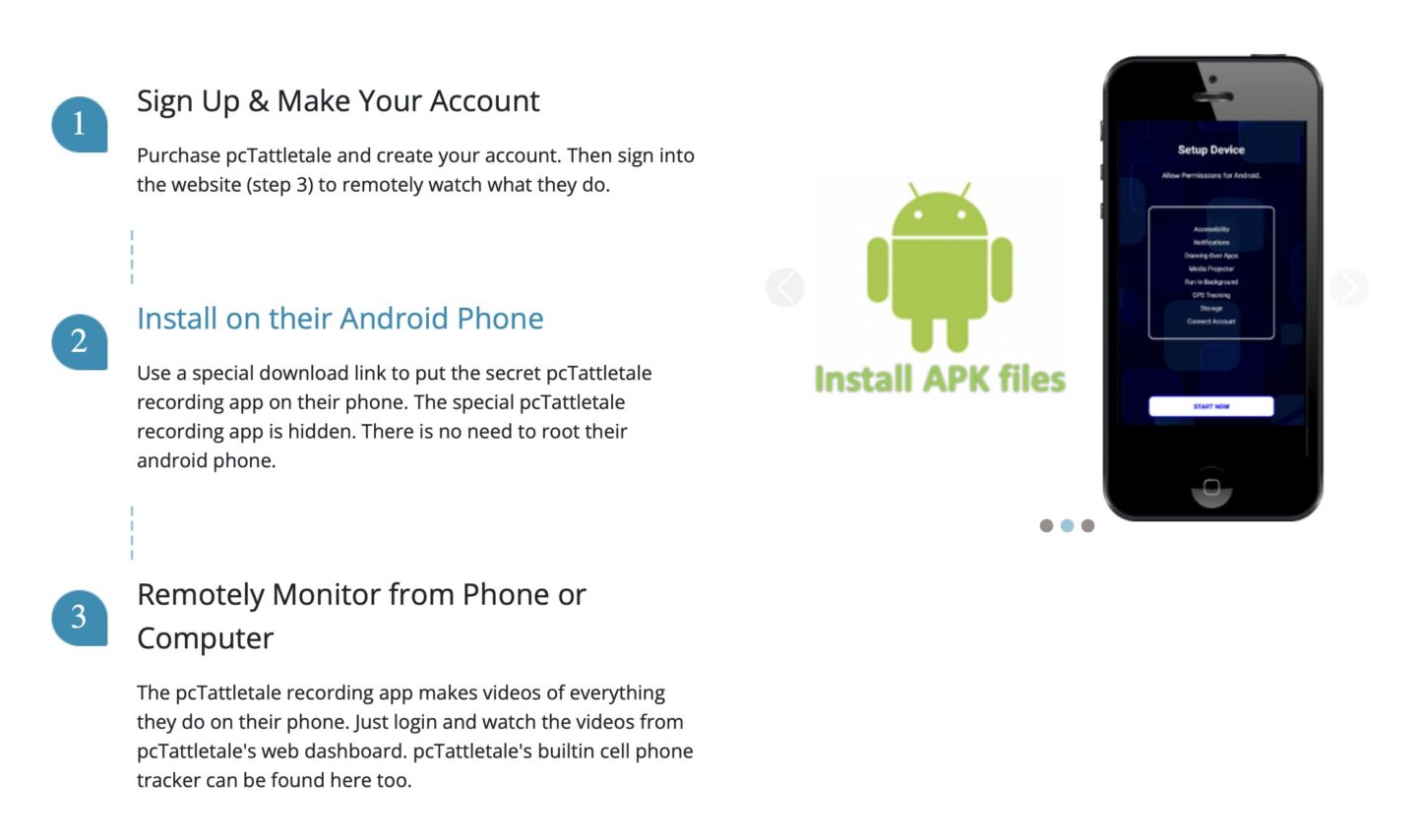
This is how pcTattletale used to describe its install process. This is how pcTattletale used to describe its install process.

Around this same time, federal investigators in California had launched an investigation into "stalkerware," and pcTattletale was among their targets. It also looked like a site where an arrest might not be too difficult, since Fleming operated out of the US and made no real attempts to hide his location. (Indeed, older versions of the pcTattletale website said explicitly that "Fleming Technologies" was based in Bruce Township, Michigan.) As a government investigator put it, "many of the other [stalkerware] websites under investigation involve targets who are believed to be overseas. For this reason, it is unrealistic to believe that the targets will soon be apprehended."

But Fleming was easy enough to find, and investigators soon obtained copies of his email account. It contained plenty of support requests in this vein: "Also if there is a way to NOT let user know you are taking screen shot that would be helpful too. My husband knows when there is screen shot being taken as it beeps. He is now suspicious of something being on his phone."

Despite being repeatedly told that people were using his product to spy on others without their consent, Fleming helped them with tech support.

A government investigator even opened up an affiliate marketing account for pcTattletale, and Fleming reached out to offer ready-made banner ads with text like “pcTattletale Cheating Husband? #1 catch a cheater spy tracker" and "pcTattletale Husband Cheating? Best Catch a Cheater Spy App."

Fleming noted in an email that pcTattletale was more successful when marketed at women, because "There are a lot more women wanting to catch their man then [sic] the other way around." Financial records showed that Fleming was selling around 1,200 pcTattletale subscriptions a year at anywhere from $99 to $300.

Based on all this, the government obtained a search warrant in late 2022 and raided the Bruce Township home where Fleming lived.

In 2024, TechCrunch reported that pcTattletale was hacked and much of its data was leaked. Apparently, hackers had gained access to the company's private keys for the Amazon Web Services account where most of the video data created by the app was stored. Fleming claimed at the time that his company was “out of business and completely done” after the breach.

The feds eventually charged Fleming with selling a product while "knowing or having reason to know" that the software was "primarily useful for the purpose of the surreptitious interception of wire, oral, or electronic communications." This week in California, Fleming pled guilty to a single count and was released on his own recognizance while awaiting sentencing.

One piece of stalkerware is off the market; unfortunately, many others remain, and their owners and operators are often harder to find.

Read full article

Comments


Read the whole story
LeMadChef
6 hours ago
reply
Denver, CO
Share this story
Delete

How The Fourth-Generation Toyota 4Runner Made A Huge Contribution To In-Car Burger Consumption

1 Share

I’m no sociologist, but it feels like eating in the car is one of the most American things a person can do. From nostalgic drive-ins to omnipresent drive-throughs, the car and food have long shared a link. While Kirby’s Pig Stand pioneered the concept of four-wheeled dining, In-N-Out’s introduction of a drive-through two-way speaker system laid the blueprint for grabbing a bite on the road. However, without a tray, eating in a car can be messy. Before the fold-out armrest table in the Ford F-150, before the Fisker Ocean’s taco tray, there was the fourth-generation Toyota 4Runner and its clever pair of little tables.

It’s no surprise that some foods are easier to eat on the go than others. A couple of years ago, we ran a test of the best and worst foods to eat while driving, and it shouldn’t be surprising that say, a McDonald’s cheeseburger fared a lot better than biryani. Really, eating anything behind the wheel is a bit distracting, so the safest way to grab a bite in the car is to park up. However, depending on what you’re eating, you’ll want room to spread out, and Toyota thought of this.

The fourth-generation 4Runner was a landmark model in many ways. It was the first and only 4Runner to be offered with a V8, the first 4Runner to feature available third-row seats, and the first 4Runner to offer hydraulically interlinked dampers. However, the real innovation we’re talking about today is a pair of elements that enhanced everyday quality of life.

2006 Toyota 4runner Front Tray
Photo credit: Cars & Bids

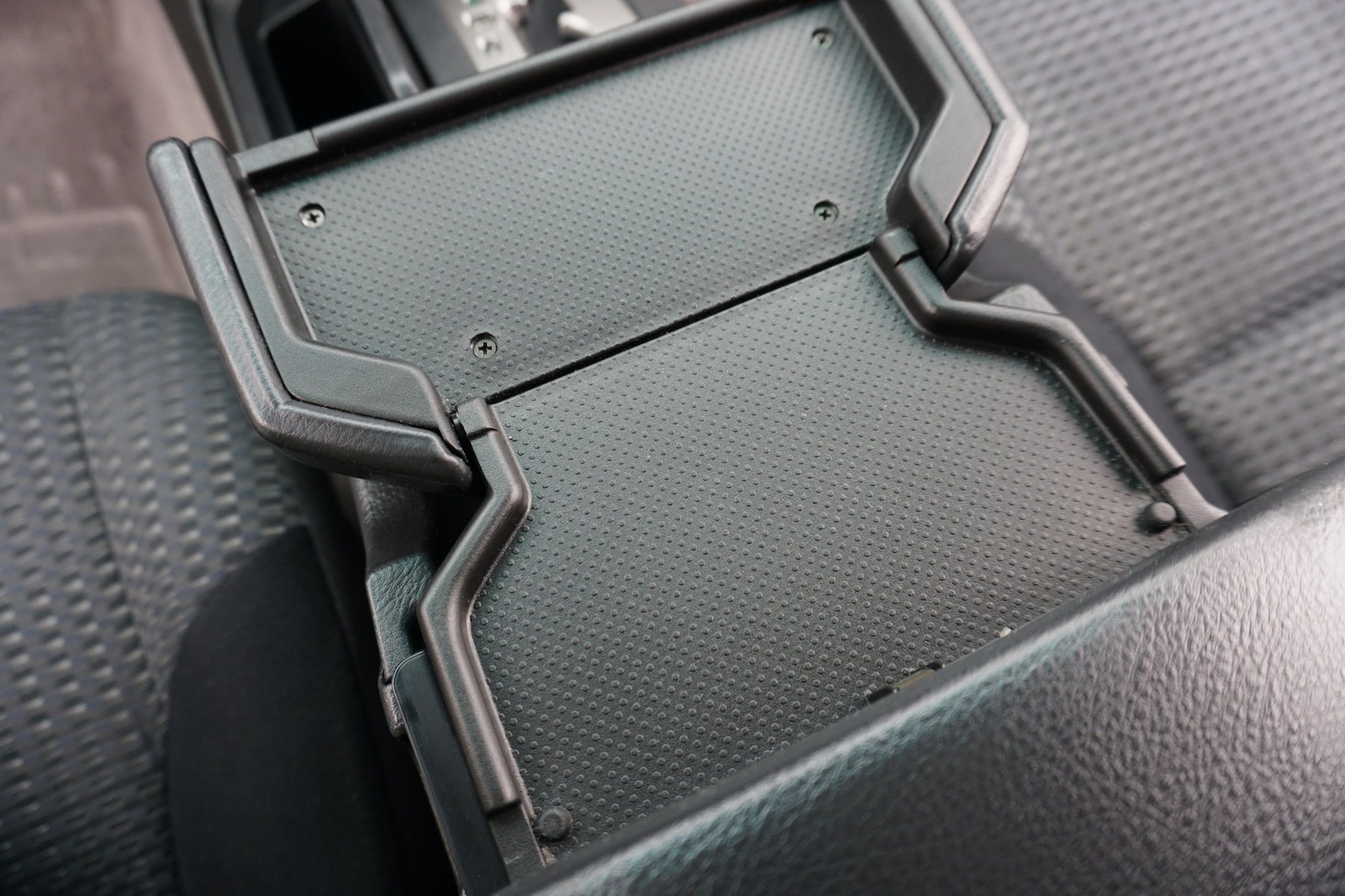
If you look carefully at the lid of the center console, you’ll notice a horizontal gap running across it. Subtle, but if you fold the front section of the console lid towards the front of the vehicle, you reveal a modestly sized flat surface. Textured to provide a little bit of grip and about the right size for a Whopper, this little touch meant owners didn’t have to eat their fast food out of their laps. Sure, a maximum rated capacity of 2.2 pounds isn’t enormous, but it should be enough for a regular slop bowl or even a KFC Double Down. That’s a huge deal in the realm of in-car dining.

2003 Toyota 4runner Rear Tray
Photo credit: Bring A Trailer

Even better, rear seat passengers weren’t left without a tray of their own, provided there was nobody in the middle seat, and the 4Runner in question wasn’t equipped with a third row. Tucked away beneath the armrest-mounted slide-out cup holders sat a slide-out tray, built mightier than the one up front. This tray was rated to support 4.4 pounds, which meant it could take the weight of even an enormous burrito.

4runner Trash Hoop2
Image credit: Toyota

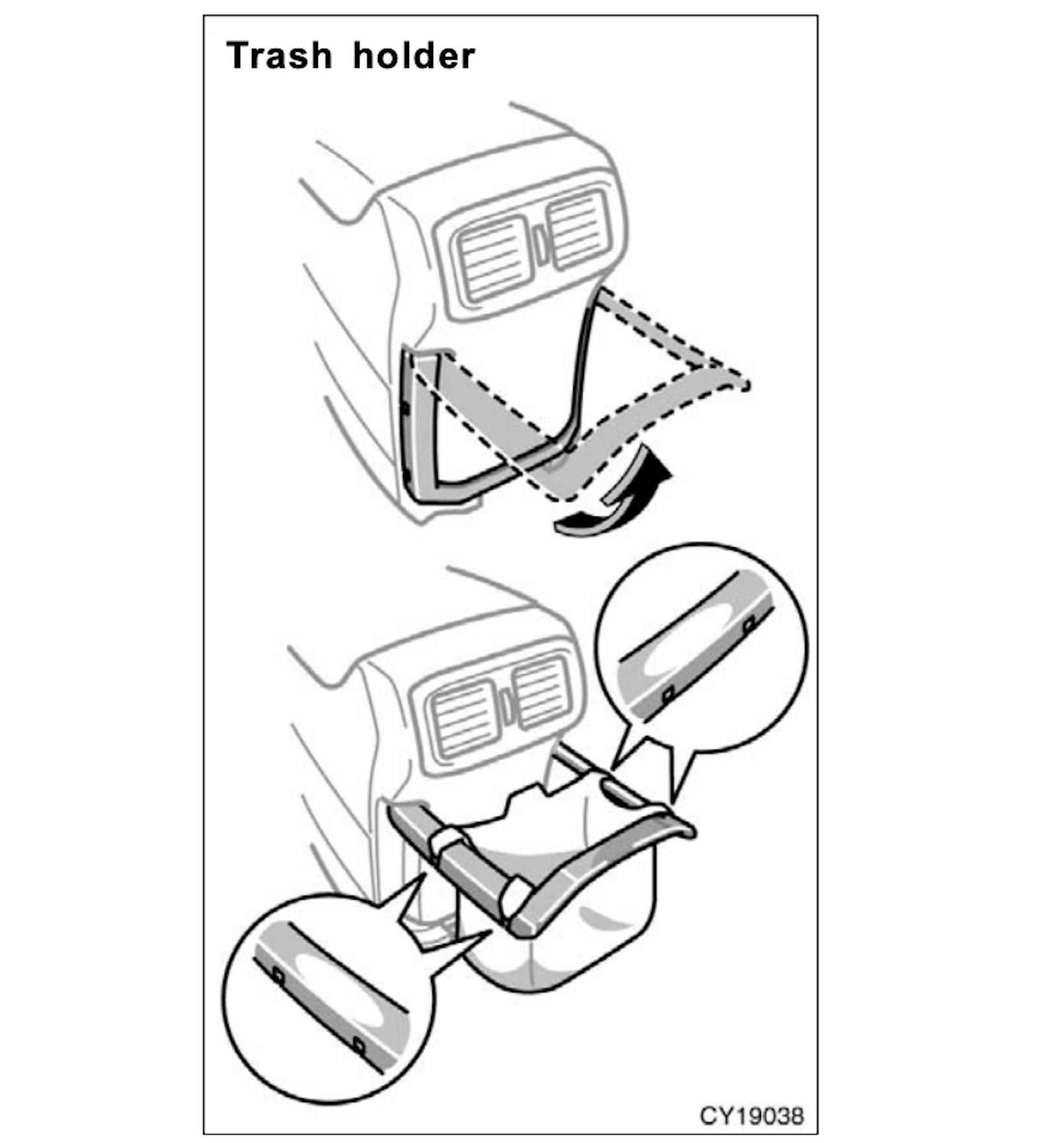
Of course, the second-biggest challenge to eating in a car beyond preventing bits of food from getting everywhere is having a tidy place to store any leftover packaging. Unsurprisingly, Toyota thought of that too. On the back of the center console sat this fold-out hoop with a couple of hooks in it, which seems strange until you approach it with a plastic bag. Yep, it’s a trash holder, and the handles of a plastic bag are meant to fit in the hooks of the hoop. This way, you should be able to avoid having a McDouble wrapped with a melted glob of cheese on it slide deep beneath the front seats to the point where it’s smelled before it’s seen. Oh, and the requirement of a plastic bag prevents any weird residue issues the little bin in the later Volvo XC40 might invite.

2003; Toyota; 4runner
Photo credit: Toyota

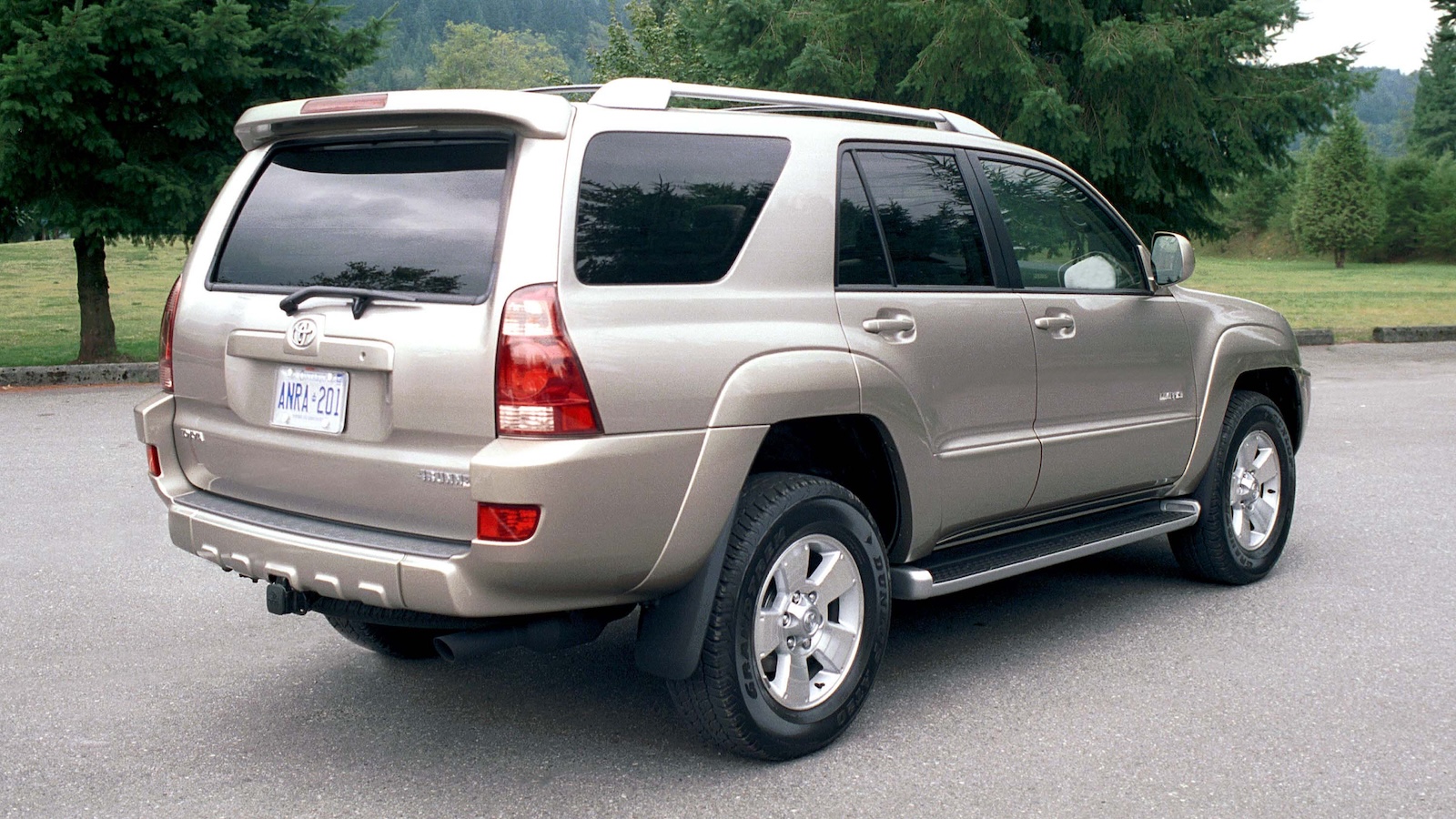
So, shoutout to the 2003 to 2009 Toyota 4Runner for its contributions to the act of dining on the go. While I’d still choose a picnic blanket and a scenic vista whenever convenient, a tray or two does sound nice when it’s absolutely pelting down with rain or snow and the nearest dining room isn’t exactly a place you’d like to be.

Top graphic images: Cars & Bids Bally/Midway

The post How The Fourth-Generation Toyota 4Runner Made A Huge Contribution To In-Car Burger Consumption appeared first on The Autopian.

Read the whole story
LeMadChef
9 hours ago
reply
Denver, CO
Share this story
Delete

Former Google CEO plans to singlehandedly fund a Hubble telescope replacement

1 Comment

Prior to World War II the vast majority of telescopes built around the world were funded by wealthy people with an interest in the heavens above.

However, after the war, two significant developments in the mid-20th century caused the burden of funding large astronomical instruments to largely shift to the government and academic institutions. First, as mirrors became larger and larger to see deeper into the universe, their costs grew exponentially. And then, with the advent of spaceflight, the expense of space-based telescopes expanded even further.

But now the tide may be turning again.

On Wednesday evening, former Google CEO Eric Schmidt and his wife, Wendy, announced a major investment in not just one telescope project, but four. Each of these new telescopes brings a novel capability online; however, the most intriguing new instrument is a space-based telescope named Lazuli. This spacecraft, if successfully launched and deployed, would offer astronomers a more capable and modern version of the Hubble Space Telescope, which is now three decades old.

A billionaire with a keen interest in science and technology, Schmidt and his wife did not disclose the size of his investment in the four telescopes, which collectively will be known as the Schmidt Observatory System. However, it likely is worth half a billion dollars, at a minimum.

"For 20 years, Eric and I have pursued philanthropy to seek new frontiers, whether in the deep sea or in the profound connections that link people and our planet, committing our resources to novel research that reaches beyond what might be funded by governments or the private sector,” Wendy Schmidt said in a statement to Ars. “With the Schmidt Observatory System, we're enabling multiple approaches to understanding the vast universe where we find ourselves stewards of a living planet.”

Essentially the Schmidts have taken innovative telescope concepts that scientists have proposed for government funding and will provide the money needed to build them. Their gift has enormous potential to advance the study of astronomy and astrophysics.

Deep blue

Named for the deep sky blue of the rock Lapis lazuli, Lazuli is an optical space telescope with a mirror diameter of 3.1 meters (by comparison, the primary mirror of the Hubble Space Telescope is 2.4 meters). It is intended to launch as early as late 2028 and begin scientific operations in 2029.

There are some notable differences between Hubble and Lazuli, starting with the orbit. Lazuli will be located much farther from Earth, in an elliptical orbit with an apogee of 275,000 km and a perigee of 77,000 km, the latter distance about twice as high as geostationary orbit. This will afford the telescope a much clearer view than Hubble, located about 500 km above Earth and increasingly affected by the passage of Starlink and other communications satellites in its observations. At this higher altitude the Lazuli team believes it can maintain control of the telescope at all times and have a rapid data downlink.

“We sit on decades of technological developments since Hubble,” said Arpita Roy, lead of the Astrophysics & Space Institute at Schmidt Sciences, in an interview. “Lazuli is a very modern take on Hubble, with a larger mirror, swifter response, and different instruments.”

The instruments are a wide-field camera, a spectrograph, and notably, a coronagraph to blot out the light from stars to reveal the atmospheres and other details of exoplanets orbiting them.
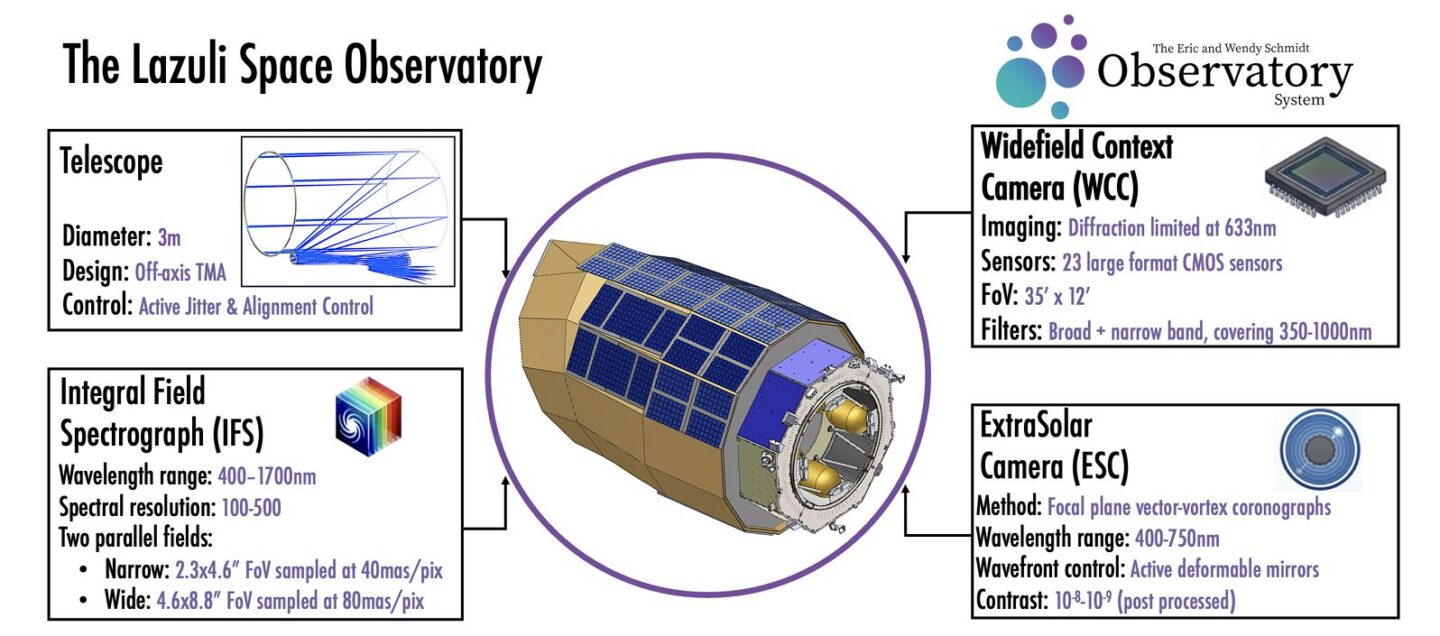
Some specs on the Lazuli space telescope. Credit: Schmidt Observatory System

Schmidt Sciences will act as the overall integrator and manager of the Lazuli project. The president of the philanthropic organization, Stuart Feldman, said he was not ready to disclose the telescope’s primary contractors yet. But he said a key goal of this telescope, and the other three projects, is to move quickly. Moving from a telescope concept to launching hardware in less than five years would be rapid indeed.

Feldman said in an interview that the major space telescopes planned, built, and launched by NASA have tended toward 25-year gestation periods. It is common today for an astronomer to design instruments on observatories that will only be used by their graduate students upon nearing retirement. Moving expeditiously should also better control costs.

Feldman said he had “moderate-high confidence” that deploying and operating Lazuli would be a success. “We are taking far more risks than NASA would be willing to do,” he acknowledged. “But we are doing things rigorously, and aiming for a very high probability of success.”

No privately funded observatory remotely close to Lazuli’s scope has ever been launched into space. If successful, it would be, in many ways, historic.

On the ground

The other three telescopes that will be funded by the Schmidts will be based on the ground, in the southern and western United States, but they are no less innovative than Lazuli. All three of the proposed telescopes are modular and take advantage of recent advances in computing power, storage, and AI processing and analyzing data.

They are:

  • Argus Array: This is an array of 1,200 telescopes with 11-inch mirrors, likely located in Texas, to mimic the effect of an 8-meter optical telescope. It will image the entire Northern Hemisphere sky. Managed by the University of North Carolina, with a company called Observable Space building the telescopes, the Argus Array will be co-funded by the Schmidts and a Russian-born British financial trader named Alex Gerko. It will produce an image every second and capture objects as faint as the 18th or 19th magnitude, Feldman said. Enticingly, it will essentially be able to generate movies of the night sky, allowing astronomers who observe a supernova or other interesting object to rewind 30 minutes, or two hours, to see what happened leading up to the explosion.
  • DSA radio telescope: This will be an array of 1,600 radio dishes, each with an antenna of about 6 meters, located in a valley in Nevada. It is far less expensive to fill a valley with these smaller antennas than to build a single Arecibo-size radio telescope. This project will be managed by the California Institute of Technology and fully funded by the Schmidts. The radio dishes will feed an enormous amount of data and require processing faster than Netflix’s global data stream currently does to map over a billion radio sources in the universe. It will aim to produce a picture of the sky every 15 minutes.
  • LFAST: This instrument will conduct scalable, large-aperture spectroscopy. Likely based in Arizona, a prototype could be deployed by mid-2026. It will contain 20 80cm mirrors in a single rack to provide the equivalent observational power of a 3-meter telescope. Among its capabilities will be to search for biosignatures on other worlds, and it is designed to be expandable over time. It will be led by the University of Arizona and fully funded by the Schmidts.

Modular and affordable

The design of each telescope selected for the Schmidt Observatory System feels very modern. Their designs are enabled by recent developments in the miniaturization of electrical components, more powerful computers, artificial intelligence, lower-cost launch, and other trends.

These telescopes could probably not have been built even five years ago. Feldman said the storage for some of the ground telescopes requires petabytes. AI will be crucial to poring over all of this data to uncover new and novel observations. And prior to the current class of commercial heavy-lift rockets, a telescope had to scrimp on mass and power; but now, with cheaper and brawnier launch, it’s easier just to throw more solar cells on an instrument.

The plan is to freely and openly share data from the telescopes. The Schmidts have emphasized that this is not a commercial project in any way. They will not be selling time on the telescopes. Rather, there will be an open competition for the best scientific ideas and observations to make.

“We are basically providing a gift to the global astronomical community,” Feldman said. “We wish the data to be openly available for all of the instruments.”

The Schmidts’ approach also includes tapping into emerging commercial space companies, such as Observable Space, which is building the Argus Array telescopes.

"The Argus Array's commitment to open data and open science represents a new model for how astronomical discovery should happen," Dan Roelker, CEO of Observable Space, said. "We're excited to partner with the University of North Carolina and Schmidt Sciences to build the more than 1,200 telescopes designed not just for today’s questions, but for discoveries we haven’t imagined yet.”

The Schmidts have been reticent to speak about costs, but Feldman acknowledged that building and launching a space telescope will easily cost in the “hundreds of millions of dollars.” And that’s just one of the four telescopes.

“Putting up a whole valley filled with 20-foot antennas is not child’s play either,” he said. “This is a very significant contribution to astronomy.”

Read full article

Comments


Read the whole story
LeMadChef
9 hours ago
reply
I am in the handful of people who think this is a low key symbol of how terrible this country has become. It's pure evil that one person can launch a telescope into space. This is a clear sign that someone has too much wealth
Denver, CO
Share this story
Delete

https://www.tumblr.com/sandmandaddy69/804382228730757120

1 Comment and 2 Shares
Read the whole story
jhamill
8 days ago
reply
Yes
California
LeMadChef
1 day ago
reply
Denver, CO
Share this story
Delete

dreaminginthedeepsouth:

2 Shares

dreaminginthedeepsouth:

Read the whole story
LeMadChef
1 day ago
reply
Denver, CO
jhamill
6 days ago
reply
California
Share this story
Delete
Next Page of Stories