Code Monger, cyclist, sim racer and driving enthusiast.
10252 stories
·
6 followers

Do Not Buy The War Crime N64

1 Share
Do Not Buy The War Crime N64

Palmer Lucky is an evil fucking worm and dipshit beneficiary of government contracts. He’s the Oculus jackass with a shitty soul patch who runs a military defense company called Anduril. I could continue to talk about the general ways I dislike him on a personal level, but I’ll instead focus on a specific one: He shares many of my hobbies, including an enthusiasm for retro gaming and FPGA hardware. If you see the company ModRetro, know that’s his company. ModRetro recently released an FPGA-based machine in the shape of the N64 called the M64. You do not, under any circumstances, need to buy a war crime N64. 

Do Not Buy The War Crime N64
If I can be super petty for a second: the knob on that thing looks atrocious. You're mixing matte and glossy! Credit: ModRetro.

First let’s just talk about the practical: There’s no shortage of ways to play the N64. You can get original hardware and a CRT or an upscaler like the Retrotink, a piece of hardware that’s made by people who really care. You can also mod an HDMI port into an old N64 if you aren’t a coward. If you want something FPGA-based that plays cartridges, the Analogue 3D works. The Superstation One runs FPGA cores just fine. Or to hell with it, just get a MiSTer or even just download a god-fearing emulator. Nobody needs Palmer Luckey’s evil little device, particularly when the market has never been more saturated. 

This is not the first product ModRetro has put out. They also put an evil Game Boy out, and specifically put one out in “attack drone metal.” I hate these winking little shits. Not only are they using retro gaming to be fascists, they’re doing it in the corniest way humanly possible. 

Former Nintendo of America President Reggie Fils-Aimé took to X, The Everything App twice in one day to signal boost that evil dipshit’s pet project. In the spirit of Hater Week, I’d like to officially state that Reggie can go fuck himself as well. 


Argonaut Games also announced they’d be rereleasing Buck Bumble in collaboration with ModRetro, and immediately got dragged for it in the replies. Buck Bumble can also fuck off.

Do Not Buy The War Crime N64
Credit: Argonautgames on BlueSky

We cannot let these people feel comfortable in our hobby. Even if it’s just on a personal level, I’m sick of seeing them. The Video Game History Foundation’s Frank Cifaldi said it best last December: “I say this with zero irony: if you are even tangentially a part of a retro video game community, it is your civic duty to push back against this company and shun anyone who doesn't. This is fascism tapping gently at the door and as soon as you let it in, it's going to invite its friends.” 

If we do not draw a line somewhere, they will continue to bring their hatred to us. There’s no better time than the present.

Read the whole story
LeMadChef
3 hours ago
reply
Denver, CO
Share this story
Delete

Solving Population Decline Through Science Fiction

1 Comment
Books Science Fiction

Solving Population Decline Through Science Fiction

Real-world solutions might be expensive or politically unpopular, so why not take a page from SF?

By

Published on July 27, 2026

Inherit the Earth cover art by Donato Giancola

Comment 25
Share New Share
cover art for Brian Stableford's Inherit the Earth; art by Donato Giancola (Tor Books, 1998)

Inherit the Earth cover art by Donato Giancola

In 2025, Canada’s population shrank for the first time since Confederation. The reason for this is very subtle: if babies born + immigrants is a smaller number than deaths + emigrants, then the population will shrink. Canada has a low birth rate and we recently turned down the dial on immigration. As a consequence, there are fewer people in Canada in 2026 than there were in 2024. Only mathematicians of the very highest order can easily wrap their minds around equations so arcane, thus we cannot blame the government if they are surprised by the logical outcome of their actions. After all, it isn’t like there’s any precedent for low birth-rate, low immigration nations featuring declining populations.

Generally speaking, governments want their populations to grow because the economy and tax base tend to scale with population. Whether or not population growth is always a good idea is a matter for another essay. Let’s just assume for the moment Canada wants more Canadians1.

Currently there are three obvious options:

Increase the birth rate

There are a number of ways this could be done (subsidizing children, for example, or punishing those who try to avoid having children). Decree 770 provides an example of how well the second one works in practice. Subsidizing babies doesn’t seem to be much more successful, aside from having fewer immediate negative externalities like dead mothers or legions of abandoned babies.

Increase immigration

This is easy to implement and works well enough, although you will want to expand housing accordingly. However, it does encounter the minor issue2 that every nation appears to have a healthy supply of xenophobic racists—often people whose ancestors were themselves targets of xenophobic racism—which means immigration can be a political hot potato.

Decrease emigration

Either convince people not to leave or make it difficult for them to leave. I’m all in favour of the first option, but it might involve wild-eyed socialism such as ensuring sufficient housing, economic opportunities, not having a deranged and heavily armed nation right next door, and so on and so forth—all courses to which federal and provincial governments seem cool. The second requires an impenetrable border. Borders are notoriously penetrable and Canada has so very much border. Plus, the voters are unlikely to react well to being told they cannot leave.

What is a government to do when solutions are difficult to implement and/or come with a lofty political price tag? Turn to speculative fiction for solutions!

Territorial expansion

Canada is no stranger to expansion. The province of Newfoundland and Labrador, for example, is a relatively recent addition. One cannot help but notice that immediately south of the border there are millions of proto-Canadians who would no doubt welcome us as liberators. Nibbling a Detroit here and a New York City there would shore up our population for a very long time.

There is a Canada-specific SF work that comes to mind; Dean Ing’s Systemic Shock, in which Canada annexes the upper third of the US, thus allowing a post-World War IV streamlined America to better focus on its core strengths. I don’t know how many new Canadians we got out of that, given that the territory in question was nuked, irradiated, and sown with bioweapons, but probably not zero…and the irradiated, sickly former Americans seem likely to appreciate single-payer health care more than the Canadians for whom it is not a novelty.

Life extension

Remember babies born + immigrants and deaths + emigrants? Reducing the number of deaths can also result in population growth. Additionally, whereas encouraging (or requiring) more babies and immigrants or fewer emigrants could prove very unpopular, almost nobody objects to the idea of living longer. The extreme case is if everyone is immortal. With no deaths and no emigration, global population can only grow.

This logic played a prominent role in the backstory to Brian Stableford’s Inherit the Earth. Hellier and his allies reasoned that:

If the population had continued to increase, so that nanotech emortality spread through a world that was still vomiting out babies from billions of wombs, nothing could have restrained the negative Malthusian checks.

Thus the engineered wave of apocalyptic pandemics to greatly reduce the human population, especially the poor people3, plus an extra pandemic that sterilized everyone to ensure that the elite who survived were dependent on artificial, easily regulated, reproduction.

This seems an appropriate juncture to acknowledge that many people, especially science fiction authors (as discussed in an earlier article), are somewhat cool on high populations. Still, if not for Hellier and his pals, this setting might have been an unqualified example.

Mass production

Currently, the supply of new locally-produced Canadians is entirely composed of artisanal, handcrafted4 babies, each one of whom requires nine months of hard work by a single labourer5 and then almost two decades of communal effort to turn into an adult. What is this, the Paleolithic? We’ve mechanized, industrialized, and automated so much of modern life. Why not people-making?

SF offers a wide range of options here. For example, Bujold’s uterine replicators (seen in her Vorkosigan books), lend themselves to factory production of babies, although as the author notes, they don’t solve the problem of raising or educating the little tykes.

A more effective approach would produce functional adults, created able to fill their role in the economy, or failing that, would duplicate already existing adults. The Pohl and Williamson-scribed Farthest Star’s misleadingly named tachyon transporter (it was actually a duplicator) would almost qualify, if not for the fact the purposes to which duplicates are put greatly limits their lifespan. A better example would be the fax from Wil McCarthy’s Queendom of Sol series, which could produce as many duplicates as there was matter available from which to construct them.


No doubt there are other possibilities I’ve overlooked. Feel free to mention them in comments below—and for further reading on SFF’s treatment of the issue of population decline, you may want to check out this previous essay.[end-mark]

  1. How many would be ideal? Well, there has to be at least one Canadian for Canadians to exist and even very optimistic estimates of how many humans the Earth can support tend to cap out at about one trillion. The answer is unlikely to be at either extreme. The median is five hundred billion Canadians, which is a nice round number. ↩
  2. Well, two minor issues. Birthrates are falling almost everywhere. How willing will governments be to allow people to leave when everyone is running short of citizens? ↩
  3. Judging by the surnames of the characters in the book, the sufficiently elite seem to have been white Anglophones like their author. What an extraordinary coincidence. ↩
  4. “Handcrafted” isn’t quite accurate, but it is a term Reactor will likely allow to appear in print. ↩
  5. With design input from another person early in the process. ↩

The post Solving Population Decline Through Science Fiction appeared first on Reactor.

Read the whole story
LeMadChef
3 hours ago
reply
I reject the idea that population decline is a bad thing.
Denver, CO
Share this story
Delete

Regular truth v. Jesus truth

1 Share

Here are some nuggets from the Wikipedia page about Victor Marx, the GOP candidate for governor in Colorado:

Marx was born to a man named Karl Marx and a young mother . . .Marx says he is a survivor of child abuse.[7] Marx claimed that at age three, his stepfather forced him to behead a cat and wear its carcass on his head.

Marx alleged that at age seven, his abusive stepfather took him to a rural area of Mendenhall, Mississippi, and made him shoot and kill a man. Mississippi sheriffs and police in the area have said there is no record of any unsolved homicides from that time. Marx claimed he contacted the Federal Bureau of Investigation and the local sheriff’s office, neither of which could solve the case as Marx was unable to provide many details. There is no evidence that Marx ever contacted authorities.[6] Marx mentioned in an interview with Colorado news station 9news that he is unsure how many people he has killed, and that he thinks the exact details do not need to be clarified

Marx founded All Things Possible Ministries in 2003.[11] Marx claimed on his campaign website that All Things Possible rescued 45,000 women and children from abuse, which was later removed from his campaign website after being disproved.[12][8] Marx has since declined to give an exact number of survivors saved in order to not “put people in danger”.[8][9]

As a minister, Marx has said that he routinely exorcised demons from people, individuals he said were possessed due to the influence of porn or unmarried couples living together.[13] In a 2023 podcast, he claimed that he “hunts demons” and recalled a time when his dog identified a demonic presence in a couple resting at a pool where he then exorcised the woman from “five demons that had been assigned to her”.[13]

Marx was reportedly friends with conservative political commentator Charlie Kirk. He has spoken at many Turning Point USA events.

Now if you haven’t accepted Jesus Christ as your personal Lord and Savior all this sounds completely insane — of course it may well sound that way even if you have — but I have a quarter-baked idea here that’s what’s going on is what I’m going to call “Jesus truth,” which is different than regular truth.

Jesus truth is true in an emotional and symbolic, rather than an empirical/factual way. It sounds like Victor Marx had a really rough childhood, and that one way he’s dealt with that is by making up a bunch of crazy-ass stories that he’s told himself and others, and which he’s successfully monetized in the process, because yay America.

Now in the Before Time this kind of thing would usually be preclusive in terms of getting to be a major party’s candidate for governor, even in the ungovernable tribal regions, let alone in an increasingly $38 a pound cheese at Whole Foods state like Colorado. But that was then, this is now, Donald Trump is president, the Republican party has gone completely insane pretty much from top to bottom, and Victor Marx, certifiably crazy person, is going to get 44% of the vote in November. Which is pretty interesting in a somewhat terrifying way.

The post Regular truth v. Jesus truth appeared first on Lawyers, Guns & Money.

Read the whole story
LeMadChef
3 hours ago
reply
Denver, CO
Share this story
Delete

AI firms want more data centers; Trump's EPA may give neighbors less say

2 Shares

The Trump administration is quietly considering a rule change that could make it easier for polluters to build facilities—including certain gas plants and diesel generators that power data centers—with little to no notice to the public.

On Wednesday, the Environmental Protection Agency held a public hearing on a proposed rule change that would hand the power to states to decide how the public participates in the permitting process for certain new sources of air pollution. The proposed rollback comes as data centers face greater pushbackacross the US, with many communities using the permitting process to try to slow down development. Any changes could have major consequences for how ordinary people are given notice about new or expanded polluting facilities coming into their neighborhoods.

“As someone actively working in communities with data centers, I know this to be fundamentally true: People want to have a say,” Vanessa Lynch, a Pennsylvania organizer with Moms Clean Air Force, said at the EPA hearing.

Companies building any kind of facilities that release air pollution are required to get permits under the Clean Air Act. Polluting sources can either be put through a “major” permitting process, meaning that they meet or exceed thresholds for certain pollutants, or a “minor” one for those that don’t.

Major sources of pollution are reviewed by both federal and state regulators and have extensive requirements before and after construction. However, there’s less oversight of minor sources. The scope of what gets permitted as a minor source is extremely broad and can include everything from dry cleaners and auto body shops to to diesel and gas engines. The latter two are increasingly being used to power data centers, with operators such as xAI and Meta using minor source permitting processes to build behind-the-meter gas plants.

The Clean Air Act does require the public to be involved in permitting processes; Congress has specified that major sources need to have several public steps, including a public hearing. EPA rules require some public participation for minor source permits. But thanks to a patchwork of state enforcement laws, that engagement process—and whether state agencies are actually complying with EPA requirements—varies across the US.

If the proposed rule is finalized, “it would put state and local agencies most familiar with local issues in the driver’s seat to determine whether, when, and for how long to provide opportunities for public participation for proposed new minor sources and modifications,” an EPA spokesperson tells WIRED, noting the rule wouldn't alter emissions standards.

These state-by-state differences can make a big difference in how the public gets involved. Keri Powell, an Atlanta-based attorney at the environmental legal advocacy group Southern Environmental Law Center, says that groups like hers often end up taking on cases in states like Georgia, which, she says, has a more robust public notification and participation process for minor sources. Earlier this month, the group alerted the state utility about construction issues at a data center, based on information they’d gotten from the companies’ public air permit applications. But if the EPA removes the federal requirement, community and legal groups in the state could get little to no heads up about upcoming projects and be shut out of participation and review.

“Georgia is an example of a place where I can say I’m concerned,” Powell says.

Sara Lips, the director of communications at Georgia’s Environmental Protection Division, says that the agency is “determining whether proposed federal rule changes would affect the public participation requirements per the state regulations.”

Kentucky also has stronger public participation laws for minor source permits. Byron Gary, a senior attorney at the Kentucky Resources Council, says state agencies have made an “informal commitment” behind the scenes to keep their public participation rules the same, even if the EPA changes its rules. But, he says, that could shift: “Who knows [if] the next administration, whether they would actually change it.”

Texas is an example of what lower levels of engagement look like. The data center boom there has driven a massive buildout of private gas plants, many of which rely on minor pollution permits. The state’s lower levels of enforcement have left some communities living in the shadows of data centers surprised at the scope of fossil fuel infrastructure being installed near their homes.

Since coming into power, the Trump administration has gone all in on artificial intelligence, removing multiple roadblocks for data center development at the federal level. That includes efforts at the EPA, which is working to make the US “the AI capital of the world,” the agency spokesperson says.

Companies are also spending vast sums of money on the data center buildout: Spending on data center construction outpaced spending on public transportation infrastructure for the first time in June. Given that public opposition is creating a new bottleneck for data center development, the timing of the rule revision, Powell says, is probably not an accident.

“I think it's part of a package of rules that the Trump administration is pushing through to make it easier for AI data centers to be constructed,” she says.

This story originally appeared on wired.com.

Read full article

Comments


Read the whole story
LeMadChef
3 hours ago
reply
Denver, CO
Share this story
Delete

Google Earth releases, swiftly retracts AI feature to make fake satellite images

1 Share

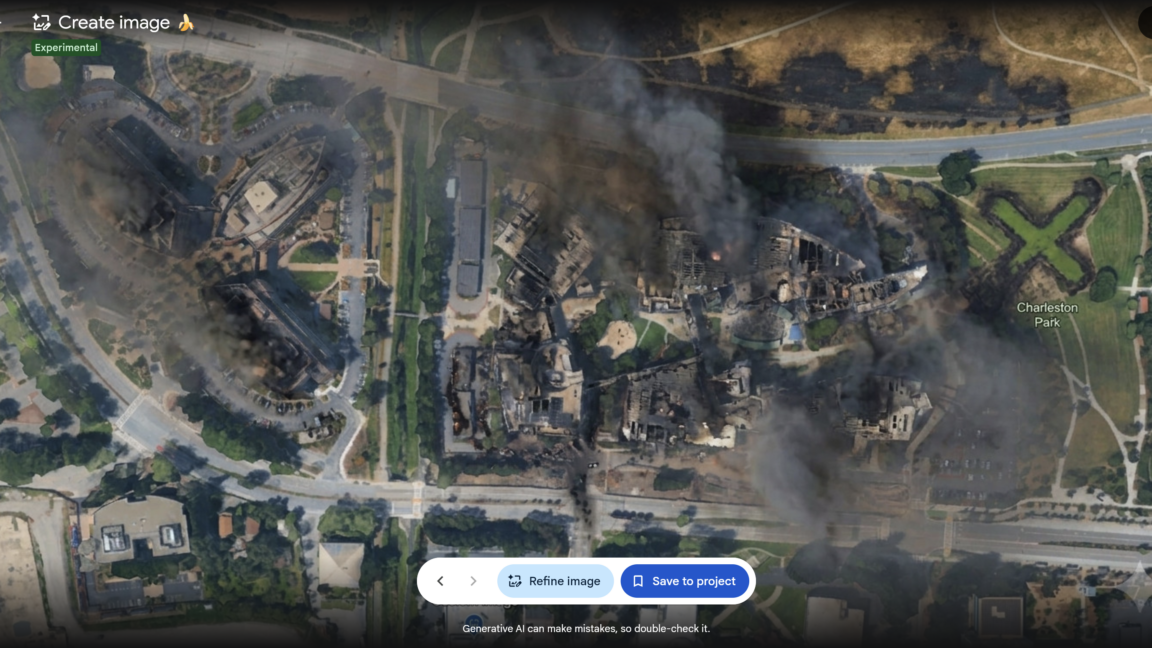
Google briefly allowed anyone to create AI-modified versions of satellite imagery available in Google Earth—before quickly reversing its decision as people shared examples of AI-generated pictures that illustrated the potential for misinformation and disinformation.

There is no shortage of generative AI tools that already allow people to create AI-modified images of real buildings and cities based on user prompts. But Google’s aborted attempt to incorporate its Nano Banana 2 AI image generator as a Google Earth feature made it even easier for anyone to create modified versions of authentic imagery depicting real locations—something that Google boasted about when initially promoting the new feature.

“For the first time, you can generate custom images using Google Earth’s satellite, aerial, and 3D imagery alongside Nano Banana, which creates concepts grounded in the real world,” wrote Bryan Horowitz, product manager for Google Earth, in a company blog post on July 30.

That possibility deeply alarmed researchers, who often use Google Earth to help verify images and videos of locations at a time when AI-generated misinformation and disinformation have become rampant online. They showed how the new feature could simplify the process of creating false scenarios overlaid on Google Earth’s photorealistic imagery.

“Google Earth, a tool often used as a source of satellite imagery to verify photos and videos, has added a feature that allows you to alter satellite imagery with AI, for reasons,” wrote Eliot Higgins, founder of the independent investigative organization Bellingcat, in a Bluesky post responding to the AI feature’s debut.

“No way this could be abused,” Higgins added sarcastically in a follow-up post that featured an AI-modified image made in Google Earth showing a giant golden statue of President Donald Trump looming over the White House.

Within a day, Google announced on the social media platform X that it was rolling back the feature. Shortly afterward, Ars checked and found that the feature was inaccessible to Google Earth users.

Before removing the AI feature, Google had touted its potential to allow Google Earth users to depict completed real estate projects or enable teachers and students to transform the modern-day ruins of Pompeii into a “hyper-realistic view” of what the town looked like in 78 CE under the Roman Empire. But independent researchers immediately gravitated toward the potential for misuse.

“Tonight I typed just one sentence into Google Earth and put refugees near the Mexican border,” wrote Henk van Ess, an independent investigator, in an extensive blog post detailing his concerns on July 30. “Then I planted a nuclear plant in Iran. Then I put a fatal crash on a street in Amsterdam. Google’s own satellite imagery underneath all three. What on earth is Google doing?”

Checking for misinformation

Ess pointed to a previous example of AI-generated misinformation gone viral that used a Google Earth satellite photo of the US Navy’s Fifth Fleet headquarters in Manama, Bahrain. A forger had prompted Google’s Gemini AI assistant to transform a screenshot of that Google Earth image into a false image depicting the aftermath of an Iranian drone strike on the US military base.

The same process that might have taken about six steps could be done “in seconds” with the AI tool built into Google Earth, Ess said.

Before eventually removing the Google Earth feature, Google initially responded to Ess by highlighting its SynthID system that automatically embeds digital watermarks in images generated by Google’s AI tools.

“We take misinformation seriously—every image created with Nano Banana in Google Earth includes the SynthID digital watermark, so if someone is unsure about an image, they can ask the Gemini app or use Lens in Search to see if the image was AI-generated,” according to Google’s post on X on July 30. “In addition, we prevent image creation on harmful topics and are continually updating our protections.”

Previous Ars testing of Google’s SynthID system has shown that Google’s digital watermark can persist despite substantial image edits and data loss. However, Ars also encountered the issue of SynthID limiting image checks to about 10 per day.

When Ars prompted Google’s Gemini app to run a SynthID check on several AI-modified images generated within Google Earth—before Google removed the Google Earth feature—Gemini responded that it had “detected digital watermarking indicating that part or all of this image was generated or edited using Google AI tools.”

But Ess questioned why Google’s policy on preventing the creation of AI-generated images on harmful topics had not stopped him from depicting scenes such as a hospital with a bomb crater in Gaza. He also expressed skepticism about primarily relying on Google’s SynthID watermarking system and Google’s AI tools for verifying whether an image is AI-generated.

“Fakes do not travel as clean files with their credentials intact,” Ess wrote. “They travel as screen recordings, re-encodes, screenshots of screenshots, filmed off somebody’s phone in a hurry.”

Indeed, Google’s SynthID was unable to provide any image verification when Ars used a smartphone camera to take a photo of an AI-altered image made using the Google Earth feature.

Undermining trust

By introducing an AI image generator as a Google Earth feature, Google risked undermining public trust in Google Earth as a reliable reference for providing authentic imagery of the real world, Ess said. It could have also handed an additional excuse to government officials or anyone who wants to deny genuine satellite photos by claiming they were modified or generated entirely by AI tools.

Giving anyone access to an easy tool to create AI-modified satellite imagery could have also made it even harder for journalists and researchers checking misinformation and disinformation. Ess recommended using multiple sources to verify satellite imagery and relying on constantly updated satellite imagery sources such as Europe’s Copernicus Sentinel-2.

Google may have alleviated immediate concerns by deciding to quickly remove the AI tool within Google Earth—but its statement suggested that the company could eventually bring the feature back in the future.

“We’ve seen geospatial professionals using this feature for a range of useful purposes, however we’ve also seen people sharing screenshots of generated imagery that appear to violate our policies,” according to the Google statement. “So we’re rolling back this feature in Google Earth while we work on implementing stronger guardrails.”

Read full article

Comments


Read the whole story
LeMadChef
4 hours ago
reply
Denver, CO
Share this story
Delete

High school defends staying silent while boys made AI nudes of 59 classmates

1 Share

One of the first schools to shut down after students were found making AI nudes of female classmates is now asking a court to toss a lawsuit filed by victims who claimed that the school stayed silent for months while the emboldened boys targeted many more girls.

In a motion to dismiss this week, Lancaster Country Day School (LCDS)—a private K-12 school in Pennsylvania with fewer than 600 students—argued that it was false to say the school never reported the harm to law enforcement. The tip that the school received came from the Pennsylvania Office of the Attorney General, which is itself a law enforcement agency, the filing said.

It’s also false to say the school knew that girls were being targeted, the school argued, because the tip did not mention any specific student victims.

LCDS said that “it looked into the tip as best as their educator training allowed,” but the tip only identified one bad actor and was too vague to identify any potential victims. At no time did the school see the images, and the school maintains that all activity connected to the AI nudes happened off-campus.

Instead of warning all parents that inappropriate AI-generated images were potentially being made, the school only interviewed the boy accused of making the image and his mother. The boy has since pled guilty with another male student but at the time denied making the AI nudes, and the mother provided no more information.

Ultimately, LCDS closed its investigation and shared results with the attorney general, then never heard back. In its motion to dismiss, the school argued that it had no duty to report the images to local police because it’s only required to report tips on actual child abuse, and AI images don’t qualify as that in the state, at least not yet.

An attorney representing the school, Rory Connaughton of Saxton Stump, told Ars that “it is impossible to assert that the school failed to report to law enforcement when law enforcement provided the tip to the school and the school reported back to law enforcement.”

“The Attorney General’s office had the discretion and legal authority to refer this matter to the local police or conduct its own investigation,” Connaughton said. “That it did not use its investigative authority or refer the matter to the local police when armed with the same information available to Lancaster Country Day School, makes clear that the school acted properly and did not fail to fulfill any legal duty.”

Ars could not reach the attorney general to comment, but a spokesperson told a local news site, Lancaster Online, that the office “does not investigate information provided in tips. Rather, the information is passed along to the relevant school and/or police to investigate the information provided.”

"Boys will be boys," school head allegedly said

Girls suing the school argued that at least 59 girls were traumatized by “an extended, catastrophic institutional failure.” They claimed that they “were forced to go to high school while ‘deepfake’ nude images of them were circulating within the school community,” and that appallingly, Lindsay Deibler-Wallace, assistant head of Upper School, took no action to protect them after telling parents that “boys will be boys.”

The victims alleged that the school never suspended the students even after “the LCDS upper school was in a state of acute panic and disruption related to the AI-generated images.” Instead, the school allegedly discouraged girls from going to police, while withholding information from parents and obstructing efforts to investigate the distribution of AI-generated child sex abuse materials (CSAM), such as by refusing to respond to detectives seeking a yearbook photo for comparison.

Two male students have since pleaded guilty to 59 felony counts of sexual abuse of children, and their victims are hoping the court will rule that LCDS was required to report the incident to police, both by law and by “reasonable institutional practice.”

Ars could not reach the victims’ lawyer for comment. However, their lawsuit emphasized that on top of emotional harms, girls targeted were also “effectively deprived” of “equal access to the educational opportunities and benefits provided by LCDS." They've further accused the school of violating Title IX by being “deliberately indifferent” to sexual harassment that was “severe, pervasive, and objectively offensive.”

Gaps in laws may let school off the hook

Notably, another Pennsylvania school coping with AI-generated nudes on its campus did report the incident to police, according to a press release from lawmakers pushing to update the state’s law to ensure that schools always immediately report AI nudes.

In that case, a middle school student targeted 11 female classmates in deepfake images, and the school delayed contacting police until after concluding its own internal investigation.

State lawmakers argued that schools should not be delaying reporting AI nudes until their own probes end but rather should be required to promptly tip off police, who are better positioned to investigate the crimes.

Troublingly, delays in reporting can result “not only in lost evidence,” but also cause “significant trauma to the female victims,” whose images may spread further the longer the harm goes unchecked.

The press release said that lawmakers were motivated to close a loophole in a law defining child abuse that doesn’t explicitly mention AI-generated CSAM.

“This bill will make certain that law enforcement is notified at the earliest possible moment, and it makes other changes that put the wellbeing and safety of our children first,” the press release said. But that bill is not yet law, LCDS said, and is currently under review by the state Senate.

In LCDS’s motion to dismiss, the school claimed that the very fact that lawmakers are moving to update the law is proof that it had no legal obligation to report the vague tip that it received.

Specifically, they argued that “child-on-child” incidents such as these are not legally defined as abuse, since using AI to sexualize images of young girls is not among current child-on-child exceptions, such as rape or indecent exposure. To add weight to this defense, they cited Lancaster County District Attorney Heather Adams’ decision not to charge the school “for failing to report the AI-generated content, because possession and dissemination of AI pornography did not fall under crimes defined as child abuse.”

However, it’s unclear if that argument will hold up, since the students who made the images admitted to 59 counts of sexual abuse of a child, and the court will surely consider that. As punishment, the boys were ordered to “serve probation and perform 60 hours of community service each,” Lancaster Online reported. In their complaint, victims argued that “the tip described conduct constituting child sexual abuse" under state and federal laws—"specifically, the production and/or possession of child sexual abuse material involving minor students.”

School accused of aiding spread of AI nudes

LCDS’s attorney told Ars that only the students are criminally liable for the images and that the court should agree to leave the school out of the fight since the only alleged connection is that the boys were their students.

“What Student Plaintiffs do not allege, at any point in the Complaint, is that the images were shared in school, during school hours, or using school equipment or a school Internet connection,” LCDS’s filing said. “The sole nexus to LCDS in the Complaint is that the Student Plaintiffs and the harassers were all students of the school, but that is not enough to survive a motion to dismiss.”

Although gaps in the law may help the school escape the AI nudes scandal, its motion to dismiss did suggest that the court may not grant every demand in their filing. On aiding and abetting claims, the motion to dismiss noted that case-law is “split,” which means an unfriendly judge could side with students and leave the school on the hook for at least some liability for negligence.

However, if the judge doesn’t lean their way, LCDS argued that victims still can’t argue that the school knew the images existed or intentionally helped facilitate their spread, which the school thinks should be fatal.

For victims, the school’s response coolly denying it could have intervened sooner is likely unsurprising but still jarring. Their complaint alleged that after it became clear that the AI nudes described in the tip were real, the school failed to “provide adequate support, counseling, and resources to the victims following the abuse,” allegedly negligently inflicting emotional distress at the time when girls felt most vulnerable walking the halls.

Read full article

Comments



Read the whole story
LeMadChef
4 hours ago
reply
Denver, CO
Share this story
Delete
Next Page of Stories