Code Monger, cyclist, sim racer and driving enthusiast.
9921 stories
·
6 followers

Things upcoming

2 Shares

So: I've had surgery on one eye, and have new glasses to tide me over while the cataract in my other eye worsens enough to require surgery (I'm on the low priority waiting list in the meantime). And I'm about to head off for a fortnight of vacation time, mostly in Germany (which has the best Christmas markets) before coming home in mid-December and getting down to work on the final draft of Starter Pack.

Starter Pack is a book I wrote on spec--without a contracted publisher--this summer when Ghost Engine just got a bit too much. It's a spin-off of Ghost Engine, which started out as a joke mashup of two genres: "what if ... The Stainless Steel Rat got Isekai'd?" Nobody's writing the Rat these days, which I feel is a Mistake, so I decided to remedy it. This is my own take on the ideas, not a copy of Harry Harrison's late 1950s original, so it's a bit different, but it's mostly there now and it works as its own thing. Meanwhile, my agent read it and made some really good suggestions for how to make it more commercial, and "more commercial" is what pays the bills so I'm all on board with that. Especially as it's not sold yet.

Ghost Engine is still in progress: I hit a wall and needed to rethink the ending, again. But at least I am writing: having working binocular vision is a sadly underrated luxury--at least, it's underrated until you have to do without it for a few months. Along the way, Ghost Engine required me to come up with a new story setting in which there is no general AI, no superintelligent AI, no mind uploading to non-biological substrates, and above all no singularity--but our descendants have gone interstellar in a big way thanks to that One Neat Magictech Trick I trialed in my novella Palimpsest back in 2009. (Yes, Ghost Engine and Starter Pack are both set very loosely in the same continuum as Palimpsest. Or maybe it's more accurate to say that Palimpsest is to these new novels what A Colder War was to the Laundry Files.) So I finally got back to writing far future wide screen space opera, even if you aren't going to be able to read any of it for at least a year.

Why do this, though?

Bluntly: I needed to change course. After the US election outcome of November 2024 it was pretty clear that we were in for a very bumpy ride over the next few years. The lunatics have taken over the asylum and the economy is teetering on the edge of a very steep precipice. It's not just the over-hyped AI bubble that's propping up the US tech sector and global stock markets--that would be bad enough, but macro policy is being set by feces-hurling baboons and it really looks as if Trump is willing to invade Central America as a distraction gambit. All the world's a Reality TV show right now, and Reality TV is all about indulging our worst collective instincts.

It's too depressing to contemplate writing more Laundry Files stories; I get email from people who read the New Management as a happy, escapist fantasy these days because we've got a bunch of competent people battling to hold the centre together, under the aegis of a horrific ancient evil who is nevertheless a competent ancient evil. Unfortunately the ancient evil wins, and that's just not something I want to explore further right now.

I'm a popular entertainer and it seems to me that in bad times people want entertainments that take them out of their current quagmire and offers them escape, or at least gratuitous adventures with a side-order of humour. I'm not much of an optimist about our short-term future (I don't expect to survive long enough to see the light at the end of the tunnel) so I can't really write solarpunk or hopepunk utopias, but I can write space operas in which absolutely horrible people are viciously mocked and my new protagonists can at least hope for a happy ending.

Upcoming Events

In the new year, I've got three SF conventions planned already: Iridescence (Eastercon 2026), Birmingham UK, 3-6 April: Satellite 9, Glasgow, 22-24 May: and Metropol con Berlin (Eurocon 2026), Berlin, 2-5 July. I'm also going to try and set up a reading/signing/book launch for The Regicide Report in Edinburgh; more here if I manage it.

As during previous Republican presidencies in the USA it does not feel safe to visit that country, so I won't be attending the 2026 worldcon. However the 2027 world science fiction convention will almost certainly take place in Montreal, which is in North America but not part of Trumpistan, so (health and budget permitting) I'll try to make it there.

(Assuming we've still got a habitable planet and a working economy, which kind of presupposes the POTUS isn't biting the heads off live chickens or rogering a plush sofa in the Oval Office, of course, neither of which can be taken for granted this century.)

Read the whole story
LeMadChef
1 hour ago
reply
Denver, CO
Share this story
Delete

From Cloudwashing to O11ywashing

1 Share

I was just watching a panel on observability, with a handful of industry executives and experts who shall remain nameless and hopefully duly obscured—their identities are not the point, the point is that this is a mainstream view among engineering executives and my head is exploding.

Scene: the moderator asked a fairly banal moderator-esque question about how happy and/or disappointed each exec has been with their observability investments.

One executive said that as far as traditional observability tools are concerned (“are there faults in our systems?”), that stuff “generally works well.”

However, what they really care about is observing the quality of their product from the customer’s perspective. EACH customer’s perspective.

Nines don't matter if users aren't happy
Nines don’t matter if users aren’t happy

“Did you know,” he mused, “that there are LOTS of things that can interrupt service or damage customer experience that won’t impact your nines of availability?”

(I begin screaming helplessly into my monitor.)

“You could have a dependency hiccup,” he continued, oblivious to my distress. “There could be an issue with rendering latency in your mobile app. All kinds of things.”

(I look down and realize that I am literally wearing this shirt.)

He finishes with,“And that is why we have invested in our own custom solution to measure key workflows through startup payment and success.”

(I have exploded. Pieces of my head now litter this office while my headless corpse types on and on.)

It’s twenty fucking twenty five. How have we come to this point?


Observability is now a billion dollar market for a meaningless term

My friends, I have failed you.

It is hard not to register this as a colossal fucking failure on a personal level when a group of modern, high performing tech execs and experts can all sit around a table nodding their heads at the idea that “traditional observability” is about whether your systems are UP👆 or DOWN👇, and that the idea of observing the quality of service from each customer’s perspective remains unsolved! unexplored! a problem any modern company needs to write custom tooling from scratch to solve. 

This guy is literally describing the original definition of observability, and he doesn’t even know it. He doesn’t know it so hard that he went and built his own thing.

You guys know this, right? When he says “traditional observability tools”, he means monitoring tools. He means the whole three fucking pillars model: metrics, logging, and tracing, all separate things. As he notes, these traditional tools are entirely capable of delivering on basic operational outcomes (are we up, down, happy, sad?). They can DO this. They are VERY GOOD tools if that is your goal.

But they are not capable of solving the problem he wants to solve, because that would require combining app, business, and system telemetry in a unified way. Data that is traceable, but not just tracing. With the ability to slice and dice by any customer ID, site location, device ID, blah blah. Whatever shall we call THAT technological innovation, when someone invents it? Schmobservability, perhaps?

So anyway, “traditional observability” is now part of the mainstream vernacular. Fuck. What are we going to do about it? What CAN be done about it?

From cloudwashing to o11ywashing

I learned a new term yesterday: cloudwashing. I learned this from Rick Clark, who tells a hilarious story about the time IBM got so wound up in the enthusiasm for cloud computing that they reclassified their Z series mainframe as “cloud” back in 2008. 

(Even more hilarious: asking Google about the precipitating event, and following the LLM down a decade-long wormhole of incredibly defensive posturing from the IBM marketing department and their paid foot soldiers in tech media about how this always gets held up as an example of peak cloudwashing but it was NOT AT ALL cloudwashing due to being an extension of the Z/Series Mainframe rather than a REPLACEMENT of the Z/Series Mainframe, and did you know that Mainframes are bigger business and more relevant today than ever before?)

(Sorry, but I lost a whole afternoon to this nonsense, I had to bring you along for the ride.)

Rick says the same thing is happening right now with observability. And of course it is. It’s too big of a problem, with too big a budget: an irresistible target. It’s not just the legacy behemoths anymore. Any vendor that does anything remotely connected to telemetry is busy painting on a fresh coat of o11ywashing. From a marketing perspective, It would be irresponsible not to.

How to push back on *-washing

Anyway, here are the key takeaways from my weekend research into cloudwashing.

  1. This o11ywashing problem isn’t going away. It is only going to get bigger, because the problem keeps getting bigger, because the traditional vendors aren’t solving it, because they can’t solve it.

  2. The Gartners of the world will help users sort this out someday, maybe, but only after we win. We can’t expect them to alienate multibillion dollar companies in the pursuit of technical truth, justice and the American Way. If we ever want to see “Industry Experts” pitching in to help users spot o11ywashing, as they eventually did with cloudwashing (see exhibit A), we first need to win in the market.
    How to Spot Cloudwashing
    Exhibit A: “How to Spot Cloudwashing”

  3. And (this is the only one that really matters.) we have to do a better job of telling this story to engineering executives, not just engineers. Results and outcomes, not data structures and algorithms.

    (I don’t want to make this sound like an epiphany we JUST had…we’ve been working hard on this for a couple years now, and it’s starting to pay off. But it was a powerful confirmation.)

Talking to execs is different than talking to engineers

When Christine and I started Honeycomb, nearly ten years ago, we were innocent, doe-eyed engineers who truly believed on some level that if we just explained the technical details of cardinality and dimensionality clearly and patiently enough to the world, enough times, the consequences to the business would become obvious to everyone involved.

It has now been ten years since I was a hands-on engineer every day (say it again, like pressing on a bruise makes it hurt less), and I would say I’ve been a decently functioning exec for about the last three or four of those years. 

What I’ve learned in that time has actually given me a lot of empathy for the different stresses and pressures that execs are under. 

I wouldn’t say it’s less or more than the stresses of being an SRE on call for some of the world’s biggest databases, but it is a deeply and utterly different kind of stress, the kind of stress less expiable via fine whiskey and poor life choices. (You just wake up in the morning with a hangover, and the existential awareness of your responsibilities looming larger than ever.)

This is a systems problem, not an operational one

There is a lot of noise in the field, and executives are trying to make good decisions that satisfy all parties and constraints amidst the unprecedented stress-panic-opportunity-terror of AI changing everything. That takes storytelling skills and sales discipline on our part, in addition to technical excellence.

Companies are dumping more and more and more money into their so-called observability tools, and not getting any closer to a solution. Nor will they, so long as they keep thinking about observability in terms of operational outcomes (and buying operational tools). Observability is a systems problem. It’s the most powerful lever in your arsenal when it comes to disrupting software doom spirals and turning them into positive feedback loops. Or it should be.

As Fred Hebert might say, it’s great you’re so good at firefighting, but maybe it’s time to go read the city fire codes.

Execs don’t know what they don’t know, because we haven’t been speaking to them. But we’re starting to.

What will be the next term that gets invented and coopted in the search to solve this problem?

Where to start, with a project so big? Google’s AI says that “experts suggest looking for specific features to identify true cloud observability solutions versus cloudwashed o11ywashed ones.”

I guess this is a good place to start as any: If your “observability” tooling doesn’t help you understand the quality of your product from the customer’s perspective, EACH customer’s perspective, it isn’t fucking observability. 

It’s just monitoring dressed up in marketing dollars.

Call it o11ywashing.

Read the whole story
LeMadChef
1 hour ago
reply
Denver, CO
Share this story
Delete

All The Cava In Spain

1 Share

On Tuesday, November 4th, Zohran Mamdani won the New York City mayoral race, by A LOT.

He did this because he was/despite being a brown Muslim immigrant socialist who openly and actively supports everything Ezra Klein and his ilk told us we should probably just give up in order to win elections against creepy men supported by billionaires and Nazis.

We do not, it appears, have to do this. We probably don’t have to be excited about candidates with Nazi tattoos either.

I was sorry we were not still in New York when the news broke, because I heard that people were shouting and crying and popping bottles on the streets there, I heard that Not Like Us was playing at the victory party, I heard there was a lot of joy.

I felt a lot of joy myself, and I almost cracked open the bottle of champagne that has been patiently waiting in our fridge since early September, even though that bottle is actually waiting for some other event. But Max didn’t want to drink champagne and actually I had to fluff him up to feel excitement and joy about the election results at all.

“Well, this is good but people are going to get disappointed when it turns out he can’t actually do all that shit in his platform” is the paraphrase of his general mood.

IT STILL MATTERS, THOUGH, I said to him. We still get to be overjoyed that a long-shot socialist candidate mobilized a million people, got an entire nation excited about him, kicked Andrew Cuomo’s ass, scared the shit out of the billionaires, freaked out Alan Dershowitz so much that Dershowitz said he would blow his own brains out if Mamdani won — okay, no, since I bother to fact-check my newsletters by hand, unfortunately that is not true, he did not say that — and came out swinging for policies that, whether or not he can deliver on every single one of them, are the RIGHT policies, are some of the basics on which a livable NYC for everybody must be built, are not too much to ask for, are the very beginnings of imagining a future in which oligarchs, demagogues, and fascists are defeated, in which profit, cruelty, and control are not the gods before which we all must bend the knee and be broken.

Hmm, that was one long-ass sentence.

Anyways, so Max agreed we were allowed to be joyful in this moment, WHATEVER COMES NEXT. And we toasted the moment with a delightful orange wine, and we left the bottle of champagne unopened in the fridge.

&&&

“What about this champagne, Amy? You keep mentioning it.”

Okay, I’m gonna try to lay out the argument here.

The bottle of champagne is in the fridge so we can break it open when Trump dies.

I don’t know when this will be. I do know that, whatever the live-forever grifters tell the oligarchs who are afraid to die —

and even though I don’t believe in hell, if I were those guys, I’d probably be pretty scared to die anyways, because Pascal’s wager takes on a different magnitude when you’re actually a monumental macro-villain —

and I’m pretty sure Dante would boot out one of the guys that Satan has in his three mouths or else grow Satan some extra mouths to make room —

I do know, despite the Bryan Johnson-sponsored nighttime-erection internet-of-things cock ring, despite blood boys and on-demand magnesium infusions, despite preventative full-body MRIs —

I do know that everyone dies.

Everyone. Every single person in the history of the world has died. Even Henry Kissinger died, although it took him an excruciatingly long time. This means that Donald Trump will die.

And when Donald Trump dies, whenever that is, I want a bottle of bubbly already chilled so I can celebrate.

&&&

Yes, I said that. I will celebrate when Donald Trump dies. I celebrated when Henry Kissinger died. Not with champagne, but with memes, as the internet does.

When Trump dies, I want champagne. I want memes. I want people shouting and dancing in the street. I want “Ding Dong the Witch is Dead” playing on repeat from everyone’s apartment windows. I want bonfires of Donald Trump presidential portraits torn down from post office walls.

And I want all of those motherfuckers still in charge when he dies, if he dies in office, to know that he was hated, that Dante would have shoved Donald Trump up one of Satan’s assholes, where Satan’s asshole teeth will endlessly chew him up and shit him out, only to hoover that shit back in again and start the whole process all over, endlessly, for eternity.

Hell, I’ll write that Dante fanfic myself.

Blake's Dante https://upload.wikimedia.org/wikipedia/commons/thumb/9/97/Illustrations_to_Dante%27s_Divine_Comedy%2C_object_72_Butlin_812-69_recto_Lucifer.jpg/500px-Illustrations_to_Dante%27s_Divine_Comedy%2C_object_72_Butlin_812-69_recto_Lucifer.jpg
Blake’s Dante, via Wikipedia

&&&

I understand that in the current environment it is risky for me to say these things. But, well, I can’t be fired, because I don’t currently have an employer, and I would like to clarify that these views are my own, that even the champagne taking up space in the fridge is entirely my idea, that no one else is responsible for my Dante fanfic.

&&&

The champagne, specifically, became a Thing when the internet started its first round of “Is Dear Leader dead?” over Labor Day weekend, 2025, when he was briefly AWOL. There was wild speculation. There were conspiracy theories. There were Weekend At Bernie’s memes. Amongst people I spoke with about this, there were mixed feelings: yes it would be great if that motherfucker would just stroke out and die (recent speculation on Trump’s obvious and continuing health problems suggests he may have had a stroke that weekend he was missing), but we’d still be stuck with all these other cartoon villains, of which I offer this very incomplete list: JD Vance, Russ Vought, Peter Thiel, Mark Zuckerberg, Elon Musk. Stephen Miller, Steve Bannon. RFK, Jr.

These men have collectively done an immense amount of damage to the entire fucking world, such that it’s hard to know which of them will go down in history as the biggest mass murderer of the 21st century — Satan will eventually need to grow a lot of new assholes — and if Trump dies in office these guys will still be in power.

Nevertheless, Trump’s death in office would be a tremendous moment of possibility, what the ancient Greeks used to call a kairos.

This is because he has no adequate succession plan. He is too stupid and too narcissistic to groom someone for that role or allow someone else to be actively groomed for that role in his presence. Of course JD Vance is angling for it, but JD Vance, even if he divorces his heathen wife and marries Erika Kirk, a blond Christian woman (another internet rumor), does not have the charisma that Donald Trump has.

No, I don’t personally think Donald Trump is charismatic. But I know that his kind of charisma works for a uncomfortably large minority of humans living in the United States, and I know that there is no other US-based fascist right now who has that kind of charisma.

Don’t just take it from me, take it from Steve Bannon, who just the other day said:

Look, we have to understand that if we don’t do this to the maximum—the maximalist strategy—now, with a sense of urgency, and in doing this, seize the institutions... if we don’t do this now, we’re going to lose this chance forever, because you’re never going to have another Trump. [emphasis added]

There will be disarray when Trump dies. There will be chaotic power struggles. Factions will factionalize even more. People who feared Trump’s wrath may become bolder, or at least fear other peoples’ wrath instead. If we as dissidents continue to organize, to grow our own power, then we will be more ready to seize that moment.

And, I submit, the more of us who are out there in the streets popping bottles and dancing like the Berlin Wall just fell, the more likely this is to happen.

Which is to say, put a bottle of your favorite bubbly in your fridge, and get ready to party.

&&&

This was actually supposed to be a historical essay about Generalissimo Francisco Franco, who was the fascist dictator of Spain for 36 years until his death in office in 1975, but whose anointed successor, Juan Carlos de Borbón, the grandson of the last king of Spain, turned out not to be especially committed to Francoist fascism, and instead worked with the opposition to transition Spain to democracy, albeit flawed.

I knew almost nothing about Franco before a casual remark someone (I can’t remember who) made during the Labor Day death watch.

“When Franco died,” they told me, “it was said that the people drank all the cava in Spain.”

I latched on to “all the cava in Spain” because it is an incredible image — a people released from bondage to an evil person celebrating that release so determinedly and excessively that they used up all the traditional celebratory beverage in the country. I imagine Spaniards asking Frenchmen to drive some cases of champagne over for them, asking the Italians to send their prosecco, we are out of the celebration beverage, send more, we are not done celebrating.

With this sparkling image in my head I went looking for more information about this event, about Franco himself, and about what happened after his death.

I looked specifically for news articles about the reaction to Franco’s death by the people, and unfortunately I found nothing to suggest that all the cava in Spain had in fact been drunk that week. Of course many people quietly celebrated, in some places more than others — The New York Times reported that “In such contentious regions as Catalonia and the Basque country, champagne bottles were opened in private to toast a long‐awaited opportunity for change.” But Spain did not run out of cava.

Plenty of people were still afraid. This was a consolidated fascist government that had ruled from 1939, when, with Hitler’s assistance, they won the Spanish Civil War. The idea that it might just go away must have seemed impossible. And yet, it did.

Franco was not a dumb man and he ruled for a long time. Unlike Trump, he was concerned with succession and he had chosen his longtime right-hand man and Opus Dei fanatic, Luis Carrero Blanco, as his successor.

In his Christmas 1969 speech, Franco said, regarding the succession, “Everything is tied down, securely tied down.” 1

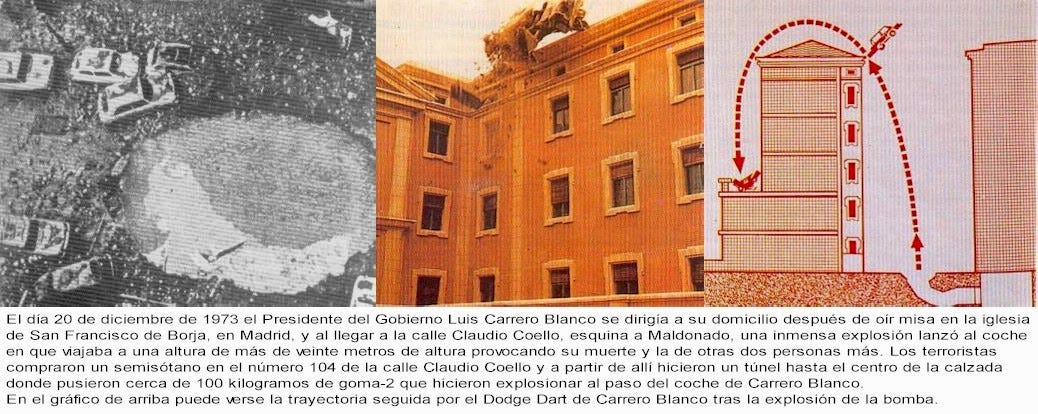
Blanco became Prime Minister in June of 1973. In December 1973, he was assassinated by Basque Separatists in a dramatic car bombing in Madrid. It is well worth reading the Wikipedia entry on this bombing, which includes a statement about the bombers’ reasons as well as the information that many Spaniards quietly approved of and joked about it, saying Blanco had become “Spain’s first astronaut,” because the bombing threw the car spectacularly far into the air.

Thus, in 1973, Franco, his health failing, was left without a successor.

Nothing was tied down, after all.

&&&

In the summer of 1975, pressed for time, he tapped Juan Carlos for the role. Juan Carlos swore loyalty to the principles of Francoism and parliament appointed him as Franco’s successor. Franco died, finally, as all men do, on November 20th, 1975, and Juan Carlos was crowned two days later.

Immediately upon his death, dissident political parties (all illegal under Franco) released statements demanding change. A group of dissidents in the military, several of whom were then under arrest, released a statement insisting that the crowning of Juan Carlos should not occur without the agreement of the people. In his speech at his coronation, Juan Carlos was conciliatory.2

By 1977 political prisoners had been released and those who had fled in exile were allowed to return home. The first free parliamentary elections since 1936 were held in June 1977.

And, by the end of 1978, a new constitution had been ratified and Juan Carlos had signed it. Francoism was over.

&&&

Obviously the story is a little more complicated than that; stories always are. Spanish democracy is not perfect; one fascinating little tidbit I found during my Franco research was “the Cassandra Case”: the story of a young woman who made a series of tweets between 2013 and 2016 playing on the ‘Spain’s first astronaut’ joke about Carrero Blanco’s death. In 2017 she was convicted of “extolling terrorism,” although the conviction was later overturned. I came across this story not long after the assassination of Charlie Kirk, and it’s one reason I didn’t write this essay back in September when I was first digging into the Franco stuff.

And, whether or not Francoism is truly over is still a site of debate. When I started down the Franco rabbit hole, besides old news articles and Wikipedia entries, I also did my favorite research trick and looked up college course syllabi on modern Spanish history to see what the readings were. Most of them were in Spanish, unsurprisingly, but I found a book called Exhuming Franco: Spain’s Second Transition, and I was able to check it out from the Boston Public Library.3

Anyways this is a whole book about the legacy of Francoism in modern Spain, and it’s a pretty interesting on how one country responded to its fascist past, what was buried and what was revealed, and how people felt about it forty years later.

Despite these complications, Franco’s death really did usher in an era of greater freedom. Under Franco hundreds of thousands of people were murdered, sent into exile, or held as political prisoners. And, a brand new constitution is no small thing. (We sure as hell could use one here in the US, because ours sucks.)

A NY Times article on the 2nd anniversary of Franco’s death in 1977 writes “The bitterness of the extreme right was apparent in the speeches at today’s rally. Blas Pinar, head of the New Force Party, said: “Forty years of Spanish history were built up by Francisco Franco and this Government has destroyed it in two years.”

&&&

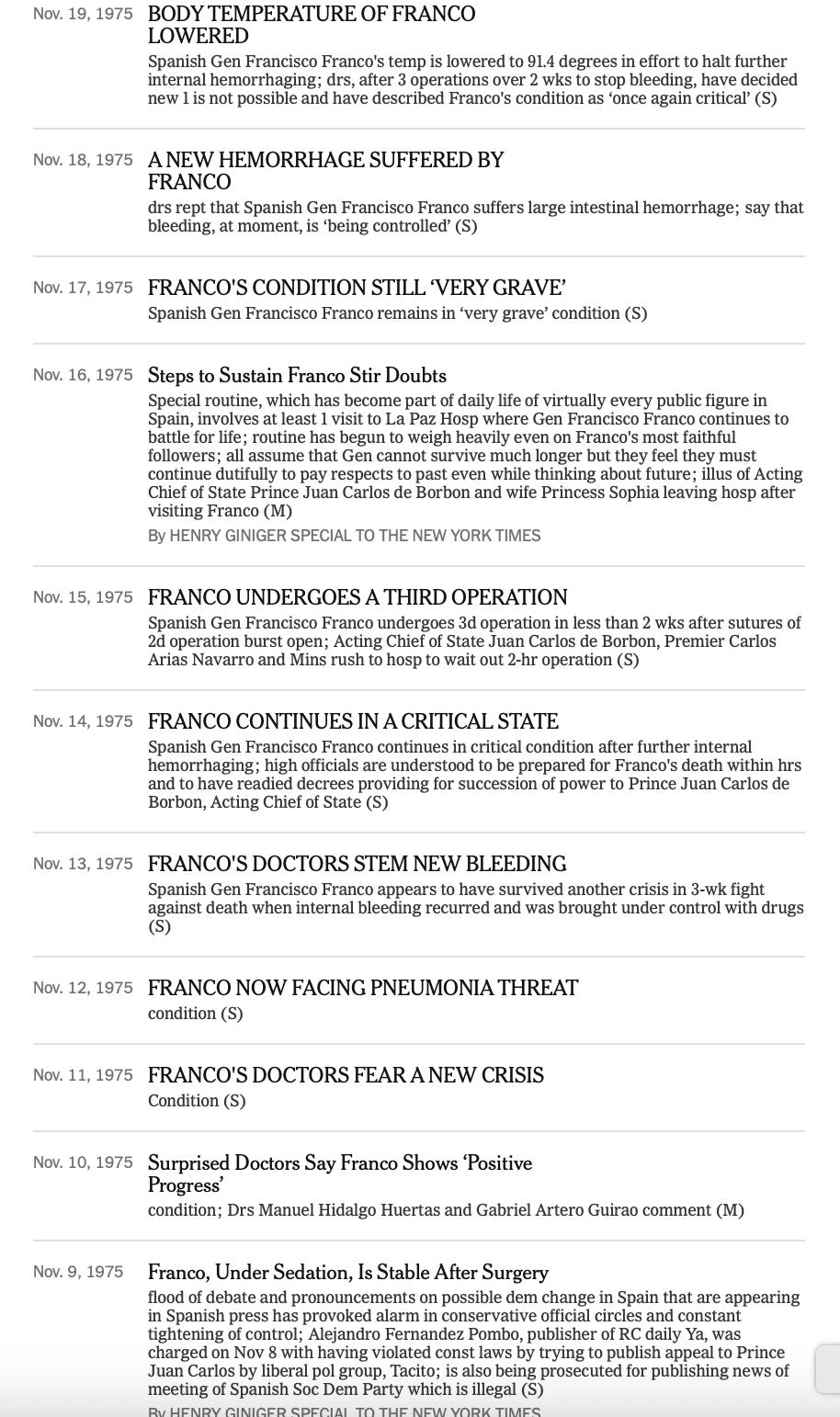
When digging into Franco’s death, I found article upon article upon article in the New York Times, going back decades, reporting on his state of health, sickness, or definitely-not-sickness.

In the last couple of months before his death, his state was followed so closely that it reached absurd levels; please enjoy this screenshot from the last 10 days of New York Times coverage, and feel free to scroll through decades of their coverage on his health here.

Then, upon his death, we get this report from the Times:

General Franco died after a tenacious five‐week battle during which he was repeatedly described as showing unexpected strength. In the final medical bulletin a team of 32 doctors, who had resorted to extraordinary measures, including three operations and reduced body temperature, to keep their patient alive, indicated that they had continued to seek to revive him to the last.

The final clinical diagnosis included Parkinson’s disease, acute miocardial infarction, acute digestive ulcers with repeated massive hemorrhaging, peritonitis, acute kidney failure, thrombophlebitis of the left thigh, bronchial pneumonia and shock.

This is some wild-ass medical shit going on, and I go into it so deeply to point out that nobody insists on doctors doing this kind of desperate shit unless they are really, really afraid of what will happen when the person in question dies.

These are the actions of people who know they don’t have it all tied down.

&&&

So absurd was the reporting on Franco’s ‘long battle’ (and the battle itself…) that Chevy Chase famously joked about it on the December 13th episode of Saturday Night Live (then in its first season), saying, in Weekend Update (three weeks after Franco’s death): “Our top story tonight: Generalissimo Francisco Franco is still dead.” Chase expanded on the joke for several weeks afterward and it later became a catchphrase with its own wikipedia entry.

“Forty-five years later,” wrote Faber in 2021, “the SNL skit has lost little of its punch, or for that matter, relevance. Franco is still dead, of course; but he also continues to be held in contempt, to garner praise, and to dominate the headlines.” 4

&&&

I give you this very long story about Franco for three reasons:

First, as a reminder that the study of history matters:

History matters now more than ever, and we do not have to leave it only to historians, students, or miscellaneous ‘history buffs’.

I am not a historian, a student, or a history buff. But I got interested in something and I did a little research, for which I used zero AI, by the way, and I learned some interesting things. Wikipedia, newspaper archives, and paper books from libraries are all free access to history. Reference librarians still exist, for now. Professors still exist, for now. Access to history, our own and others’ is still possible. We must ensure it remains so.

Second, as a hopeful example:

Franco’s fascist dictatorship fell and, as the rightists complained, was almost completely dismantled in the two years after his death, in part because he did not have an appropriate successor in place.

Donald Trump’s fascist dictatorship is NOT fully consolidated, and he has no obvious successor. Bannon is desperate to consolidate power NOW because he knows there is only a slim window of time to do so.

He knows, in other words, that it is not “all tied down”.

Third, as instruction:

Donald Trump will die, as all men do. It might be soon. It might be while he is still in office. Those of us opposing fascist rule must continue to HOLD THE LINE against them; refuse to let them consolidate their power. And when Trump does die, we must be prepared to seize that moment as the opposition in Spain was prepared to seize the moment of Franco’s death. One way that ordinary people can seize the moment is in celebration.

So keep that bubbly on ice, people.

Unfortunately, if Franco is any model, Trump’s death will not mean we will get to stop hearing about Donald Trump. We will all be stuck hearing about Donald Trump for the rest of our lives, because there will be no escaping his grotesque legacy. Indeed, we should insist on continuing to talk about Donald Trump, even as we can’t stand to hear his name, because if we stop talking about Donald Trump, we will lose access to an incredibly important piece of our history, and when someone with his level of charisma and tendency toward fascism pops up again, we will be unprepared.

&&&

In conclusion: celebration is important, even if the future remains, as it always is (and I give thanks for that!), undetermined. Like all men, Donald Trump will die, and when he dies we should celebrate, and if we have not already overcome his fascist government, we should recognize it as an auspicious opportunity to do so. We should be ready for this. And, because he has no successor and because he is in ill health, WE MUST HOLD THE DAMN LINE now.

Also GO ZOHRAN! The other day, high off his victory, I finally joined the Democratic Socialists of America, after years of not quite wanting to because I objected to this or that about them. The DSA is running the candidates most aligned with my own values, within the two party system, and sometimes those candidates win.

Last remark: when I talk about Trump’s death, I am explicitly and only talking about the fact that he is an old man with health problems, and old men die of old age, eventually. That’s it. Saying that I will celebrate when he dies of old age is not a celebration of political violence. It’s a celebration of bad people finally dying and being endlessly chewed up and shat out of Satan’s asshole.

If anyone feels like illustrating this vision for me, sans AI, I will pay.


PS: It took me many, many hours of research and thinking and writing to come up with this issue, and I stuck with it because I felt I had something really important to say and because I think being willing and able to struggle through learning and thinking and writing is so critical. If you appreciated this effort and you can afford to, I would appreciate it if you donated to a food bank or food pantry near you. Thanks!

Share

1

From the book Exhuming Franco: Spain’s Second Transition, by SEBASTIAAN FABER, Vanderbilt University Press, 2021, p. 2

3

Side note: all Massachusetts residents can get Boston Public Library cards, you don’t need to live in the city of Boston. Anyone who lives near a major city library may consider checking their policies too. Libraries need to be used! Support our libraries!

4

Exhuming Franco, p.27

Read the whole story
LeMadChef
1 hour ago
reply
Denver, CO
Share this story
Delete

You need to use the tools of the job you've chosen to do

2 Shares

When you look in at industries and fields from the outside, most of them seem filled with odd rituals, needlessly stringent rules, and overly moralistic “purity” rules.

If your background is in tech or finance, the immediate impulse is to “optimise” and build from “first principles”. You start from scratch, do only what you think is necessary – a decision you make without actually looking into the history or background of the field you are entering – and for a while this works quite well. You’re outperforming the dinosaurs of the old guard, doing more with less money, never realising that practices that develop over years or decades in a collaborative field might not impact an individual or small organisation until well after they’ve built something that can be destroyed.

Ironically, some of the best examples of this are when non-tech people buy into a “magic” solution for making software, whether it’s Rapid Application Development (RAD) or the Large Language Models of today. They think the code is the hard part of software development when it’s only a small part of a much larger system of collaborative work, design, testing, research, and rewriting.

It’s easy to fall into this misunderstanding because much of our talk of practices or methodology does not frame them as practices but as self-evident truths.

Or, more specifically, the metaphors we use to explain and transmit the practices to new practitioners become petrified: they become fixed symbols that simultaneously obscure and represent the underlying practices.

(Apologies for the Nietzsche reference. I’m not that guy, honest.)

Test-driven development, agile, waterfall process, for example, no longer directly signify the underlying practices they used to – practices that were evolved and developed through solving actual problems in actual projects. They have become petrified metaphors that happen to have guidelines embedded within them, like partially-digested invertebrate caught in a trilobite gut and fossilised with the rest of it.

This creates a double trap:

  1. Outsiders don’t understand the utility of the practices – these tools of the trade – because they now look like rituals and purity politics.
  2. Insiders apply the tools blindly as rituals not understanding their context or background well enough to adapt them to their situation.

The worst case scenario would be that the problems the original practice solved begin to recur because everybody applies the tool first and foremost as a ritual. Nobody knows it well enough to adjust the practice to new or changing problems.

They invent a new practice, give it a fancy name, and the process begins again.

Most of these practices evolve as adaptations. They are rarely designed from scratch but tend to develop first as a result of collaborative work at one institution and, when it’s discovered to work, starts to spread to other organisations doing similar work and tackling the same problems.

Newsrooms and newspapers are a good example of this.

Journalistic practice isn’t a purity signal #

There are a number of practices in journalism, documentary work, and reportage that crop up again and again. You see them emerge independently in different countries, under varying kinds of governments, and under diverse economic systems.

They get abandoned, then reappear, sometimes more than once.

Some are obvious, such as the sourcing and protecting your sources. Given the nature of the work, much of it will involve developing contacts that give you information. Knowing how to find contacts, source information, and protect your sources if need be isn’t a purity signal or an ethical code. It’s a practice that lets you do the job. If you don’t do it, at some point you’ll stop being able to get the information and do the work (so you get promoted into management, natch).

Others are less obvious. The journalistic writing style, for example, results in a textual structure that’s purpose-designed to be adaptable. The first paragraph summarises the story and front-loads the most important information of the entire piece. Each successive paragraph is less and less important to the whole. Each paragraph tends to front-load the most important points of that particular paragraph.

This results in a piece of text that is more easily editable on a deadline, more easily scanned by the reader, and can often outright be cut in half to fit on a page.

This focus on adaptability, which provides ease of editing and scanning, means the writing style also lends itself to the web, even though the length restrictions there are more a matter of reader patience than available space.

(This is also why using a Large Language Model to summarise news items tends to be so incredibly inaccurate. The first paragraph is often already the summary, so the model is just taking an already serviceable summary and then watering it down with less relevant facts from further down the text, removing them from their context, which tends to change their meaning.)

One of the more important practices of a journalist or reporter is less about efficiency or productivity and more about self-preservation: impartiality. It’s not, specifically, an ethical stance, although it is addressing a number of ethical issues by the by, but it’s overall a practice that makes the journalistic work more defensible and less vulnerable to attack.

And journalism gets attacked all the time.

News media and the press are the fourth power. They serve as a check on the government’s three powers: legislative, executive, and judicial. It isn’t a coincidence that whenever oligarchs, demagogues, and authoritarians attempt to assert their control over the three main powers of government, they begin by attacking news and the press. We’ve seen this repeatedly in history, most notably when a society begins to shift authoritarian, such as in Fascist Italy, Nazi Germany, Putin’s Russia, Orban’s Hungary, or the US today.

You don’t need full-on fascism for these attacks to happen. They happen every time and everywhere power gets consolidated, for example during economic bubbles or monopolies.

Impartiality, proper sourcing, and a neutral style of language is journalistic self-defence, not a purity signal.

If you make a living digging up and highlight information on powerful people who don’t want that information highlighted, they will attempt to undermine you.

If you have a financial conflict of interest, then their message is easy. “You can’t trust what they say because they’re manipulating you for their own benefit.”

It doesn’t matter if it’s true or not, whether it affected the story or not, the existence of the conflict re-frames the story in the public eye, rendering all of what it delivers suspect.

The same work, same writing, same format, same structure, same style, and the same delivery will have a different effect on the public if there is a perception of a conflict of interest. If there’s an actual conflict then even those who support the work will begin to have questions.

Avoiding conflicts of interest in the stories a journalist writes, proper sourcing, and a neutral style of writing is an act of self-preservation. If they don’t do it, they run the risk of being unprotected when something happens, when somebody with even a modicum of authority takes a dislike to their work, and their career will be over.

If you want to continue to do journalistic work, you need to pick up at least some of the practices of journalism simply out of self-defence.

Claiming that impartiality, sourcing, and neutral language is purity signalling or a vestige of an older era is like saying that wearing a helmet while riding a motorcycle is a useless purity signal that amounts to nothing more that a performative adherence to outdated rituals.

It’s there to protect you when something goes wrong, it’s not for those watching you from the sidelines.

(Mockery is its own kind of shield. Well-sourced mockery such as Last Week Tonight or Pivot To AI comes from a long tradition of parodying power. Western culture, at least, gives comedy a lot of leeway that has a similar function to the journalistic neutral style of writing.)

Over the past three decades, journalistic practices have steadily been devalued. That many, if not most, of you consider them to be useless purity signalling only serves authoritarians and oligarchs. It serves those who don’t like their power to be scrutinised or criticised.

The ethical dimension to impartiality isn’t inherent in the practice itself but in that the alternatives are less ethical: the other option is to serve and defend power. As long as you serve one master well and are useful to them, they are likely to stand by you even as you criticise others with power.

Tech journalists, for example, by and large opt to protect their work and career by simply working for the subjects instead of acting as a check on their power. They only cover critical stories when they’ve already broken out and even then they tend to co-opt the language of neutrality to downplay the impact in the name of “balance”. This is why neutrality and impartiality aren’t inherently ethical in and of themselves. The tactics and trappings of impartiality can be directly co-opted to serve unethical work. Serving power is obviously simpler and safer than attempting to do anything meaningful with your life but, thankfully, it’s not an option everybody can stomach.

Some people actually want to do important work.

If you do aspire to having a career scrutinising and criticising power, then for God’s sake, show at least a hint of a survival instinct! You can’t copy the practices of shills like Kevin Roose or Casey Newton while targeting the very powers they serve and protect. You need to shore up your defences! Review your potential conflicts of interest! Think about how and what you write in terms of defensibility and sourcing. You have two readers: the archetype that represents your likely audience and a tech oligarch’s opposition research team.

If you want to fight the fight of a journalist, you need to take up their weapons. If you don’t, you will get ploughed.

Case in point, Ed Zitron’s recent fall from grace as the “AI” Bubble’s most notable critic.

The unguarded flank #

If you don’t know who Ed Zitron is, he’s a notable blogger (sorry, “newsletter writer”) and podcaster who has made a bit of a career digging up information, analysing, and reporting on tech and the “AI” Bubble specifically.

He has written reports on industry finances, how specific products such as Google’s search were degraded, shady deals, and more.

He has a writing style that’s quite verbose and partisan, neither of which I’m really in a position to criticise.

(There’s also a question of what is a neutral tone of writing on the web. The tone of the web is different from print. You could argue that the blogger style of emotive writing is more neutral to the likely audience than a newspaper’s historical house style. But that’s a topic for another day.)

Ed Zitron definitely behaves like an asshole on social media. He gets angry at people who agree with him, demands credit at every turn, and just generally behaves like a pain in the ass.

That also isn’t in any way disqualifying. If we dismissed every reporter or journalist who is an insufferable asshole, the newsrooms of the world would be empty voids, populated only by a traumatised intern or two.

He doesn’t like to give credit and omits most prior work on “AI” criticism in his coverage. This can get annoying, but given that his focus has been on company finances, investment, and executive decisions, it’s been hard to argue that it compromises the work he does in any meaningful way.

That work has been interesting and often onerously detailed. Up until recently, most of the criticism of his reports has been minor. Some quibbles about how he uses terms (but the numbers were accurate). A couple of questions about projections and estimates, which he generally acknowledged in the text. A lot of complaints about the writing style and behaviour, both of which are completely valid but don’t change the facts he reported on.

The newsletter has also been popular. He was fast becoming the poster child for those who are criticising how the “AI” Bubble is playing out in the real world. He did research, had developed contacts and inside sources, and seemed to check his facts. He has been doing journalistic work using journalistic practices.

Or, at least, some journalistic practices.

He’s never hidden the fact that he is a PR guy. The fields of journalism and PR are, unfortunately, closely connected and there is steady traffic in both directions between the two.

Considering just how much work he’s been putting into his journalistic work – he regularly publishes newsletter articles that are over ten thousand words long, in addition to his podcast – I had always assumed that he was a former PR guy. I didn’t have the imagination to think somebody had the time to regularly hammer out several books’ worth of material and work in PR both at the same time.

But, a profile on him from Wired (itself the poster-child of servants of power masquerading as journalists) recently highlighted the fact that he is still running a PR firm, one that not only had tech companies as clients, but “AI” tech companies, including some of the least-reputable “AI” companies around, such as DoNotPay and (formerly) Nomi.

The backlash online has been swift and intense.

Conflicts of interest re-frame your prior work #

Remember Zitron’s tendency to hog credit and not reference other critics?

Something those critics all have in common is heavy criticism of DoNotPay and character-based “AI” chatbots such as those sold by Nomi. Those two companies have each become poster-children of sorts for distinct kinds of abuses by the “AI” sector:

  • DoNotPay was fined for promising cheap automated expertise that it couldn’t deliver, putting their customers at risk.
  • Nomi was one of the early indications that the psychological harm from chatbots could both be widespread and literally life-threatening.

Almost every active critic of the “AI” bubble, the ones that have kept up a pace of output that’s similar to Zitron’s, has covered these two companies.

But not Zitron, it seems.

The revelations about his clients re-framed his writing. That he focused on the more obviously unstable companies in “AI”, while at the same time downplaying the contributions of researchers who have broader and more fundamental criticisms of the technology and the industry – who have specifically criticised his clients – no longer looks like an innocent decision. The conflict of interest changes how people see the writing, how they understand it, and undermines their trust. It re-frames the audience’s understanding of him from being an independent crusader to being a shill at best.

The writing itself hasn’t changed. The work that went into them hasn’t changed. The facts they report on are still facts. But his actions have changed how readers will interpret the text and all that the companies need to do to deflect his reports and criticism is to point at the conflict. “That’s the guy you trust, huh? Really?”

I have no doubt that a PR guy as capable as Zitron will find a way to salvage something out of this and bring himself back into the centre of attention. But his writing no longer does the job it used to. It has become a different thing entirely. What exactly it becomes will depend on how he spins and and re-reframes his work. But he used to position himself as a journalistic speaker of truth to power and that is no longer a position he can hold.

Another irony in all of this is that the Wired piece is generally laudatory:

In truth, Zitron’s two jobs aren’t in as much tension as they might seem to be. The PR wheedling and the critical needling come from the same place: He loves this stuff. He’s just mad it doesn’t work better.

This isn’t surprising because your average Wired editor, historically, wouldn’t know journalistic ethics if it walked up to them and hit them in the face with a shovel. (A “smart” shovel, obviously. The kind with bluetooth that only works half the time.) Wired has been one of the more consistent cheerleaders of the tech apocalypse over the years and their recent turn towards criticising the current US administration doesn’t even come close to making up for it.

The silk gloves treatment Ed Zitron got from Wired – “the funny part of Zitron’s becoming the face of tech’s new pessimism. He is, in fact, its truest believer” – shows us that it would have been trivial for him to head this entire thing off at the pass.

Once the newsletter and podcast started to get some traction, he could have just fired his “AI” clients. Then if somebody had mentioned them, he’d have been covered by a simple “yeah, that was before I truly understood how bad it was”.

It wouldn’t have been perfect. Some people would have still dismissed him, but that would have largely been the people who were already dismissing him for being an asshole (which he is).

But he wouldn’t have been put in the situation of having a whole host of potential allies turn their back on him, forcing him to retool his media career on the spot.

Dude has a book deal that’s threatened by this kerfuffle. This didn’t need to happen.

Turns out, if you want to act like a journalist, write like a journalist, and fight the fights of a journalist, not practicing journalism can get you into trouble.

Read the whole story
LeMadChef
1 hour ago
reply
Denver, CO
Share this story
Delete

I do not have any clue what I am up to!

1 Share

Max and I are in New York City. I sit at a window stuffing myself full of bagels and think about things I meant to write but didn’t. Forgive me, internet, I haven’t sent a newsletter in more than a month, forgive me I didn’t post a photo shoot on insta, my followers want to know where I went, am I still alive, what am I up to.

My dear Reader: I do not have any fucking clue what I am up to.

I’m writing this quick and dirty because I have been stuck on sending newsletters even though I have a million things I want to say and my schedule is capacious enough that I should be able to find the time to say them.

But the words are all jumbled up in my mind and I know they are just the best words, the cleverest words, I have all the best words, she says, giraffe and airplane and rhinoceros, I can ace your cognitive test, like Our Dear Leader has been bragging, but words are just words, they need to be put together in the right order, they need to have meaning, they need to be chosen deliberately by a human mind, I would not ask you to read words that were not, but that’s why I haven’t sent you any newsletters, because when I go to write the words down I can’t immediately make them meaningful, intelligible, and it HURTS, it burns, master, it burns, it feels bad, and then I stop almost immediately.

Oh look, she has no grit, she failed the cupcake test, she doesn’t know how to grind, she’s a quitter, she’s a loser, she’s a flake.

I mean, what I am is someone who spent April thru August trying very hard not to die, and so yeah, I guess my grit got ground down, it’s hard to come back from that, I’m trying to have some compassion for myself, but also I really want to send something out to you all because it is one of my most fundamental beliefs about the world that my words can make a difference.

But, ugh, I hate all those words I just wrote and now I want to cry.

***

Let me try again, with lower standards this time.

I’m sitting now in a coffeeshop across from where we’ve been staying in NYC, and it’s not the best location for the moment due to the fact that they are loudly digging up the street, but another woman just came in as well, driven to this coffeeshop because the one she usually goes to has a gas leak and we are commiserating about the noise and the coffee shop guy closes the door for us to block out the noise — and — here we are, in community….

***

Last week I was walking back from the Soho Trader Joe’s and I tried to bum a cigarette off a nice woman I saw sitting on a bench smoking a cigarette. “Oh, I bummed this one,” she said apologetically. “I don’t let myself buy them anymore”. I laughed. “Me either,” I said. Another day I was sitting outside Penn Station and I watched a woman bum a cigarette off a guy sitting next to me. Three minutes later he turned to me and asked did I want one too. “hah, you saw me looking,” I said, “but no. I mean, yes, but no. But also I just think it’s heartwarming, the bumming of cigarettes.” He looked at me like I was a little daft, which I am. But the bumming of cigarettes is a microcosm of mutual aid, as is the provision of a lighter. In this paper I will —

And — community —

***

Speaking of community, speaking of mutual aid.

In late August, I started volunteering for my local food pantry. I show up and help unload trucks. Acorn squash, limes, diapers, soap. Carrots, lettuce, eggs, granola bars, milk. Ramen and canned tomatoes. I live in a town with a lot of wealth, but people are always lining up for the food pantry. For me, it is simple, straightforward work. It is physical, it is social, it is IRL.

I didn’t really used to think of a food pantry as political, but of course a food pantry is political. A food pantry declares that people should not have to go hungry in the midst of plenty. A food pantry is not trying to disrupt anything, turn a profit, address theoretical future existential risks to humanity. A food pantry is addressing current existential risks to humanity, to actually existing humans right in this minute, just as the Gaza flotillas have been trying to do. A food pantry does not think that poverty or hunger mean you are defective or immoral or lazy, it does not comment on these topics, it simply provides food.

Yes, I understand there are complexities to the operation of food pantries, but my role is simple: move the food. I like this simple role, one that does not require me to add links or mess with styles, make a slide deck, care about ARR or EBIDTA. I do not have to talk to a chatbot or a tech bro to do the work. I do not have to join the zoom, answer the Slack message, write the progress report. I just move the food.

~~~

If you have been reading the news the last few days, you might have noticed people writing ever more urgently about the food. That is because, while the (US) federal government has the money to continue to provide SNAP benefits in November, but they are choosing not to. 12% of US residents receive SNAP benefits. SNAP, for those who are not US-based or aren’t familiar with current terminology, provides cash for food.

Our government is choosing to deliberately starve the US population.

Other people have written about how cruel and fucked up this is, about the kind of evil people willing and eager to starve their own populations into submission. I won’t repeat them here. I will just, along with everyone else on the internet who gives a damn, tell you that you have before you an unbelievably simple and satisfying opportunity/obligation for the practice of mutual aid and the building of a community strong enough to stand against shameless cruelty: feed your neighbors.

The first and most obvious way to do this is to donate money to your local food bank and food pantry. In Boston this is the Greater Boston Food Bank and my local pantry is the Brookline Food Pantry. If all you do is give money, that is very fucking important, so don’t say “all I did was give money” and feel bad about it. Money buys food, and the food banks can buy more food per dollar than you can.

Also you can volunteer. As I described above, it is hard to find a more immediately feel-good way of spending your time than feeding people. Most importantly, THE PEOPLE GET FED!

Finally, there are other ways to help get people food. Food pantries can’t serve every hungry person, for all kinds of reasons.You might have a community fridge that you can drop food off at. You might get involved in a group that provides meals and other supplies to the unhoused. You might check with your local schools and libraries to see if there are opportunities to distribute food through those channels (even just classroom snacks can make a difference to students who aren’t getting enough food at home).

It’s evil to starve people, but we don’t have to let people starve.

***

Max and I went to No Kings in New York City. This seems like a million years ago now but that is because since then somehow half the White House has been demolished and we are starting a war with Venezuela and ICE is throwing more and more tear gas in the streets of Chicago and we are debating whether a man with a Nazi tattoo and some kind of fishy stories about that Nazi tattoo, a guy who also turns out to have worked for Blackwater, i.e. WAS A MERCENARY, is a suitable Democratic candidate for the Senate. (sidetone: read Tressie McMillan Cottom about hit, she always has a great take.) So much has happened since No Kings that if I hadn’t already started this newsletter last week, when the White House had not been mutilated, I might have entirely forgotten that No Kings happened at all.

It did happen, and it was huge, despite the poor media coverage. It was also a lot of fun. (Yes, we are allowed to have fun while protesting). I hand-rolled a poster from some spare cardboard and the sharpie I carry with me everywhere these days. The poster said “Absolutely the Fuck Not” and it was very popular amongst middle aged women at the protest. Apparently we’re all very angry.

Anyways here I am with my sign:

****

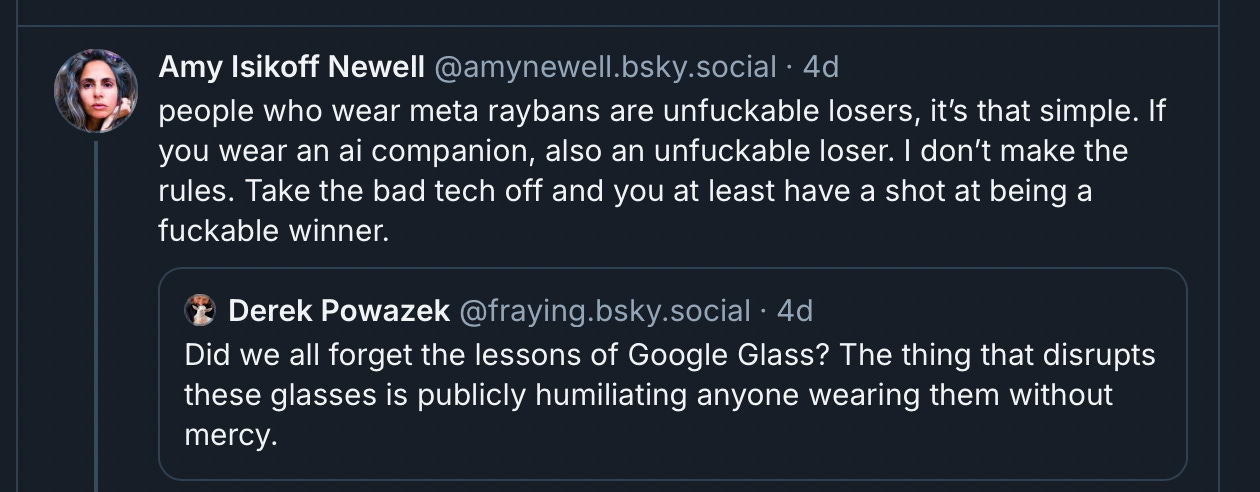
Also while we’ve been in NYC, friend.ai, which I will not link to, has been papering the city with ads, which the people of NYC then creatively defaced. friend.ai is a company that sells a little surveillance pendant you can wear to ensure that you lose all your actual friends. Last weekend the company did some promotional event in a park near where we are staying, which Max and I stumbled upon. Those of you who follow me on bluesky may have noticed that I have a lot of rage toward wearable surveillance tech.

Reader, I saw that friend.ai promo event and I lost my fucking head. There was a guy with a camera and a line of people waiting to yell at some poor person dressed up as the friend pendant. “What is this, do I get to yell about the surveillance tech?” I yelled. “Yes, absolutely,” someone told me. “Just a couple of waivers for you to sign.” “Waivers?” I yelled. “This is a fucking promotional event? Fuck that! Fuck your surveillance tech! People who wear this shit are unfuckable losers!” I yelled, directly at the camera, while giving the double finger.

Max casually walked away to the other end of the park, like he didn’t know me, which he probably at that moment wished were true. I started walking away after I was done with the yelling, but the cameraman followed me. “I’m filming a documentary” he said, “and I’d like to use this footage.”

I got the documentary filmmaker’s number and said I’d think about it. I did think about it. But in the end I told the guy I didn’t think you could make a documentary about a 23 year old tech founder and his dumbass startup without it becoming a hagiography, and I had no desire to play a bit part in a hagiography as the wild-eyed profanity-spewing enraged middle-aged woman, even though I am, in fact a wild-eyed profanity-spewing enraged middle aged woman.

***

Finally, again, I know it was a month ago now that Ezra Klein wrote a completely dumb essay about Charlie Kirk and then had Ta-Nehisi Coates on his podcast (can we get rid of podcasts, by the way? PLEASE???) so that Coates could explain to him how very wrong he was and Klein could utterly fail to understand his point. But I keep thinking about that conversation (I read the transcript, because I don’t listen to podcasts — gift link)

In it, Klein asks Coates why “we” are losing, and Coates matter of factly says sometimes you lose. Losing doesn’t mean you’re doing something wrong or, importantly, that your values are wrong because they are out of step with the values currently in ascendance. The values currently in ascendance are cruelty and punishment, exclusion, hate, degradation. They suck.

Anyways, here’s part of the exchange:

Then let me flip that question a bit. Why are we losing?

We’re losing because there are always moments when we lose.

See, that feels very fatalistic to me.

It doesn’t feel fatalistic to me. It feels like the truth. Let me express what I mean.

I’m Ta-Nehisi Coates, I’m the writer, I’m the individual, right? But I am part of something larger, and I’ve always felt myself as part of something larger. I have a tradition, I have ancestry, I have heritage. What that means is that I do whatever I do within the time that I have in my life, whatever time I’m gifted with, and much of what I do is built on what other people did before them.

Then, after that, I leave the struggle where I leave it, and hopefully, it’s in a better place. Oftentimes it’s not. That’s the history in fact. And then my progeny, they pick it up, and they keep it going.

I can't get this exchange out of my head.

When you read or listen to a man like Coates talking to a man like Klein, it’s immediately obvious which of those two people is more admirable. Coates clearly has wildly more moral clarity, understanding of history, and courage. Coates is grounded; Klein is not. Coates has really thought through what matters to him; Klein has spent his career scrambling to say stuff to stay relevant and feel important.

I keep going back to this exchange because there has never been a more critical time for each of us to clarify our values and to reach for courage. To access the courage of our convictions, we will need to pay more attention to the people who are obviously already doing that, like Coates, and less attention to the ones flailing around trying to make sure that they “win”, like Klein.

***

I started this essay by saying I don’t have any idea what the fuck I am doing. Here we are at the end of the essay, and I see that this is not true.

Sure, in the day-to-day sense it is frequently true: I wake up and try to figure out how to spend my day, I start a neighborhood chat group but I don’t know if it will work or if I am doing it right, I take a drawing class and can’t even decide if I like it or not. I wait for Max at the entrance of a camera store in New York, and while waiting I start talking to the guy at the door, and he tells me it’s a grand opening and there will be prosecco later, so I return to the store for prosecco and I meet a woman there who I think is cool and we exchange numbers and go to a wine bar and then I have maybe a new friend, but maybe not, because I don’t have any idea what the fuck I am doing.

But in a much deeper sense, I know exactly what I care about, and what I’m trying to do. I am trying to orient my energy and creativity and labor towards the moral ground on which I stand, I am trying to live up to my own values, I’m trying to build courage and clarity and strength, for myself and my community. I’m trying to show the fuck up to this terrifying historical moment, with bravery, not cowardice.

Just because it’s difficult and confusing, just because I’m not sure exactly how to do what I’m trying to do, doesn’t mean that I don’t know what that is.

Subscribe now

Share

Read the whole story
LeMadChef
1 hour ago
reply
Denver, CO
Share this story
Delete

Mercedes Has Finally Figured Out A Way To Sell Modern Headlights That Don’t Cost $1 Billion To Replace

1 Share

If you’ve ever dealt with replacing a modern headlight assembly before, you’ll know they’re insanely expensive. The pods that hold the lights, daytime-running lights, and turn signals can easily cost four figures.

Because they’re usually sealed together with glue, replacing individual parts within the assembly is a huge pain, to the point where it’s actually cheaper to buy a whole new unit. For years now, owners and insurance companies have had to front massive costs to get headlights fixed, even when there’s only minor damage.

Mercedes, under the guise of wishing to make it easier for scrapyards to disassemble and recycle parts, finally has a solution—one that I hope the rest of the industry follows.

Mercedes Wants To Make Sure Its Cars Are Easy To Recycle

Have you ever wondered what happens to a car when it’s no longer viable as a car? Whether it’s been crashed, broken to the point of being too expensive to fix, or rusted to the point of being unsafe to drive, cars like this usually end up in a junkyard to be salvaged.

New Cla 250+
Source: Mercedes-Benz

Even if a car can’t be driven anymore, it still has some value. Cars are complex machines with a lot of different parts, which means even worthless examples usually have working or undamaged pieces that can be salvaged and sold (glass, body panels, interior pieces, wheels, etc.), and metals that can be recycled. This is how salvage yards make their money.

Because cars are made up of so many different materials and assembled in increasingly intricate ways, it’s impossible to recycle everything from a vehicle in a reasonable time frame. Taking apart a modern car by hand, with all of its wiring, glue, welds, and fittings, can take weeks. So a lot of recyclable materials end up in the trash because they’d take too long to separate from the rest of the car. There usually isn’t much delicacy when it comes to this type of work:

Mercedes, realizing a lot of materials that could’ve been recycled in the dismantling process are ending up in the trash, never to be used again, has launched a new initiative within the company called Tomorrow XX. The program is taking a look at more than 40 components, reengineering them to reduce their carbon footprint and make them easier to use again as raw materials. From the release:

At the end of a vehicle’s lifecycle, Mercedes-Benz wants to close the loop and return as many recyclable materials as possible to the system. The prerequisite for material recycling is ensuring components are easy to dismantle and that different materials can be separated by type.

How, exactly, does Mercedes plan to do this? Less glue and less welding, by the sounds of it.

Finally, A Modern-Day Headlight That Makes Sense

Tomorrow Xx: Mercedes Benz Unveils A New Dimension Of Sustainability
Source: Mercedes-Benz

Previously, replacing something as simple as a headlight lens or bulb on a modern headlight assembly would take a ton of hours and a lot of painstaking glue-related work, where you’d have to heat up the glue and peel apart delicate pieces of plastic. Do it wrong, and you’ll end up breaking something (ask me how I know). Mercedes’ new headlight concept sidesteps all of that with an exceedingly simple method:

The various components such as the lens, cover trim and frame, housing and electronics are joined with fasteners rather than glue (today’s standard practice). As a result, the headlight can be separated into individual components with ease and without damage. This means individual components can be replaced, making a modern headlight repairable for the first time. Following a stone chip, for instance, there is no need to replace the entire headlight, just the lens. For customers, this could make repairs more efficient in future. The longer service life of headlights could also help conserve resources and minimize carbon emissions.

This is exactly how headlight assemblies used to be, when stuff was easy to fix. I feel like this sort of fastening method could’ve been reimplemented on modern headlights years ago, when manufacturers started realizing how expensive and annoying dealing with glue was. Alas, it was probably quicker and cheaper to use glue, which is why virtually every headlight assembly still uses it.

Mercedes goes on to say that each part of the headlight is made from one specific material, making those parts easier to sort for reuse or recycling. The company estimates that using this type of assembly could reduce carbon emissions by nearly 50 percent by saving on manufacturing. I’m just happy it won’t cost owners an arm and a leg to replace a cracked lens anymore.

Tomorrow Xx: Mercedes Benz Unveils A New Dimension Of Sustainability
Source: Mercedes-Benz

Headlights are just the tip of the iceberg for Mercedes. It provides the door panel, a shockingly complicated part in 2025, as another example:

A similarly complex component are interior door panels, which consist of different parts joined by ultrasonic welding. Mercedes-Benz has developed a new joining technology to better and more easily separate individual materials. The adapted thermoplastic rivet is now easy to undo, allowing faster separation of individual components without damage. Optimizing dismantling in this way both simplifies repair and improves recyclability. The new technology could potentially replace a large number of thermoplastic joints in vehicle interiors.

Having dealt with the horrors of disassembling glued-together headlight assemblies and door panels in the past, I really think Mercedes is onto something here. Even if there was no environmental benefit here, I’d be really into this idea, because it makes the lives of repair workers and disassembly facilities way easier. Every other automaker should take notice.

Top graphic images: Mercedes-Benz

The post Mercedes Has Finally Figured Out A Way To Sell Modern Headlights That Don’t Cost $1 Billion To Replace appeared first on The Autopian.

Read the whole story
LeMadChef
2 hours ago
reply
Denver, CO
Share this story
Delete
Next Page of Stories