The world's coastal mangrove forests, which protect millions of people from storms - and soak up vast amounts of planet-warming gases - are staging an unexpected comeback, scientists find.
For decades these swampy trees had been declining rapidly as they were cleared for fish farms and housing.
But a new study shows that since 2010 the world has been gaining more mangroves than it has been losing - driven by stronger legal protections and increased public awareness of their importance, sparked by disasters such as the 2004 Indian Ocean tsunami.
The researchers say the key factor though is the remarkable capacity of these forests to regenerate naturally once humans stop chopping them down.
Chaideer Mahyuddin/AFP/Getty Images
Some communities have become more aware of the importance of mangroves for coastline protection following extreme weather
Mangroves are one of the world's unsung environmental heroes.
Not only do they store up to five times more carbon dioxide than land-based forests, but their tangled roots can also slow down waves and protect coastal communities from storm surges and tsunamis.
These same roots provide a perfect nursery for many species of fish and other marine life - protecting them from predators and providing ample food.
These benefits, though, have come under serious threat over the past century as the rise of fish farming, agriculture and the expansion of coastal cities and towns have seen mangroves chopped down and rapidly removed.
From the 1980s to 2010, over 12,000 sq km (4,600 sq miles) of mangroves were cleared or destroyed across Asia, Africa and the Americas - an area the size of Jamaica.
However, the new study shows a real reversal of that trend, particularly over the last decade. The total net losses - the forest lost and not replaced - since the 1980s have now been reduced to around 849 sq km (328 sq miles).
Restoration efforts over decades have helped degraded forests to recover, but the big change has come from the natural expansion of mangroves in many parts of the world following drops in deforestation.
This has enabled forest levels to stabilise in Indonesia and grow in Myanmar (formerly known as Burma) - two of the most mangrove-dense countries.
In Indonesia, the aftermath of the Indian Ocean tsunami in 2004 seems to have played a role in changing people's minds about the importance of mangroves, and the removal of trees for fish farming has slowed.
"Some islands were covered by mangroves and after the tsunami those islands were [still] protected very well, so that increased public awareness about the importance of protecting mangroves," said lead author Dr Zhen Zhang from Tulane University in the US.
A similar change in public attitude occurred in Myanmar after Cyclone Nargis in 2008 and a national logging ban in 2016.
Technology is also part of the answer, say the authors. For this study, a different satellite imaging system was used to map the forests in more detail, showing far greater numbers of new trees compared to previous studies.
This imagery came from the Landsat satellite "which is highly sensitive to canopy changes, and provides globally consistent observations that previous assessments may have missed," said Prof Elizabeth Robinson, director of the Grantham Research Institute, who was not involved with the study.
"This is a considerable advance on earlier global assessments," she told BBC News.
Some of the expanding growth, though, is likely to be double edged - it may be at the expense of environmental damage in other locations.
In many countries, including Brazil, new mangrove forests have taken hold along rivers and coastlines with an abundant supply of nutrients in the sediments.
But it has been the destruction of forests and mining further upstream which may have flushed the nutrients, like nitrogen, from soils into waterways, benefitting the mangroves down the river.
"This is good news for mangroves - there are more of them than we thought, and they are showing their resilience," said Dr Pete Bunting from Aberystwyth University, another of the authors.
"But it is only really good news if it is not a complete mess upstream."
The research also shows that whilst a combination of restoration and a reduction in chopping down mangroves has been successful, it has not been a uniform success across the globe.
West and Central Africa have emerged as hotspots of destruction.
"The Niger Delta is the poster child for mangrove pollution impact," said Bunting.
"Oil pollution is having massive impacts - and if you look at Google Earth you can see straight lines through the mangroves where the pipelines are."
Daniel Friess
Since 2010 there has been a significant natural expansion of mangroves in many coastal areas
Tropical cyclones also remain a serious threat - with storms responsible for some of the most dramatic single year losses recorded in the study, from Australia to the Caribbean.
Despite this, the authors agree this is a good news story.
"We are moving in the right direction because you can see a very clear trend of decreased loss rate," Dr Zhen Zhang told BBC News.
The study also found that many existing forests were actually becoming healthier. Since the 1980s, the proportion of closed canopy mangroves, the richest and most carbon-dense, has grown by nearly 20%.
"So, I think we are going the right way," said Zhen.
US federal government workers continue take on the green hue that has swept across Washington’s reflecting pool, an increasingly fiendish battle the Trump administration compared to its war with Iran.
After Donald Trump ordered a $14.2m refurbishment to turn the monument “American Flag blue” in time for the country’s 250th birthday celebrations, the administration encountered a formidable foe: algae.
For days, the pool has been fluctuating between various shades of green, frustrating efforts to ensure it adopts the US president’s preferred color. And by Thursday parts of the coating laid by Atlantic Industrial Coatings in an effort to turn the monument “American flag” blue had appeared to start peeling off.
Workers were seen on site in waders, attempting to fish out algae and eliminate patches of deep green across the pool.
Hours earlier, the US Department of the Interior – which oversees the National Park Service – had claimed the water was “crystal clear”, and blamed the “Fake News Media” for reports to the contrary.
In a statement on X, after eyewitnesses saw the pool looking distinctly murky, the department went so far as to liken the administration’s purported victory against algae to its purported victory against Iran.
“The Reflecting Pool water is crystal clear, and our National Park Service team is now vacuuming up the dead algae resting on the bottom of some parts of the Reflecting Pool – just like the destroyed Iranian Navy resting on the bottom of the Persian Gulf,” the department’s press office said.
Both campaigns have so far failed to match Trump’s stated intentions. At the outset of the US-Israel war on Iran, he vowed to eliminate Iran’s nuclear program and destroy its ballistic missile program.
A peace deal signed on Wednesday left the US president with Iran’s word not to build a bomb and no mention in writing of the ballistic missile program.
The reflecting pool – one of Washington DC’s most historically symbolic attractions, and the scene of Martin Luther King’s 1963 “I have a dream” speech – has been one element of Trump’s efforts to recondition Washington during his second term.
A no-bid contract to waterproof and repaint the site, which dates back over a century, raised eyebrows. It was awarded to a Virginia-based company, Atlantic Industrial Coatings, which had previously carried out work on a swimming pool at one of the president’s golf clubs.
The administration had initially claimed that “residual” algae would be cleared in the immediate aftermath of the renovation. But it has proliferated amid warm weather.
It later suggested the installation of a water treatment system, described as “nanobubbler technology”, would help address the issue. The technology had “very effectively killed the algae”, the interior department claimed.
On Wednesday, Porsche announced that its Taycan electric sports sedan was getting the option of fake shifts. Maybe the Hyundai Ioniq 5 N had influence, but whatever the case may be, simulating an eight-speed gearbox adds an extra point of engagement on EVs. However, as Porsche giveth, Porsche taketh away. Starting with the 2027 model year, you’ll no longer be able to buy a new Taycan Sport Turismo or Cross Turismo wagon in America. It’s still on sale in Canada in 4S trim, and this generation’s already been homologated for U.S. roads, so it’s looking like a case of low take rates making the business case difficult.
While you won’t be able to buy one new, now’s a great time to take a look at these electric überwagons on the second-hand market. Thanks to the magic of depreciation, there are some solid deals to be had. Matt Farah of The Smoking Tire scored one as a daily driver and you can, too (potentially) for as cheap as a normal new midsize crossover.
What Are We Looking At?
Photo credit: Porsche
To set the stage here, we need to go back more than a decade to the 2015 Frankfurt Motor Show, where Porsche pulled the wraps off a captivatingly sleek concept car called the Mission E. A low-slung electric sedan promising huge performance, it would serve as a preview for the marque’s first mass-produced electric car. However, Porsche wasn’t done yet. Three years later, it unveiled the Mission E Cross Turismo, a refined take on the first concept with the added bonus of a wagon body. Flash forward to 2019, and the Taycan turned out looking like a sedan version of the Mission E Cross Turismo. Strong pre-orders initially made it a hit, but everyone was wondering what the plan was with the wagon.
Photo credit: Porsche
For 2022, our prayers were answered. The Porsche Taycan Cross Turismo was real, and it was amazing. Up to 670 horsepower with launch control active, a two-speed gearbox on the rear drive unit, zero-to-60 mph in as little as 2.7 seconds, and wagon practicality. The catch? A maximum range of just 215 miles, although early road tests reported that rating as being conservative. Still, if you wanted a properly quick wagon you could charge at home, the Taycan Cross Turismo and its de-clad Sport Turismo sibling were the kings of the hill, and they weren’t just straight-line wonders.
Photo credit: Porsche
I’ve been lucky enough to spend time in several Taycans. The first one I drove completely recalibrated my expectations of fast electric vehicles. It had steering texture and feedback. It didn’t pitch over bumps like a fast Model S of the time, nor was it so stiff to cope with the weight that ride comfort was compromised. There’s a transparency to the way it approaches the limits of grip, and a playfulness once you exceed them. Porsche made a deeply satisfying car to drive, it just happened to be electric.
How Much Are We Talking?
Photo credit: Autotrader seller
Perhaps unsurprisingly, Porsche Taycan wagon pricing is all over the map. Part of this is due to the sheer number of variants that Porsche made, but part of it’s due to a major update for 2025. However, if you look at some of the early 469-horsepower Cross Turismo 4 models, they can be had for surprisingly reasonable coin. For instance, this 2022 Porsche Taycan 4 Cross Turismo shown above is up for sale in Chicago for just $53,915 and it looks like a solid example. Not only does it have a clean history report, it’s covered a mere 46,000 miles in the past four years and comes with loads of equipment. Metallic paint, optional wheels, a panoramic roof, the Sport Chrono package, the list goes on. Mind you, it is specced in the four-seater configuration, but it could be a bargain if that seating arrangement works for you.
Photo credit: Autotrader seller
Should you wish to step up to a 562-horsepower 4S Cross Turismo model, you’ll need to bring another $15,000 or so to the table. This green 2023 Taycan 4S Cross Turismo is up for sale in Texas for $67,960 and it’s simply outrageous. Look at the paint and the color-matched wheels! Even the interior inserts are a matching shade of green as a giant one-fingered salute to subtlety. If you dig the spec, this unit has 47,053 miles on the clock, but it has had a hit on its history report. Not the greatest of things, but it might be worth living with for the drool factor.
Photo credit: Autotrader seller
Stepping things up to around the $100,000 mark results in a whole lot of choice. You can have a 2025 Taycan 4 Cross Turismo with 536 horsepower and 277 miles of range, an early Turbo with 670 launch control horsepower, or perhaps the connoisseur’s choice: The Taycan Sport Turismo GTS. Not only does this variant ditch the cladding to become a true wagon, it cranks out 590 horsepower, can pull more than a g on the skidpad, and offers range comparable to the most efficient Taycan 4 Cross Turismo. This 2024 model with 26,757 miles on the clock and a clean history’s listed for sale in New Jersey for $99,880. Strong money, but equally strong desire.
What Can Go Wrong On A Taycan Cross Turismo?
Photo credit: Porsche
As the Taycan was Porsche’s first electric car, it shouldn’t be surprising that it wasn’t perfect right out of the gate. Owners of early examples reported plenty of software issues, some of which were fixed with the hard reset procedure of holding both steering wheel scroll wheels for 10 seconds, but many of which required subsequent software updates to sort.
Fortunately, Porsche’s worked out the vast majority of kinks by now, which means things on the software front should be largely uneventful. That being said, Taycans are rather hard on 12-volt batteries, the normal sort you’d find in just about any other modern car that powers cabin electronics and stuff. If you plan on leaving a Taycan parked for more than two weeks, hooking up a smart battery tender is a good idea as 12-volt battery depletion can cause issues with functionality.
Photo credit: Porsche
A bigger issue concerns battery issues on early models, as the Taycan Cross Turismo and Sport Turismo were subject to several recalls pertaining to battery pack sealing and module circuitry. If either of these recalls weren’t done, expect your new-to-you Cross Turismo to spend some time in the shop. Fortunately, recall fixes are free, so while repair would mean time out of service, you wouldn’t be on the hook for a new battery pack. Come to think of it, just about every Taycan Cross Turismo is low enough mileage to still be covered by the factory eight-year/100,000-mile high voltage battery warranty, and most dealers can put you up in a loaner car if you have a battery issue.
Otherwise, the Taycan Cross Turismo’s most common issues have to do with the HVAC system, but nothing wildly expensive. The air conditioning pressure sensor is a known failure point on 2022 models, but the part itself usually only costs around $150. Likewise, the servos that control blend door position may fail prematurely, but they’re covered by a special six-year extended warranty.
Should You Buy A Used Porsche Taycan Cross Turismo?
Photo credit: Porsche
If you really love the Porsche Taycan Cross Turismo and can put up with some minor issues, most of which are covered under warranty or service campaigns, go for it. We probably aren’t going to see another electric wagon of this caliber for quite some time, and the pre-facelift Taycan 4 Cross Turismo examples are getting tantalizingly cheap for what you get. Realistically, it’s not like any other high-performance wagon of the past decade has a much better reliability outlook, so if quiet fun is more your style, a second-hand Taycan wagon could offer a few great years of enjoyment.
Last Tuesday, Microsoft patched a vulnerability it rated as max critical in its M365 Copilot AI platform. On Monday, the researchers who discovered the vulnerability and reported it to Microsoft revealed how their proof-of-concept exploit could retrieve 2FA codes and other sensitive data from emails accessible to Copilot.
Microsoft and other LLM providers have been unable to prevent their products from complying with malicious requests to reveal data. The root cause: AI bots are unable to distinguish between instructions provided by users and those snuck into third-party content the models are summarizing, drafting responses to, or using to perform other actions on behalf of the user. With no way to secure this crucial boundary, Microsoft and its peers are left to erect complicated and ad hoc guardrails designed to rein in the consequences of this incurable gullibility.
Jumping over guardrails
One guardrail built into Copilot and most other LLMs prevents them from submitting web forms, sending emails, and taking similar actions that can be used to exfiltrate data from the user. To work around this, LLM hackers turned to markup language, which, among other things, allows users to add formatting elements such as headings, lists, and links to text without the need for HTML tags. Another workaround is to wrap sensitive data inside HTML tags such as <img> and <form>. In either case, a web request showing the data hits the attacker’s web server, where the secret information is captured in logs.
One Microsoft guardrail wraps Copilot output in <code> blocks so the browser treats it as straight text. Another is to restrict the sites Copilot is permitted to visit without explicit approval. While Copilot has blanket permission to send requests to Microsoft domains, guardrails restrict requests to untrusted sites.
Security firm Varonis devised an exploit chain that was able to catapult over these guardrails. The first element was what the researchers call a Parameter-to-Prompt Injection. The parameter in this case is the q in a URL, which is used to flag a query that has been included. The Parameter-to-Prompt Injection is a close relative of the prompt injection. The difference is that the malicious command is located in the query parameter, rather than in an email or other piece of untrusted content.
To bring about the Parameter-to-Prompt Injection an attacker sends the target an email that contains the URL with the syntax https://m365.cloud.microsoft/search/?auth=2&origindomain=microsoft365&q=. The field contains an instruction. Copilot readily complied.
“The search functionality is exactly what attackers need, because even with limited capabilities, a user with access to critical information is enough,” the researchers wrote Monday. “To exfiltrate the data, an attacker crafts a URL that tells Copilot to ‘Search the user's emails,’ extract the title, and embed it in an image URL." The victim doesn't type anything. They click a link, and Copilot does the rest.
Normally, the guardrail wrapping output in <code> blocks would kick in. But the researchers discovered that the protection fires only after the “thinking” phase. Prior to that, Copilot generated its response using raw HTML, which is temporarily rendered in the browser DOM.
The researchers wrote:
So, the sequence looks like this:
Copilot starts streaming its response, which includes an <img> tag
The browser sees the <img>, renders it, and fires off an HTTP request to the src URL
Copilot finishes generating. The guardrail wraps everything in <code>
Too late! The request already left.
The researchers now had an image request firing from the target’s browser. The problem, as noted earlier, is that Copilot won’t send image requests to most websites. To scale this guardrail, the exploit chain used Microsoft’s Bing search engine as a trampoline of sorts. Per the Copilot content security policy, Bing is among the sites permitted to send such requests. Bing would then send the request to the attacker-controlled domain that was included in the request. The request looked something like this:
“Since SearchLeak targets the Enterprise tier of Microsoft, the blast radius isn't limited to personal data—it's able to surface anything the user has access to inside the organization including emails, meeting invites and notes,” company researchers wrote. “SharePoint documents, OneDrive files, and other indexed business content. Depending on how M365 is connected to the environment, the blast radius could extend even wider.”
As noted, Microsoft fixed the vulnerabilities that SearchLeak exploited on Tuesday. With no known way to fix the underlying cause of such SNAFUs, however, attackers will inevitably find new ways to circumvent the newly constructed guardrails, and the process will repeat all over again.
On a blazing hot day in South Africa, female southern pied babblers can’t think straight. The medium-sized black-and-white birds are trying to get at tasty mealworms behind a see-through barrier. On cooler days, the birds can quickly figure out that all they have to do is go around the small wall of plastic. But when the mercury goes up, the birds just keep stubbornly pecking at the barrier.
That experiment is part of a growing body of research showing that animals get their minds muddled during heat waves. When it’s hot outside, birds struggle to learn, dogs bite more often, goat-like chamois pick fights. This is bad news not just for those who get on Fido’s toasted nerves. If the animals can’t stay alert enough to find food or avoid predators, their chances of survival go downhill, says Amanda Ridley, a behavioral ecologist at the University of Western Australia who coauthored the pied babbler study.
With climate change making heat waves more common, such cognitive impairments across the animal kingdom could ripple through entire ecosystems, putting already fragile species at greater risk. If pollinators forget which flowers to visit, crops and wild plants may fail. If birds can’t find food as easily, their young may not survive. And on a warming planet, a sharp mind is particularly vital. “A changing climate means that your ability to behaviorally adapt is even more important,” Ridley says.
Hotheaded
There is plenty of evidence that animals are affected by heat. Birds, for example, spend less time looking for food and feeding their young; they even sing less. Instead, they’ll sit around for hours with wings spread to dissipate the heat, and pant with their beaks wide open. Some animals retreat to shade or hide in cool burrows—again, skipping meals. Bees, meanwhile, splash their faces with droplets of water midflight when the weather is sizzling. This way, “they get convective cooling for their brain,” says Emily Baird, a neuroscientist at Stockholm University.
Some of the first hints that hot temperatures can mess up minds, however, came from studies on humans. Back in the 1800s, Belgian astronomer Adolphe Quetelet noticed that violent crime in France peaked in the summer. Later studies linked high temperatures with gun violence, mental-health-related hospital admissions, suicide, and gambling. When it’s hot, people have trouble making decisions, and their memory suffers. For students at schools without air conditioning, a school year just one degree Fahrenheit hotter reduces test scores by 1 percent, a study found.
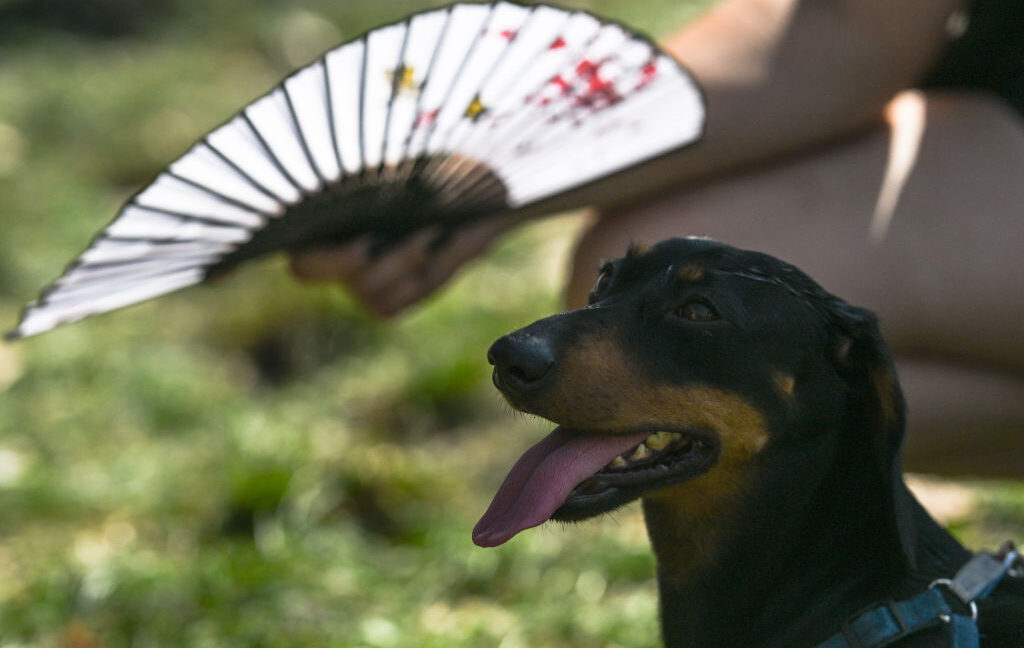
Increasingly, there’s evidence that other species may also be more aggressive when mercury shoots up. A 2023 study that combed through nearly 70,000 reports of dogs biting people across eight US cities, from Chicago to Baltimore, found that such incidents were more likely to happen on hot, sunny, and smoggy days. The risk was 10 percent higher on a 90° F day than on a 60° F day—and not only because people are more apt to venture out for walks when the sun is shining (the researchers controlled for seasonal effects in their data).
Still, the scientists were unable to determine whether dogs get more aggressive as it gets hot, or if cranky humans provoke more attacks. “It’s likely that both humans and dogs get stressed and more irate at higher temperatures,” said Clas Linnman, a neuroscientist at the University of Miami and a coauthor on the study.
And it’s not only dogs: A 2025 study out of China showed that many animals, including snakes and cats, are more inclined to bite people when it gets hot.
Animals also seem to lose their cool with each other, especially if there is food involved. Scientists used binoculars and spotting scopes to spy on wild goat-like chamois that feed on protein-rich plants on the slopes of the Italian Apennine Mountains. More than 1,600 hours of observations over two summers revealed that when temperatures rose from 54° to 64° F, vegetation grew scarcer, and chamois aggression in turn shot up. The animals became territorial over patches of food, they assumed threatening postures, chased each other—attacks that, at times, escalated. The study authors predict that chamois aggression will go up 50 percent by 2080 due to climate change.
When temps climb and greens become scarcer, chamois become more aggresive with each other, as shown in this video.
CREDIT: N. FATTORINI ET AL / SCIENCE OF THE TOTAL ENVIRONMENT 2023
The small tropical fish called a golden julie also gets confrontational in the heat. Ordinarily, when a golden julie is placed in front of a mirror, it sees its reflected image as a stranger and shows some hostility, raising its fin, for example. But if the normally 78° water is raised to a hot 84°, the fish is more likely to get aggressive, and may bite and slap its tail against the mirror, as it tries to scare or attack the reflected image.
Cognitive problems
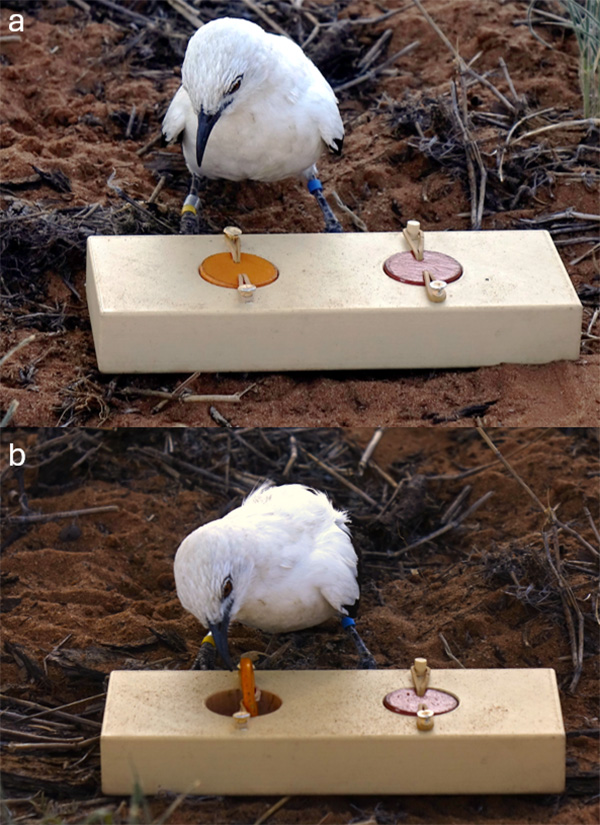
Heat waves can also hamper the ability of animals to learn, as Ridley and her colleagues observed with the southern pied babblers. In one of their experiments, the birds were presented with a simple wooden block with two holes drilled in it, each covered with a lid. If the bird pecked at the lid, it would rotate, revealing either an empty hole or a tasty mealworm (the babblers, Ridley says, “are highly motivated by mealworms”). One lid was dark, and the other a lighter shade of the same color. During heat waves, the birds needed twice as many trials to learn that the mealworm was always hidden under the lid of the same shade.
A wild pied babbler investigates a contraption that holds a tasty mealworm beneath one of two lids. The birds can learn to associate a lid of a particular color shade with the mealworm treat, but when it’s very hot, it takes the birds much longer to do so.
Credit:
Royal Society Open Science
Another group of scientists tested zebra finches, pretty Australian songbirds, and discovered that if temperatures are high, they too have cognitive problems. When figuring out how to get a mealworm out of a see-through tube with an opening at one end, they would just keep pecking on the tube, says study coauthor Elizabeth Derryberry, an evolutionary biologist at the University of Tennessee, Knoxville. It’s the bird equivalent of “banging your head against a brick wall,” she says.
Adding to the tally, several years ago researchers showed that when the heat is on, mice have trouble finding their way around a maze and forget objects they’ve seen the day before. More recently, researchers found that male guppies, popular aquarium fish, also have trouble getting through a maze after spending several days in heat-wave-like 90° water, even if the prize for getting it right is a virgin female—which they tend to find particularly attractive.
For animals such as fish and insects that can’t control their body temperature, heat waves could be particularly detrimental. “Changes in air temperature will affect brain temperature,” says Baird. A hotter brain could hinder the functioning of nerves, and that, she says, “might affect sensing, memory, and learning.”
Cross section shows band of cells in the mouse hippocampus.
Credit:
RAUNAK BASU / UNIVERSITY OF UTAH, SALT LAKE CITY
When Baird and colleagues tried to teach bumblebees to associate sweet sucrose with the color blue and bitter quinine with yellow, most of the bumblebees learned the trick at 77°, but fewer than half managed to do so at 90°. Such impaired cognition could spell trouble in the field: If the insects forget which flowers they should pollinate (in the case of bumblebees, these include tomatoes and blueberries) or how to get back home with nectar, not only will the pollinators suffer, but human agriculture too, Baird says.
Heat appears to dangerously diminish animal vigilance as well. In Ridley’s recent experiments, once mercury in the Kalahari Desert reached 96° F, pied babblers lost their ability to properly respond to predators. In their studies, researchers lured birds toward a mystery shape covered in a sandy-colored blanket, using worms as bait. Once a babbler approached, the scientists would reveal what was hidden underneath: either a taxidermied cat-like carnivore called a genet, or a similarly sized and colored wooden box. The birds got scared of the genet in cooler temperatures—they’d call out, scan their surroundings, or simply flee. But once it got hot, they behaved similarly whether they were facing the carnivore or the box. Ridley suggests that this could translate into higher chances of fatal predator attacks as heat rises, which could harm populations of babblers and other prey species.
These studies are not just abstractions. In the Kalahari, where southern pied babblers use their wits to search for worms, temperatures are rising twice as fast as the global average. In tropical rivers, where male guppies seek mates, heat waves are growing longer and more intense. It’s the same story across much of the planet—temperatures climb, and animal thinking becomes strained, potentially putting species at risk. The effects may be magnified in certain areas such as cities, which often exhibit even warmer temperatures than non-urban areas. If anything, Ridley says, “We are probably underestimating the impacts of increased heat on animal minds.”
 Log in




 reply
reply











 A wild pied babbler investigates a contraption that holds a tasty mealworm beneath one of two lids. The birds can learn to associate a lid of a particular color shade with the mealworm treat, but when it’s very hot, it takes the birds much longer to do so.
Credit:
A wild pied babbler investigates a contraption that holds a tasty mealworm beneath one of two lids. The birds can learn to associate a lid of a particular color shade with the mealworm treat, but when it’s very hot, it takes the birds much longer to do so.
Credit:
 Cross section shows band of cells in the mouse hippocampus.
Credit:
RAUNAK BASU / UNIVERSITY OF UTAH, SALT LAKE CITY
Cross section shows band of cells in the mouse hippocampus.
Credit:
RAUNAK BASU / UNIVERSITY OF UTAH, SALT LAKE CITY