Over the years, I have owned several Logitech wheels. The G25, G27, DFGT, and G29 all feel very similar. The force-feedback is weak and the velocity of wheel is limited. However, they are robust units, and I’ve never had one fail. My favorite of those wheels was actually the Driving Force GT. I liked the integrated gear shift lever (I actually used that for a hand brake at the time).
After switching to a belt driven Thrustmaster TS-PC Racer and various direct drive wheels, it’s now very hard for me to drive a Logitech gear-driven wheel. It’s so much easier to sense and catch oversteer on direct drive wheels. I have gone as far as saying that Logitech wheels are toys and the sim racer who wants to actually train real skills needs to be on a direct drive wheel with at least 5Nm of torque. By the way, I don’t mean to slander Logitech in general. I have their RS-50 wheel in my collection and that product is absolutely superb.
At UC Davis, I run something I call the “HPD-LAB”, which is somewhere at the intersection of “Ian gets the university to buy him sim racing rigs”, “actually useful instruction on performance driving”, and “Ian does experiments on college kids”. I’ve recorded laps for nearly 200 drivers. Shockingly, most of the really fast drivers have owned shitty Logitech steering wheels. Do shitty wheels make good drivers?
My own personal experience suggests that shitty wheels are very useful. I started sim racing in the off-season with a Logitech G25 several years ago (more than 10 actually). On my first track day after sim racing for about 6 months, I had become a completely different driver. Car control in the real world had become easy.
Today, with all of the great direct drive wheel choices, it’s hard to suggest getting a low-end Logitech wheel. It would be sort of like playing tennis with a wooden racquet. Incidentally, that’s a great training exercise that helps you focus on hitting the sweet spot.
It would be fun to do an experiment where you train a crop of drivers on good and bad steering wheels and see if bad wheels make good drivers.
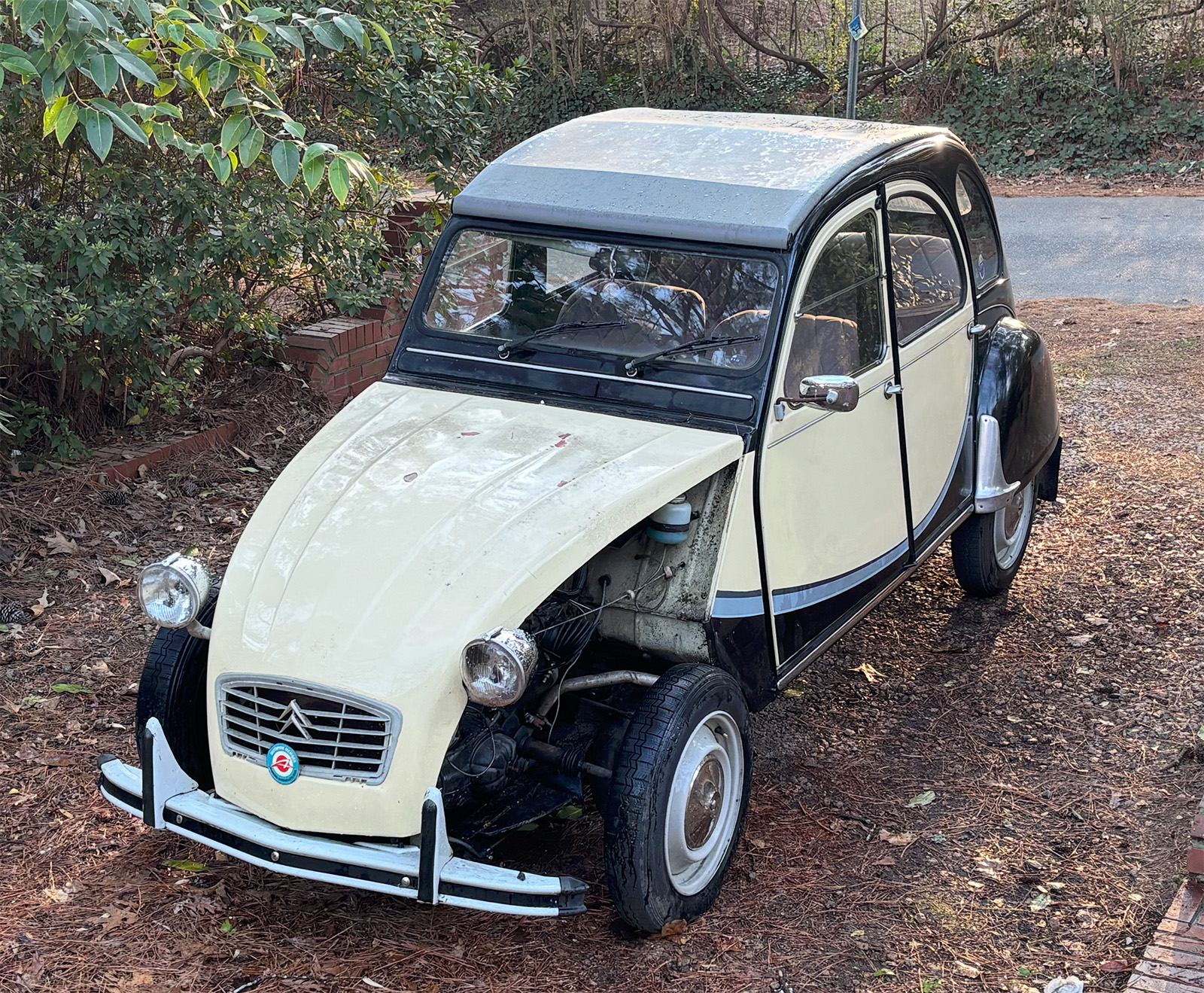
Maybe it’s because I’ve been driving around in a half-finished Citroën 2CV without front fenders myself, but I found this 1974 Nigerien-French movie, Cocorico Monsieur Poulet(that translates to, roughly, Cock-a-doodle-doo Mr. Chicken) a thoroughly charming and frenetic film, and, most significantly, a film that has one of the best and most demanding starring roles for a Citroën 2CV. Well, a 2CV derivative at least, what appears to be a 1963-1965 or so AK 350 Fourgonette van. It’s named Patience.
I’m not exactly certain of the year of the car because even at its most together in this movie, there’s only about 75% of the car present, it seems. It does seem to have the 425cc/18 hp engine, though, based on the valve covers. The car is really one of the main characters in this movie, which is about a chicken vendor, who has a plan to buy chickens cheap way out in the country and then sell them at a healthy profit in the big city of Niamey, Niger.
That’s really the essentials of the plot; most of the film was improvised by the actors, especially Damouré Zika and Lam Ibrahim Dia; Jean Rouch, the director, was one of the founders of French cinéma vérité, and was an anthropologist. The film straddles and crosses a lot of boundaries, as it is not really a documentary, not completely fictional, not entirely realistic (there’s at least one demon, you see), though the end result is gleefully chaotic and fascinating.
Here; tell your boss you need to desperately poop and then spend an hour and a half in the can watching this:
It’s in French, but there are English subtitles, which should help you get the idea. Those subtitles were not present on the version I watched a while back, so I should probably re-watch it myself and actually understand what’s being said.
As you can probably guess, though, what I was mostly focused on was the remarkable Citroën named Patience that is really one of the co-stars of the film. Delightfully ramshackle and cobbled-together, this chicken van traverses all kinds of rough terrain, including making several river crossings in various ways, from just driving on through to being completely disassembled and transported in multiple boats.
No matter how deconstructed or submerged or mud-caked the little van gets, it never stops, and manages to keep buzzing along throughout the entire film, enduring trials that would make the most smug Land Rover weep thick, viscous 20W-50.
The 2CV’s legendary simplicity I think is the crucial element that keeps Patience humming along, along with some metaphysical sort of mechanical determination I can’t fully define.
This movie is also contains perhaps the first cinematic demonstration and use of windshield-wiper-equipped goggles, which prove to be quite useful.
It’s a very different sort of movie than what many of us are used to, but I really enjoy the almost dadaist embracing of chance and happenstance, the exuberance and emotion, and the inspiring inability to give up that the characters – especially that van – embodies.
If you have time, give it a watch; it’s extremely entertaining and really makes you respect how rugged and capable these little two-cylinder machines actually are.
For the last quarter century, I’ve been lurking on every forum not only for each car or bike I own, but every car I’ve designed parts for. Mostly it’s to check that I’m not responsible for some series of horrific failures (I’m not! So far…), but I’ve never found one post, not one, praising the elegant and efficient design of a fuel pipe bracket or whatever. Not even the AC pump replacement bracket for the V6 Exige, and that was really neat. What I have found is so many questions that could be answered by reading the manual, so many terrible pieces of advice, so many wrong conclusions, and the one thing that keeps cropping up again.
That thing is the idea that cars are designed to fail the second the warranty runs out. That phrase “designed to fail” really gets to me. I take it very personally when someone suggests that I have deliberately set out to ruin their car the second their eligibility for free repair runs out.
When we start designing a car we have a set of durability targets that we have to beat. These are never defined as “must fail after,” but instead are “must still exceed this spec at the end of testing.”
[Dave Larkman is a mechanical design engineer who had a 25-year career at Lotus Cars and Lotus Engineering (the consultancy business that worked for other OEMs), eventually becoming Lead Engineer of Powertrain Design. He has also been a semi-pro drifter, rides sports bikes, and used to feel ashamed about his taillight collection until he found Jason Torchinsky on the internet. Wait, why am I writing this in third person? It’s me, Dave, writing my own bio. – DL [Ed note within ed note: You know Dave from his excellent article “I Was So Bored At Work I Redesigned A Tiny Engine Part For Fun And Accidentally Saved 22,000 Pounds Of Aluminum.” -DT]]
Many Parts/Systems Are Designed For Conditions Far Tougher Than Your Commute
One of these pistons is three years old, the other one is three years and one day old. This is what automotive engineers dream of being able to do, apparently.
A good example is a 1,000 hour idle test on engines. Idling is really tough on engines because at idle, the oil pump is doing its worst work, so any slightly moody bearing surfaces are going to get destroyed. I’ve seen a poorly heat-treated camshaft lobe wear out in just six hours of idling, to the extent the valve wasn’t opening at all, but the pass criteria on that test is that at the end of the test, the bearing faces must still be within the size and surface finish tolerances of a brand new part. As new, at the end of the test.
That test seems weirdly arbitrary, doesn’t it? 1,000 hours is a nice big round number. Engine testing is the result of a thing called Design Failure Mode Effect Analysis (DFMEA), where we sit down before the start of the project, write down everything that might go wrong, work out how severe it is, and how likely. A slight chance of a minor annoyance gets a low score, any chance at all of a safety or emissions issue and it gets a high score. Then we have to work out what testing we’d have to do in order to ensure that the design we come up with won’t suffer from the likely or severe failure modes.
The actual testing regimes are usually whatever we’ve proven to have worked well in the past. A 1,000 hour idle test sounds like something someone thought up because it’s a suspiciously round number, then found that poor parts fail, but good parts will pass. Job done.
Image: Chrysler Of Australia
A thermal cycle test is where we run an engine on a dyno at full load until the exhaust manifold is glowing red hot, then we turn off the fuel and spark, but keep motoring the engine at max revs to blow cold air through it, cooling it all down far faster than you ever could by driving it. Then repeat again and again, red hot to room temperature and back again. It’s horrific on exhaust components.
It’s also a 450 hour test, which sounds like the sort of number that’s not just plucked out of the air. Someone at some point either found that 1000 hours of this was impossible to pass despite the parts being OK for production, or that 100 hours was inadequate. Or maybe it’s just how long it takes to do 10,000 cycles. Either way, it tends to fail parts that won’t get failed by any other test, which is why it’s so useful. When your exhaust design stops failing at thermal cycle, you can relax.
Note that the target here isn’t to delay the failure until after the warranty period, it’s so that you can go to court with your DFMEA, drawings, and testing plan and say: We thought of this, we designed a solution, we tested for this, we can prove we took reasonable steps to ensure that this failure wouldn’t happen.
We don’t have an upper target for durability. Cars are almost infinitely repairable; with careful use and the right maintenance, you can get to 500,000 miles on pretty much any car, even one that I’ve worked on. But that maintenance is going to cost, which isn’t going to be acceptable once the value of the car falls below the cost of a new set of spark plugs (which is what happened to one of my old E30 BMWs).
We can make engineering decisions to keep that maintenance cost low, but every time it’s going to increase cost, and probably mass. I worked on an engine on which you could swap out the cylinder liners in half an hour — great for keeping maintenance costs low, but an utter irrelevance for pretty much every car owner on the planet. All engineering is a compromise, and anyone who says otherwise is trying to sell you something that’s very, very expensive, and also still a compromise.
The liners were made of glass, in case you were wondering; you had to pop them out for cleaning every few minutes of running time.
That’s a lot of text in one go, let’s break it up with a picture of some weird engine parts, all of which made it through testing first time without a single issue. Remember folks: Every bracket is already a design failure. (Brackets are inelegant).
These tests cost tens of thousands in prototype parts (look at how much aluminium they had to machine away on that big curved bracket – it started off as a rectangular billet), then more tens of thousands in labor to build, run, strip, and inspect. As a design engineer, you don’t want to waste that much money by getting it wrong, but that’s not the worst part of failing the test – those parts will also be fitted to the rest of the test engines, and test cars — maybe hundreds of them. If your prototype part isn’t durable, then that entire phase of testing can’t be done until you’ve fixed it; the knock-on cost is millions, or tens of millions.
So you do the analysis, you benchmark successful designs, and you hope that everything you design will be good as new at the end of whatever horrific accelerated life testing they throw at it. Sometimes it goes wrong, and there’s a combination of tolerance and assembly and testing that overloads something, or creates a weird resonant frequency, or maybe the guy doing the heat treating put a “before” cam in the “after” pile, but for the most part, you design for success, and expect to get it.
If you have a wacky new idea, you test it on research engines for years before risking it on a production project.
Design Engineer pay isn’t great, so we’d be open to the idea of a massive bonus for creating dealer service work, if such a thing existed. But often we don’t even work for the same OEM as the dealer network. With the amount of consultancy work and badge engineering going on, the link between the people who design your car and the people who will service it is tenuous. In fact, the only dealer feedback we get is “make servicing easy,” which we totally ignore just to infuriate the fifth owner sixteen years later (actually we agonise over that too – I still feel bad about the requirement to use a
crow’s foot to get to one of the inlet manifold nuts on supercharged 2ZZ Exiges, and that was over twenty years ago).
There is no motivation at all to design-in a lifetime limiting feature; it’s bad for us personally, in an immediate being-shouted-at way, and if that failure can cause an engine to stop, or a loss of vehicle control, then we know the guys who risk their lives testing the cars. Sometimes we are those guys.
One of these cars on my drive is a carefully disguised prototype, I can’t tell you what of because it’s super secret. Wait, did they really write the name on the side in foot-high letters? Urgh, everything is marketing.
While I always considered it deeply cool to get to do some testing or mileage accumulation, always in the back of your mind is “what if something important fails right now?” The pre-production cars have to pass a huge amount of testing before they’re allowed out in public, but when you’ve spent weeks in DFMEA meetings, it sticks in your head. You really don’t want anything to break, ever.
Designing Parts To Fail At A Specific Time Isn’t Easy
But. What if we were evil? What if there was some kind of incentive to create failures and drive up reliability fear in customers to increase extended warranty sales? Presumably in a way that wouldn’t also utterly tank actual vehicle sales. Could we do it?
I’ve designed parts to fail. They were shear pins, the things that let collapsible steering columns not spear you in the chest, but in my case, they were steel pins half a mile under the sea in an oil well drill pipe. So, I do the analysis, design the notched pins, design the housings to load them in shear, then test a bunch of them and get an unworkably huge range of results. Getting those pins to be strong enough not to break until we needed them to was a nightmare, and that was when we could create an overload to suit us. Trying to get that huge bell curve of actual part durability to start after the right time or number of cycles is pretty much impossible, and for that bell curve to be narrow enough for one of the wheels to fall off a significant number of customers’ cars the day after the warranty runs out is just impossible.
Then you have the problem of the customers’ use case. Say it’s 100,000 miles or three years, are those miles on a track or sat idling in traffic? Are those years parked at the coast going rusty or baking in the sun? Or I guess both if you aren’t in the UK. Designing something to fail in large numbers immediately after that time/distance, but not a minute/mile before, is just impossible when you have no control at all over the environment or customer abuse.
Even if it were possible, which it definitely isn’t, the OEMs would have to test everything not just to exceed the required durability, but then carry on testing to destruction. That would cost hundreds of millions more, and seriously delay the introduction of new designs by years, which would cost hundreds of millions more on top of the hundreds of millions you already spent making the project late, and all for no benefit whatsoever.
It Does Happen, But It’s Not Intentional, And It’s All Just A Compromise
If something goes wrong on your car, just out of warranty or not, it wasn’t intentional. We hoped it would provide so many years of reliable, loyal service that you’d tell all your friends to buy one too. We bet our careers on it. We get paid little enough that we drive fourteen-year-old Toyota-badged Subarus and really could have done without having to shell out for a new wheel bearing again this year; we feel your pain.
"All engineering is a compromise, and anyone who says otherwise is trying to sell you something that’s very, very expensive, and also still a compromise."
As the sixth game in a very popular series (one that, I should point out, is published by Xbox and thus part of a wider boycott movement), and a game that's been out for a little while now, Forza Horizon 6 has already been covered and reviewed to death, so you don't need me to sit here and blab on about the specifics of car handling or how stable performance is on a certain Nvidia card. What I do want to talk about are two things in particular: one thing that pleasantly surprised me, and one thing that is so deeply annoying that it's keeping me from playing the game as often as I'd otherwise like to.
First, the good stuff: Japan! Given the last few games in the series, and the track record of other Western studios trying the same thing, if you'd asked me whether Playground Games were going to be able to pull off setting a game in Japan without embarrassing themselves I'd have bet against them. It would have been the easiest thing in the world to make every race take place under gently-falling cherry blossoms, to cobble together a soundtrack featuring shamisen twangs over some beats, for the in-game radio hosts to butcher some Japanese terms so badly it'd be borderline racist.
Instead, Playground did their homework, got some help and the result is a game that, in visual terms at least, is one of the most authentic virtual tourism experiences outside of the Yakuza series. Its world is a snowglobe caricature of Japan rather than a direct facsimile, sure, but each themed stage looks amazing, and instead of going for the low-hanging blossoms doesn't shy away from depicting what are some of Japan's actual driving callsigns, like brutal, towering concrete freeways. Its recreation of Tokyo streets and the occasional, actual landmark (like Shibuya Crossing) are also fantastic. Good job!
I've never played a video game with more authentic taxis
Sadly, a lot of that good work is immediately and continually undone by the game world that's been placed atop it. Forza Horizon 6 is, like its predecessors, a game not content with simply letting you drive, and so it centres an absurd, fictional festival as its focus. This 'Horizon Festival' is the framework through which the entire game is presented to you, affecting everything from cutscenes to radio stations to the events you're taking part in. It is inescapable, and it is insufferable.
To be exposed to the Horizon Festival is to imagine a world where Glastonbury is being sponsored by Disney Plus. It's a Linkedin post's summary of Fast & Furious. It's Tokyo Drift as described by an insurance company's Super Bowl halftime commercial. It's an AI's best approximation of a culture ruled by energy drinks.
Every single character in this game, and there are many, from radio DJs to your player character's friends, is deeply annoying. Every radio station is full of physically painful 'banter', every cutscene treats Japan like some kind of cultural pilgrimage instead of just a country you're visiting to drive a car around. As PC Gamer's review says, "this series does not have characters, only delivery mechanisms for insipid chat."
In an effort to preserve my sanity, and to continue enjoying a driving game that's really fucking good at driving, I've started playing Forza Horizon 6 with as much of this crap turned off as I can toggle. I'm clearly not alone in my annoyances, either; some websites have entire blogs dedicatedsolely to muting the game's in-car dialogue.
It's incredible to me that all this guff can be both so bad and yet deemed so integral to the experience at the same time. I have fonder feelings towards Gran Turismo 7's setting; Gran Turismo 7's characters are static profile pictures, and its game world is a menu screen.
This is a driving game! You don't need any of this shit! There are times in Forza Horizon 6 when the driving is so good it almost stopped me in my (sorry) tracks: the way you can slide a car's wheels out on a dirt rally track and hear gravel pinging off your door, the lurch of a supercar blasting off the line and sending your viewpoint temporarily across the horizon, the overplayed (complimentary) trick the game constantly pulls where it shoots you off a ramp or cliff and has you flying across a track like a man in a wingsuit. It's all so damn good, then some asshole comes on the radio three seconds later and snaps me right out of my feelgood zone.
I get that this is not the hill to fight the "games are for adults" argument on, but beyond the immediate personal embarrassment of having to listen to Forza Horizon 6's shit over and over is the realisation that so many people involved in its development signed off on this garbage, all of them adults, all of them making a game aimed at adults, and it really annoys me. There's a fantastic driving game here with some S-tier visuals and sound work, and the participation of some of the world's most prestigious luxury automakers, and instead of taking any of that seriously, taking part in the Horizon Festival feels like going to a track day hosted by Mr. Beast.
Thankfully, like I've said, you can turn at least some of this stuff off. Because there is one hell of a driving game here to enjoy, so long as you're left in peace to enjoy it.
For many years (ten now, about which, more soon) McMansion Hell has featured many prominent and diverse atrocities from all over these great United States and sometimes beyond them. However, most of these posts have consisted of houses built during the McMansion Era proper – from the 80s up through around the early 2010s.
This is for a number of reasons. First of all: I like these houses because they are insane. Second of all, they are indeed quite different from one another – they represent the owner’s idiosyncratic if poorly rendered desires and fantasies. They are heavily psychologically loaded buildings. One family dreams endlessly of Tuscany, another wants to recreate the mall. All interiorize previously exterior forms of consumption.
These houses were also very expensive to build compared to their contemporary iterations: all real, solid wood cabinetry and trim, wrought iron railings, marble floors, elaborate murals - none of this is cheap. This is not to say that I’m nostalgic for the classical McMansion (though many are) only that it, like, most other facets of architectural and everyday life, have become progressively cheaper and more bland.
The McMansion never truly goes away. It merely changes shape over time. One of the shapes it currently takes is a particularly loathsome imitation of contemporary high architecture (specifically the kind of houses architects love to build for celebrities in California) executed in the most wretchedly parsimonious manner possible. It feels cheap to use the word ‘slop’ but their indiscriminate nature - the way they have no regard for why or how the things they imitate even work - allows it. Of all the building forms that could be generated with AI, this is the most likely. At any rate, behold:
Yes this is a real house. Yes you can buy it for $6 million in, yet again, Barrington, IL. It has 5 bedrooms and 5.5 bathrooms totaling 11,600 square feet. But most importantly, it looks like dogshit, and that’s with ten layers of Photoshop have been used to gussy it up which, by the way, also makes it appear entirely not of this world. Were it not for the photos of the empty interiors, I myself would have trouble trusting my own eyes. Part of the reason it looks so unreal is because the design itself is absurd, as though someone created four equally ugly vessels and threw them up one by one.
In 2017, in a now-deleted essay for Curbed (RIP - they destroyed the archive) I called these types of houses McModerns, simply because they were McMansions dressed up in modernist garb, which they wore no differently than they would Neo-Tudor or Mediterranean (broadly construed.) These houses don’t warrant a new neologism, but they do feel like a degraded or perhaps even gonzo version of even that old concept. Slop works fine too, especially because half of what’s in these images isn’t real.
Much fascinates me about these houses, however one of the most unique elements vis a vis the last 30 years of building is how overtly and almost hostilely masculine they are. Anything that can be construed as feminized - color, softness, ornament - has been ruthlessly purged. They also rip off tech industry minimalism which only ads to their bro-ey nature. While previous iterations of McModernism (think new builds in Colorado with fake wood exteriors) scream dads with IPAs, these houses scream Reddit to me. They are Elon Musk-adjacent in sentiment.
By the way, this is what that room looks like without the fake furniture. It’s basically a sunroom.
Whole Foods would like to call in a robbery.
Because these houses are designed by men, for men, no one involved has learned how a kitchen works. Many are calling this setup the “grindset tiktok video kitchen.” This is the kitchen you see in those day in the life of an AI startup founder videos your algorithm forces you to watch against your will.
Virtual staging is actual literal slop. In fact, one can say that it was an early harbinger of the ontological crisis we now face, one of the first instances where one is forced against one’s will to question reality, what one sees with one’s own eyes. Beyond that, I think virtual staging is literally a form of lying. You can use it to make a space look bigger or smaller than it is. In this – lying to impress – it also has a lot in common with AI. This dining room has nothing to do with the world I’m living in. These chairs are not my problem.
It’s actually AMAZING how much of what’s in this house, beyond the furniture, is fake. Every single material is fake. The stone is aluminum paneling. The plants are plastic. The concrete is printed on some kind of surface (as evidenced through its repetitive pattern), though it’s hard to say from just pictures. I don’t even trust the floors!!
Ok if you haven’t read Kelly Pendergrast’s amazing essay “Merchandizing the Void” about how houses are all like stores now, HERE IS THE LINK. Some ideas never die, they just evolve, king. Like you.
Please, I’m very cold.
Unfortunately there are no pictures of the rear exterior of this house, so this is where we will have to conclude for today. That being said, these houses and their antecedents are developing a design language all their own that will, in time, be as culturally rich to us as the houses of yore. The problem is they are less visually interesting. They are houses made to scroll in and scroll right by. Expect to see more of them here, but only if they have something, anything to say.
Automobiles have been around for well over a century. During that time, we’ve gotten pretty good at designing and building their basic components and controls: seats, doors, pedals, steering wheels, mirrors, etc. But when today’s automakers decide to make an electric vehicle (EV), they seemingly forget much of what they once knew, creating new versions of features that are objectively, obviously worse than the time-tested designs they replace.
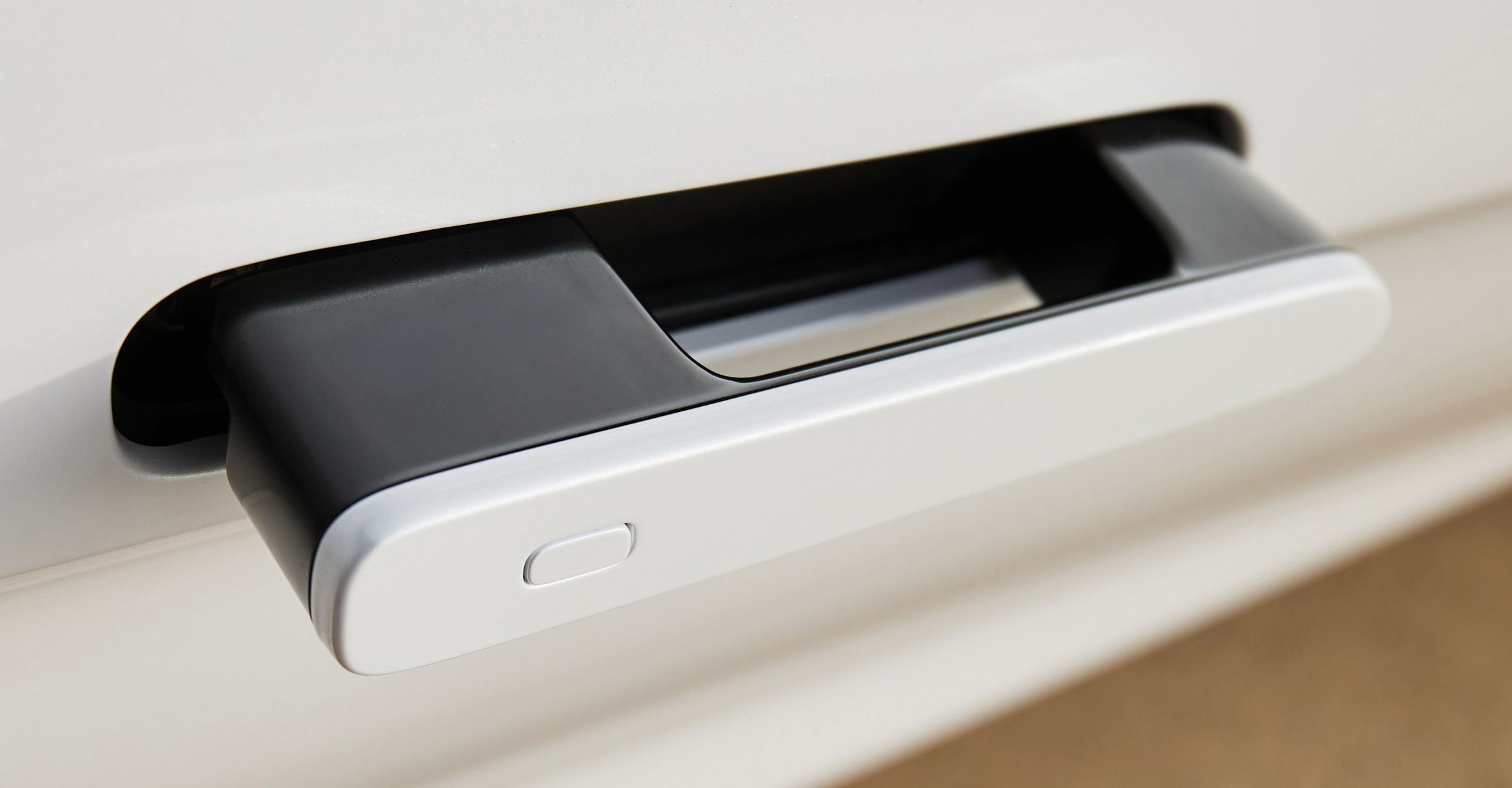
When Tesla ushered in the modern EV era in the early 2000s, some of these changes made sense, at least from a marketing perspective. To convince a cautious public to consider an EV, the vehicles had to appear “futuristic.” Flush door handles that automatically extend when you approach the car are definitely cool and fancy! But electronic door mechanisms like these have also proven to be unreliable, and possiblydangerous.
On the interior, Tesla settled on a minimal design dominated by a large touch screen. Touch screens provide a lot of flexibility. This is why our phones no longer have physical keyboards on them. Touch screens are also, perhaps surprisingly, less expensive than the array of physical buttons and switches that they replace in car interiors. This savings is especially important on EVs, where the cost of the vehicle is dominated by the battery (yes, to an even larger degree than an internal-combustion car’s cost is dominated by its engine). But despite their cost savings, the over-use of touch screens in cars has provenunpopular. They’re also not greatfor safety.
In 2026, we’re well past the time when EVs need to compromise safety and functionality in order to appear futuristic. As for the cost savings, well, that’ll be harder to shake. Once automakers got a taste for cheap touchscreens, they spread to all cars, not just EVs.
To help the industry get back on the right track, I’ve created a checklist for car designers. Make sure your new car—EV or otherwise—checks all these boxes to avoid making the same stupid mistakes that have plagued modern cars for years.
Accessible exterior door handles.1 When approaching a car, the door-opening mechanism should be obvious and immediately usable. You should not have to wait for a sensor to detect your presence and then activate some mechanism before the door is able to be opened.
Physical door opening mechanisms. The thing you pull to open the door should be physically connected to the door-opening mechanism. It’s fine to have the door handle activate an electronic door opener, but pulling that same handle farther and harder should activate the physical mechanism. This applies to both…
Interior
Exterior
Door handle affordances. In design, “affordance”
refers to the possible actions that can be readily perceived. When approaching a door, it should be readily apparent what you must do to open it. You should be able to see the door-opening mechanism, and it should be obvious how to use it. So many modern cars—and especially EVs—fail this test! There’s even a Saturday Night Live sketch about it. And, again, this applies to both…
Interior
Exterior
Physical charge-port door mechanism. For decades, cars have had small doors covering the place where fuel is added. We’ve gotten pretty good at making cheap, reliable fuel-filler doors. When carmakers design EVs, they all-too-frequently decide that the door that covers the charge port should be entirely electronic, opening and closing under its own power in response to a touch-screen input or a finger-swipe somewhere on the exterior of the car. We are currently not very good at making these electronic charge-port doors work reliably. They add nothing to the car beyond extra cost and “pizzazz.” This is a poor trade-off for even the tiniest decrease in reliability of such an important function.
Turn signal stalk. While there are arguments to be made for including various controls on the steering wheel itself, especially in sporty or race-inspired cars where removing your hands from the steering wheel for even a moment might be unwise, a stalk on the steering column is still the best overall choice for activating (and de-activating) turn signals. No experienced driver during normal driving has ever had to spend even a moment searching for the turn signal stalk to activate it, but this happens all too often when using turn-signal buttons on a steering wheel, especially when the wheel is rotated some arbitrary amount at the time the turn signal is needed. Stalks are great. Use them.
Physical buttons on the steering wheel. Speaking of controls on the steering wheel, when adding these, use physical buttons, not touch-sensitive controls. The driver’s hands are all over the steering wheel during normal use. There should be no possibility that merely brushing against a part of the wheel will inadvertently activate some feature of the car. Furthermore, the driver should be able to feel for controls on the steering wheel without looking at them. Use real, physical buttons and switches on the steering wheel.
Physical controls for temperature and fan speed. Climate controls are frequently used. These controls should be physical so their location never changes and so they can be used without looking at them. No, making the climate controls “fixed and always visible” on the touch screen is not the same thing.
Physical controls for air flow and direction. Grabbing a vent control and pointing it in the desired direction is much more obvious and efficient than navigating a touch-screen menu and then dragging your finger on a visualization of the car interior to try to direct the air flow. By all means, have electronically actuated vent controls to change the air flow for vents that are unreachable from the driver’s seat, but all vents should be physically controllable by the people who can reach them.
Physical glove box opening mechanism. One of the more astoundingly stupid features in many EVs is a glove box that can only be opened by using the touch screen. Truly, the mind boggles. One step up from that is a glove box that is opened via a button, but that button activates an electronic release. Someday, I expect electronic door releases to be as reliable as physical door mechanisms, but we’re not there yet. Glove boxes should have simple, obvious, physical opening mechanisms.
Rearview mirror. An actual, real rearview mirror should exist in any vehicle that has any sort of rear visibility. Rearview “mirrors” that are actually screens are popular in fancy cars these days, but they’re worse than real mirrors in multiple ways. Screen technology cannot yet match the dynamic range and contrast of the real world.
But more importantly, current screen technology requires the driver to focus on the surface of the screen itself, which is mere feet away from their eyes. This is a large change in focal distance from looking at the road ahead. Actual mirrors allow the driver’s eyes to focus on the road behind the vehicle, rather than the surface of the mirror. This is a much smaller change in focal distance, and is therefore easier, faster, and more comfortable.
Until and unless screens can match all these beneficial attributes, real mirrors should remain a fixture in cars. (In the meantime, feel free to add cool night-vision camera views or other digitally enhanced screen views as an option on top of the actual mirror.)
Rear window. Vehicles that can have a rear window should have a rear window. Yes, I’m looking at you, Polestar 4. “Mirror screens” aren’t enough. (See previous item.)
Side-view mirrors. US law still mandates side-view mirrors, but other countries do not. Carmakers have pounced on this opportunity to make their most expensive cars worse by using side-view cameras instead of mirrors, with screens on the interior to show what the cameras see. Screens are poor replacements for actual mirrors, as discussed earlier.
I hope the auto industry’s EV-induced fever breaks soon, so every new car doesn’t have some previously working feature broken for no good reason. If you know a car designer, please print this checklist and send it to them. The world will thank you.
Many of the checklist items involve door handles. Automakers often cite aerodynamic efficiency to explain their bad door handle designs, but it's a terrible excuse. First and foremost, flush door handles that are entirely mechanical do exist. Second, the extra range provided by flush door handles is negligible, even at sustained highway speeds (and near zero at slower speeds). Third, and most damningly, the standard wheels and tires on most EVs hurt range way more than any door handles. Smaller wheels and tires with smoother outer surfaces are a huge win for efficiency, but those are usually unpopular options on EVs rather than standard equipment. Meanwhile, sane door handles aren't an option at all. ↩
 Log in


 reply
reply