For the first time, the American College of Obstetricians & Gynecologists (ACOG) has released its own recommendations for maternal vaccination, providing formal guidance that diverges from that of the Centers for Disease Control and Prevention amid unprecedented policy changes and meddling from anti-vaccine Health Secretary Robert F. Kennedy Jr.
ACOG President Camille Clare blamed "changing national recommendations coupled with rampant vaccine misinformation" for the confusion among patients and health care professionals about vaccines during pregnancy.
"It is incredibly important for the public to have access to reliable, evidence-based information on maternal immunizations from a trusted source. ACOG is proud to be that source," Clare said in a statement.
ACOG's 2026 Maternal Immunization Schedule differs most significantly from the CDC's current schedule by including recommendations for COVID-19 and seasonal influenza vaccines. Those vaccines have been dropped from the CDC's recommendations under Kennedy, in conflict with scientific evidence and amid strong opposition from medical organizations.
Currently, the CDC recommends only two immunizations during pregnancy: Tdap (against tetanus, diphtheria, and pertussis) and RSV (against respiratory syncytial virus). ACOG's new guidance recommends influenza, COVID-19, RSV, and Tdap vaccines. It also provides clear recommendations for additional vaccines for certain populations, as well as vaccinations recommended during postpartum and while breastfeeding.
Medical organizations revolt
"Immunizations are an essential part of prepregnancy, prenatal, and postpartum care," said ACOG Chief of Clinical Practice Christopher Zahn in a statement. "As OB-GYNs, we have the power to combat vaccine misinformation on our own platforms, help our patients make educated decisions, and increase confidence in vaccination overall."
Thirteen other medical organizations have already endorsed ACOG's new vaccine recommendations, including the American Academy of Pediatrics (AAP), the American Academy of Family Physicians, the National Association of Nurse Practitioners in Women’s Health, and the American College of Nurse-Midwives.
AAP President Andrew Racine highlighted the need for such guidance, citing the vulnerability of babies. "Their immune systems are still developing, and in those first months of life, they rely on us—the adults around them—to help keep them safe. Maternal vaccines are one of the most effective ways to protect not only the mother but her newborn as well."
The AAP has led the charge against Kennedy's anti-vaccine agenda, spearheading a lawsuit against changes that Kennedy has made to federal vaccine recommendations and the Advisory Committee on Immunization Practices (ACIP), an influential panel of advisors the CDC relies on to set policy. That litigation, which is ongoing, led to a temporary injunction in March that reversed many changes to CDC's vaccine schedule and blocked most of Kennedy's hand-selected ACIP members.
The Regional Court of Munich hit Google with a temporary injunction barring the company from spreading false claims about two Munich-based publishers through its AI-generated search overviews (case no. 26 O 869/26). The court classified Google as a direct infringer because the “AI overview” is its own content, not just a list of search results.
The crux of the issue is whether the “AI Overview” Google now provides — and which is often erroneous because LLMs can’t read or exercise judgement, they can only spit out statistically likely words — counts as a presentation of information provided elsewhere, as a normal search query might be, or is a new creation with its own set of liabilities. The court, for various reasons, decided it is the latter (go ahead and click through to see a fuller explanation of the court’s decision).
I’m not well enough versed with the German legal system to determine whether this sort of ruling is going to succeed on appeal (and it is absolutely going to be appealed) but as a matter of personal understanding, this ruling seems pretty legit to me. The “AI Overview” isn’t a search listing — Google has gone through the trouble of passing it through its LLM and letting the thing make a document about it, and these documents, both by tone and by their position at the top of a Google search page, sound authoritative and present as factual. These documents may not be copyrightable, but that doesn’t mean Google didn’t create them and are thus responsible for them.
I’m curious whether such a legal ruling would be possible in the United States, which has famously liberal (in the classical sense) free speech laws and has an extremely high bar for defamation, especially for public individuals, under the NYT v Sullivan Supreme Court ruling. Perhaps in the US the best avenue to pursue this would not be on the grounds of free speech but of product liability: A product that fails a significant amount of the time but is still presented to consumers as reliable feels like a class action suit waiting to happen.
No matter what, however, this is a big moment for “AI” and the information that it presents. Whether this spurs tech companies to make better products, or just spend more money on legal, will be the open question. One is, admittedly, easier than the other.
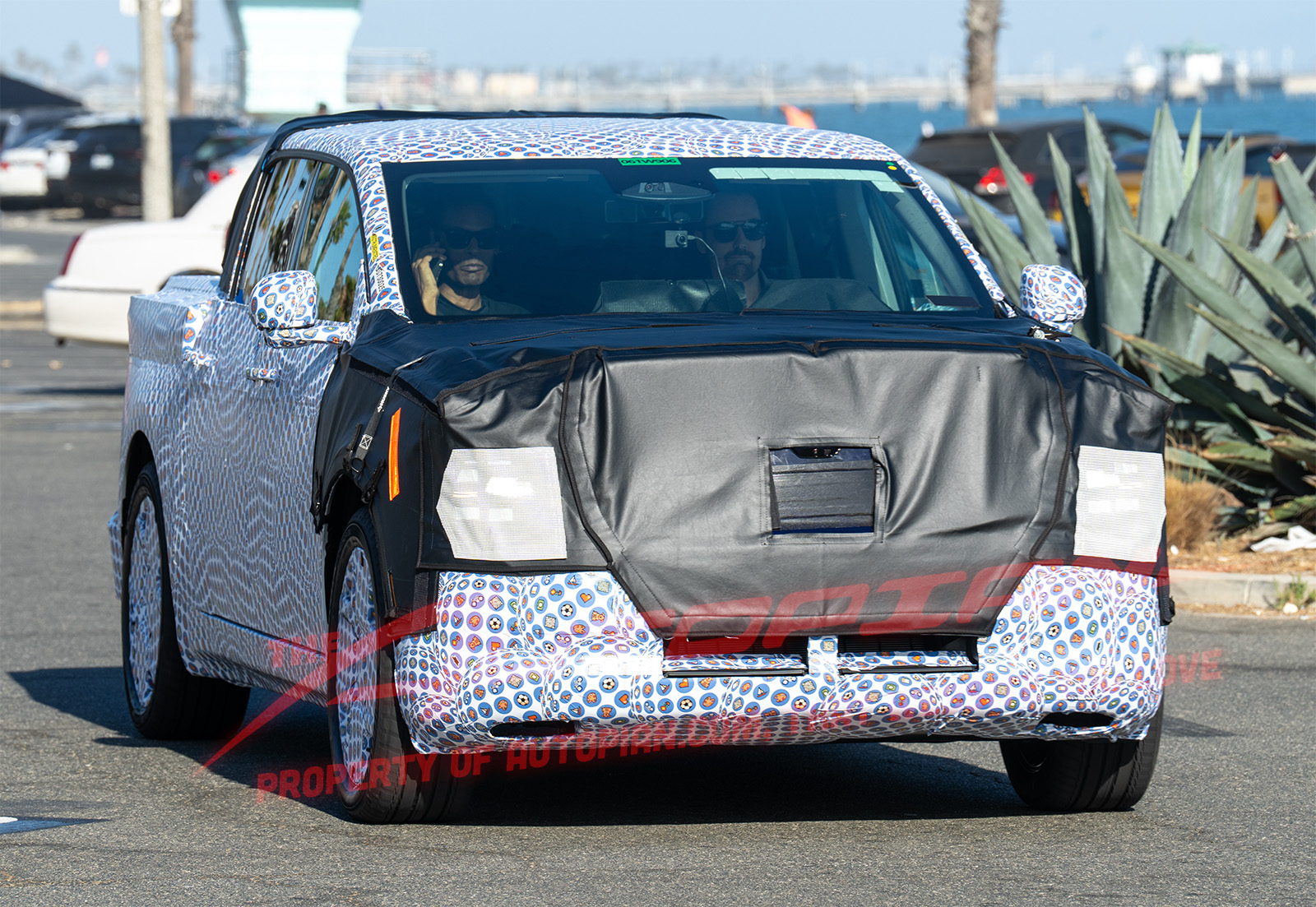
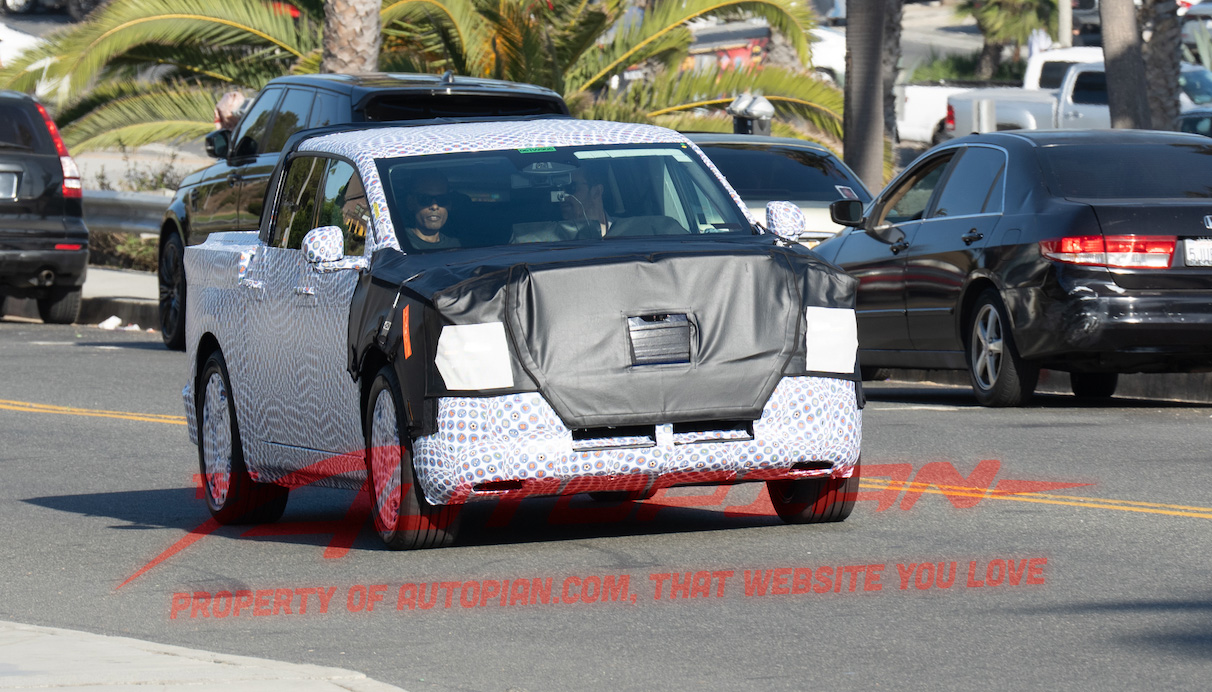
If you’re not excited about Ford’s upcoming Universal EV platform — which Ford developed secretly at its west coast Skunkworks with the goal of offering a competitive sub-$30,000 compact pickup truck among other frugal EV options — you should be. I just got an exclusive up-close look at the little electric pickup dressed in camo at a Long Beach park — it is way smaller than you think. And that’s awesome!
Rejoice, world! For far too long, we have had to deal with the scourge of ever-growing pickup trucks. Every time a new generation of a truck comes out, we learn that it’s longer, wider, and taller.
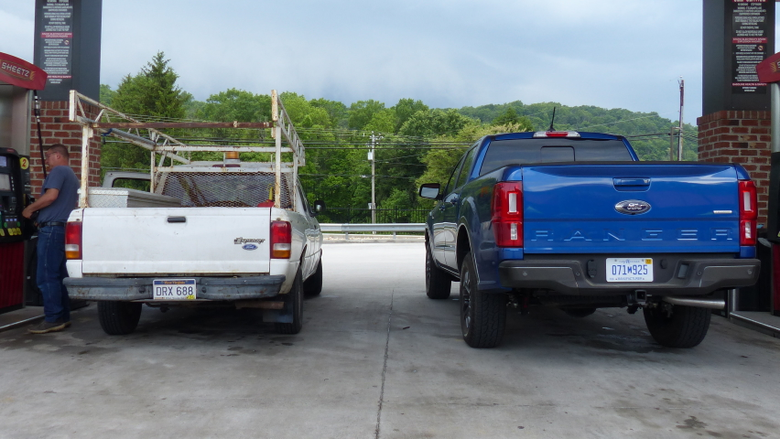
The old Ford Ranger, for example, looks like it had a few too many cheeseburgers between the early 2000s and now:
I’m pumped. Not only is Ford finally bringing back a tiny pickup truck — one seemingly even smaller than the Maverick, which itself is larger than the old Ranger — but the brand is going to offer it in EV form at a relatively reasonable price point. I’m amped, and ever since touring The Blue Oval’s skunkworks facility, I have been excited to learn more about what the thing will look like.
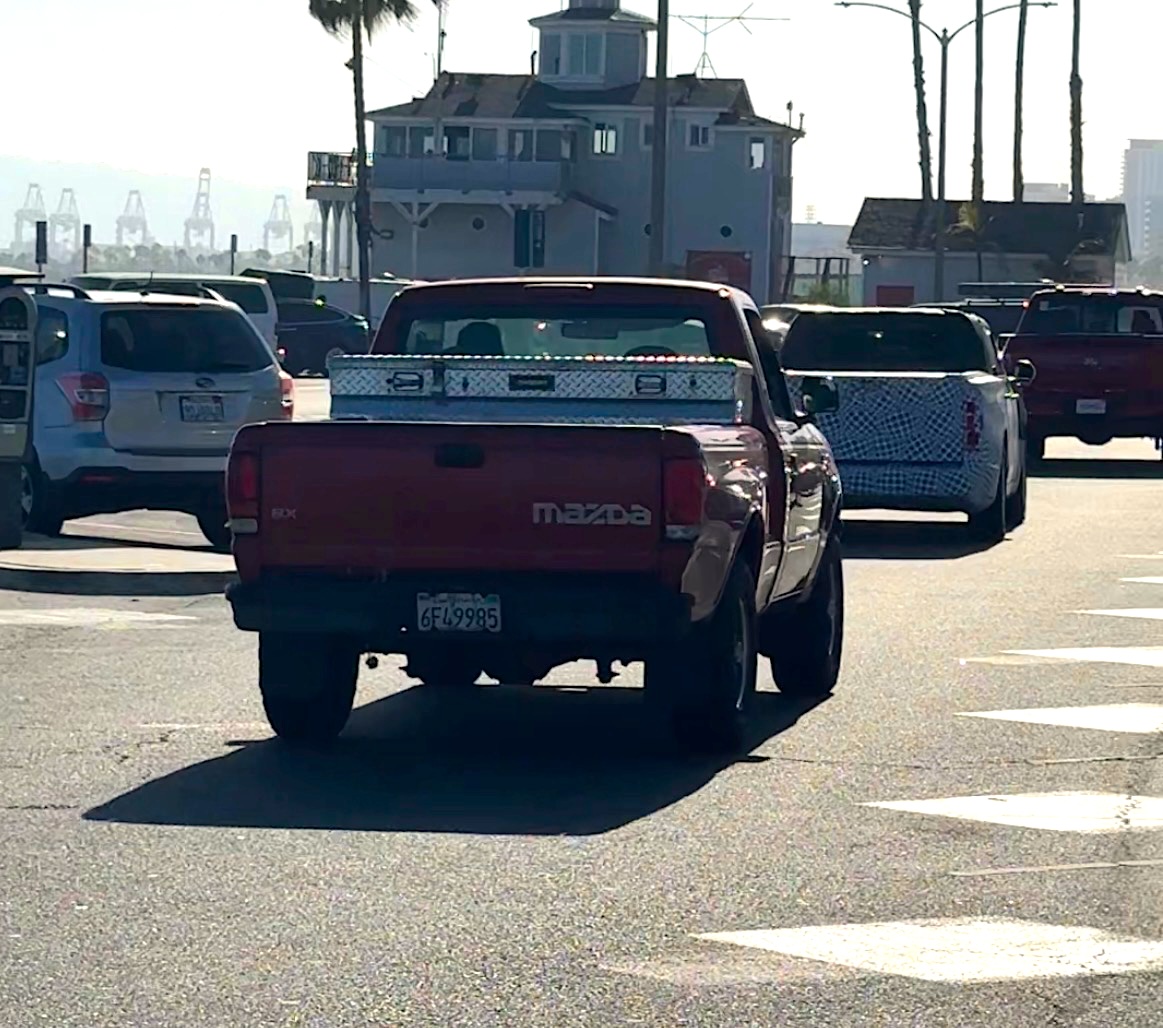
Well, The Autopian now has the best idea of any publication on the internet thanks to these spy shots that Autopian video manager Griffin and I took. Let’s first start with this horrible photo I took of the an old Ford Ranger tailing Ford’s prototype (OK, technically it’s the Mazda version of the Ranger, but you get the idea). It’s not that easy to tell the scale, but look at the Mazda and look at the F-150 ahead, and it’ll be clear that the new Ford EV is tiny:
Image: David Tracy
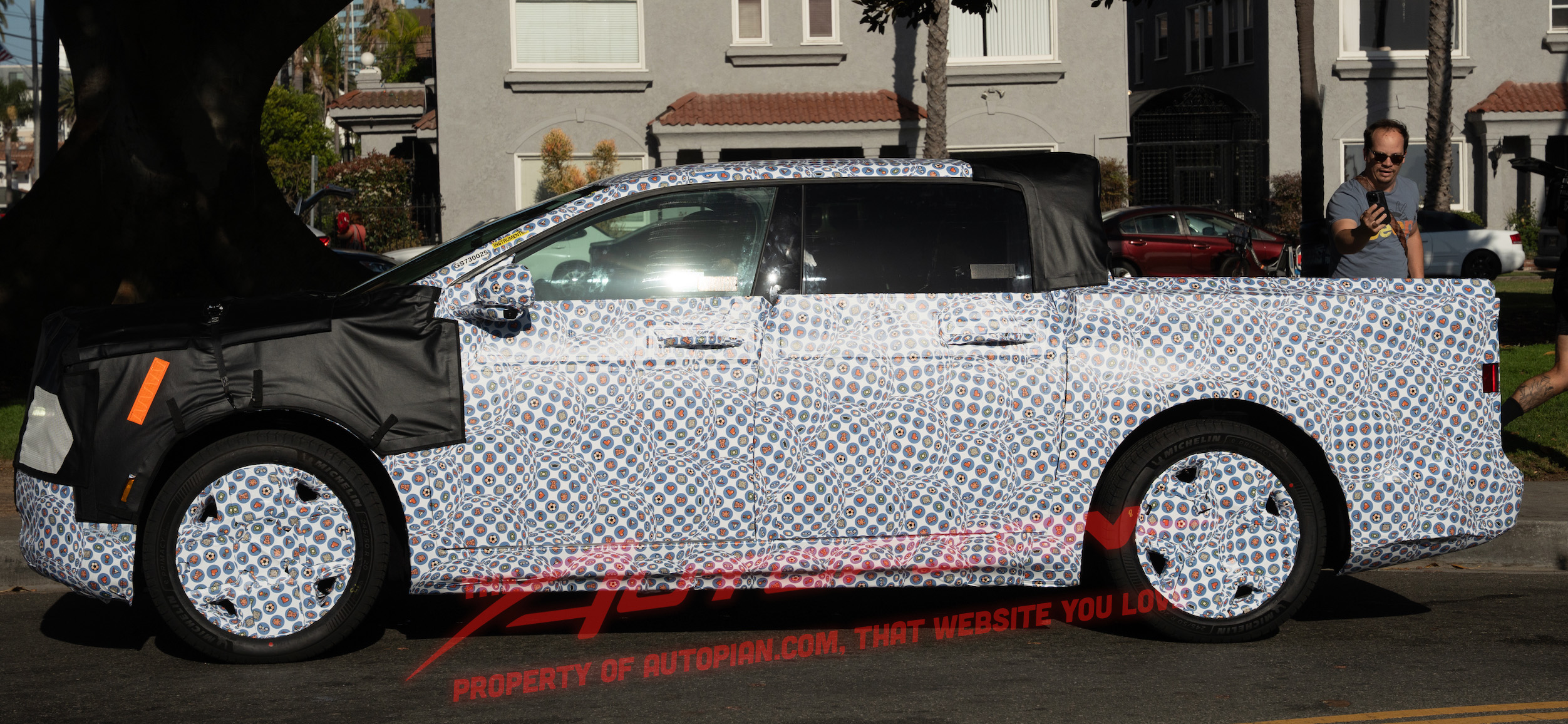
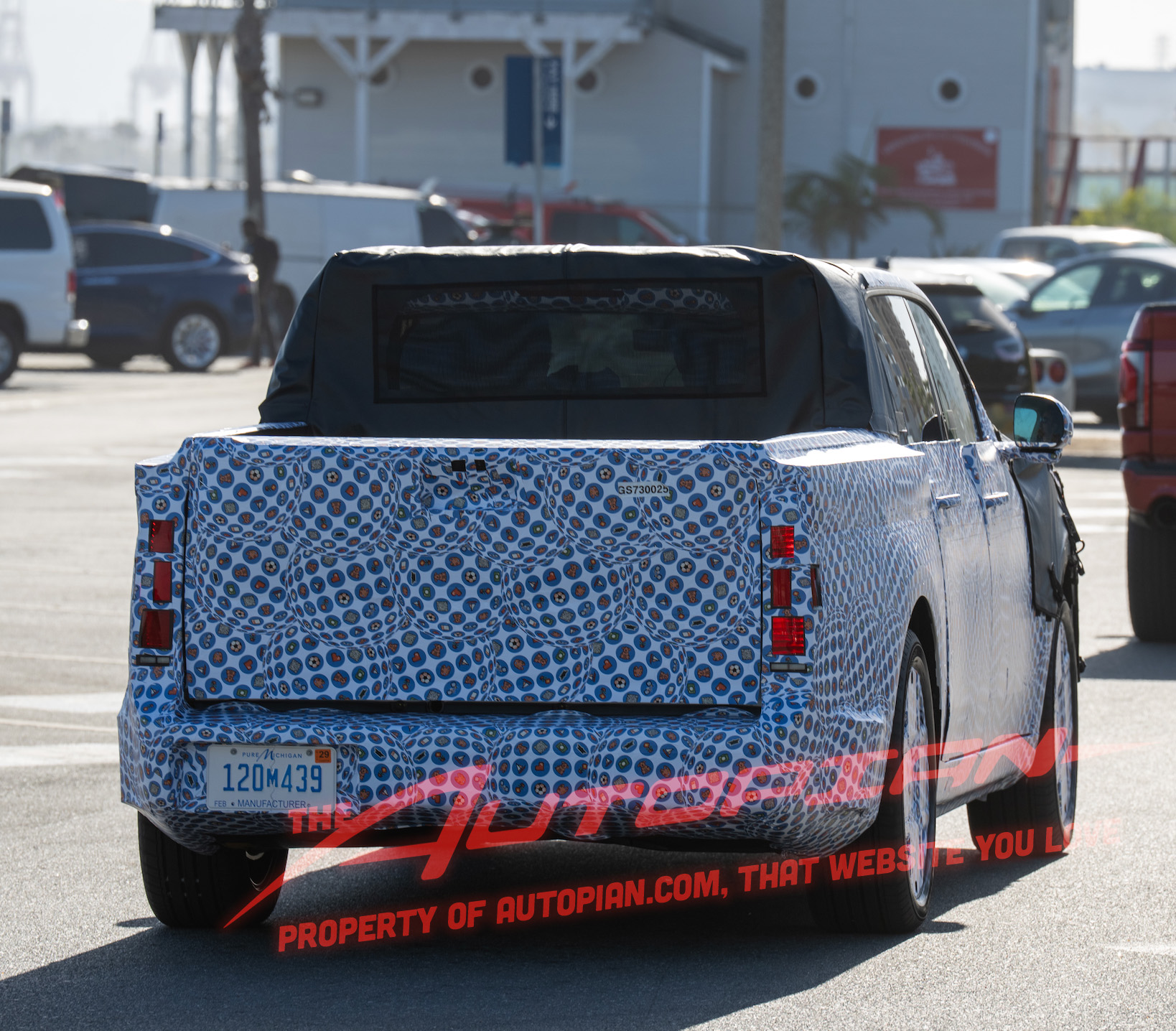
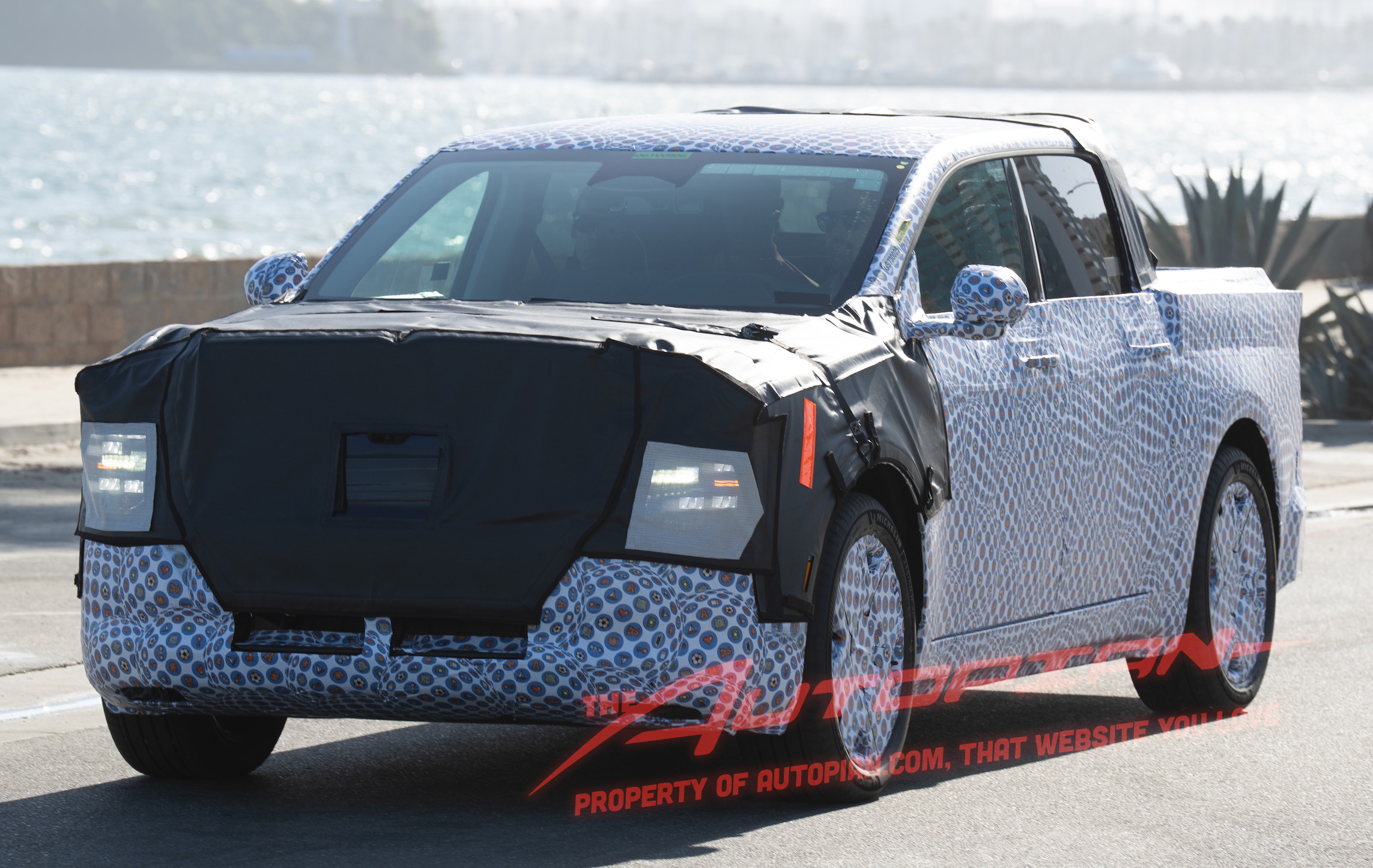
Now let’s get to the nice shots; let’s first check out the side profile without getting too distracted with camouflage that looks like wrapping paper for a baby gift (seriously, I see soccer balls, teddy bears, sailboats, hearts, painters trays, bicycles, hearts… my 14-month baby would love this); Ford has some fabric covers obscuring the shape of the vehicle’s nose and its cab, but the rear does look nice and squared off. I’m standing on a 6″ curb there, to give you a sense of scale:
The windshield looks quite raked, the ground clearance looks modest, and the wheels look fairly small for a modern EV. The second row looks fairly large (at the expense of bed length — if I had to guess, that’s a 4-ft bed), and the wheels appear to have aero-caps. This is definitely a street-focused truck meant to optimize range. I just hope it doesn’t look too soft at the nose; it’s a truck after all.
Look at the size of the two adults in the front of the truck in the image above; that should give you an idea of just how small this thing is.
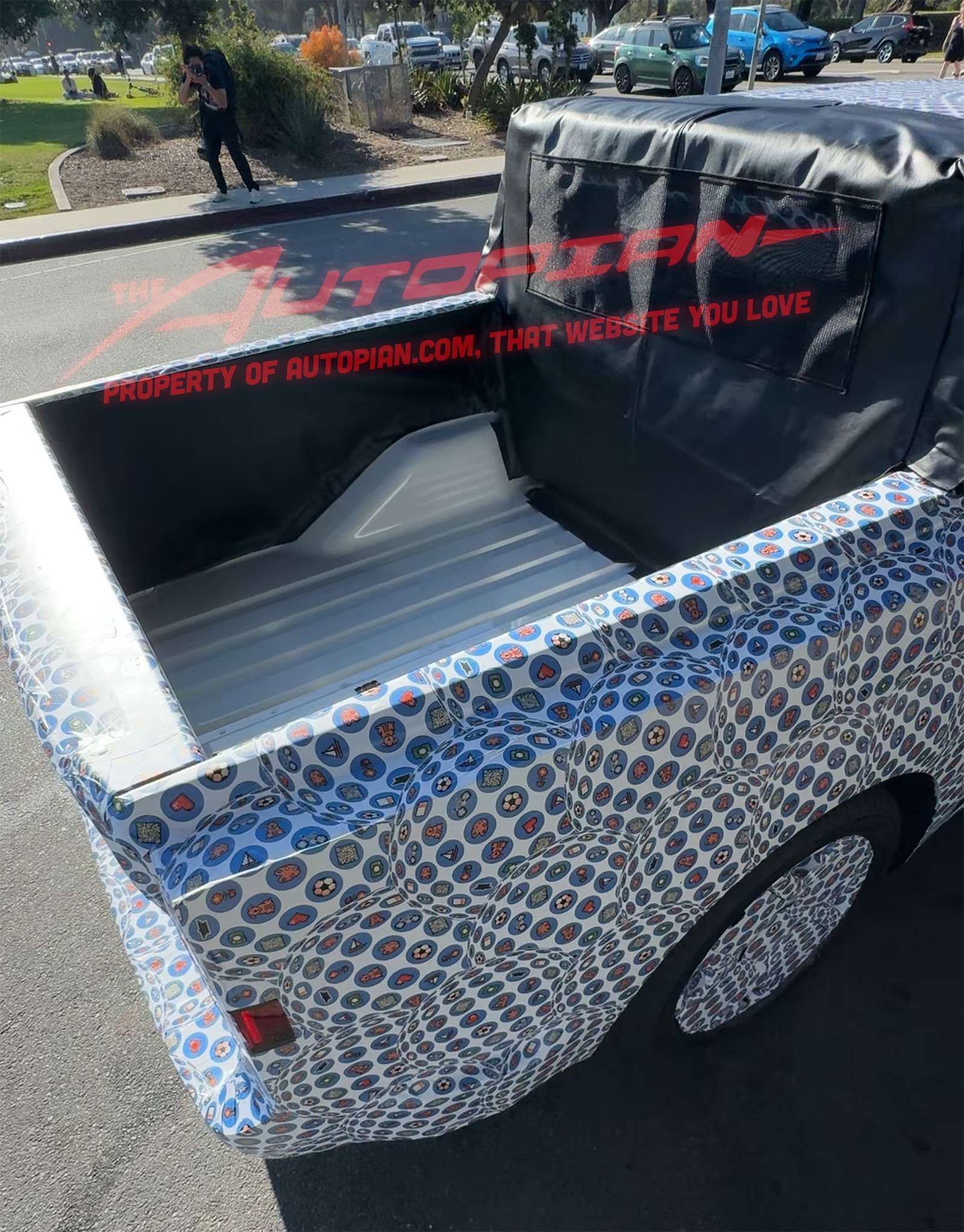
It’s really hard to distinguish the shapes on the truck’s body due to that camo; turns out, my son’s wrapping paper is absolute gas as car-camo. There appears to be some kind of something jutting out from the bedsides.
Speaking of the bed, that’s how it looks inside. It’s modestly-sized, but can probably easily fit a Ford 289 V8 longblock.
While the taillights are just little rectangular cutouts in the “wrapping paper,” I can see a bit of the headlight lenses through the camo, though in truth, I can’t really learn anything of value through that netting. I can tell you that appears to be a small grille opening built into the bumper, and is that a radar sensor in the center of the grille? There appears to be a piece of tape over the center of it, so maybe not. Above that center…thing… is what appears to be a front camera. Man Ford did a great job on this camo; I’m grasping at straws here.
The big thing is scale. America appears to be about to get its first-ever small, affordable, practical electric pickup truck, and I’m far, far, far too excited.
I just like small pickups, is all. I drive a Jeep Comanche around LA, and I regularly think to myself: This is perfect. An electric small pickup truck, especially a four-door? It could be the ultimate daily driver.
This month, Rivian begins customer deliveries of the highly anticipated R2 model that aims to bring the startup’s aspirational adventure lifestyle to the mainstream EV market. That has required cutting costs, scaling production, and reaching new customers—a big brief, then, for the diminutive R2.
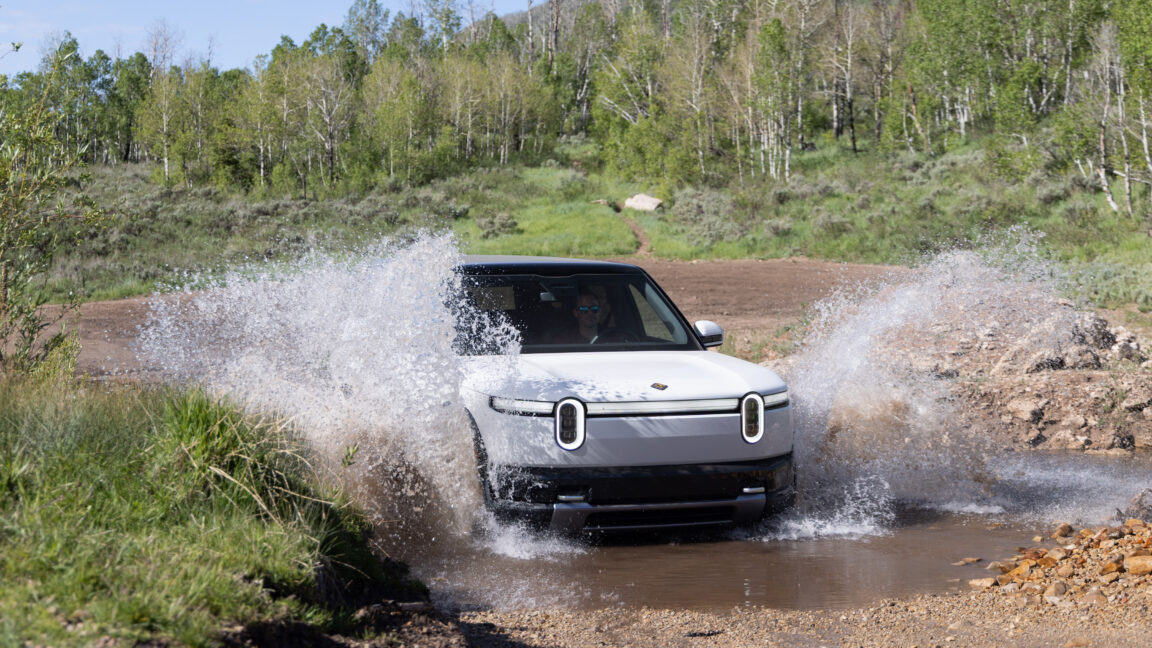
To show exactly how a startup transitions to a mass-market automaker, Rivian hosted a picturesque media event in Utah that included both on and off-road driving in the Launch Edition that stickers for just under $60,000 (including destination). We also got plenty of access to the technological development that underpins the brand’s critical electric crossover.
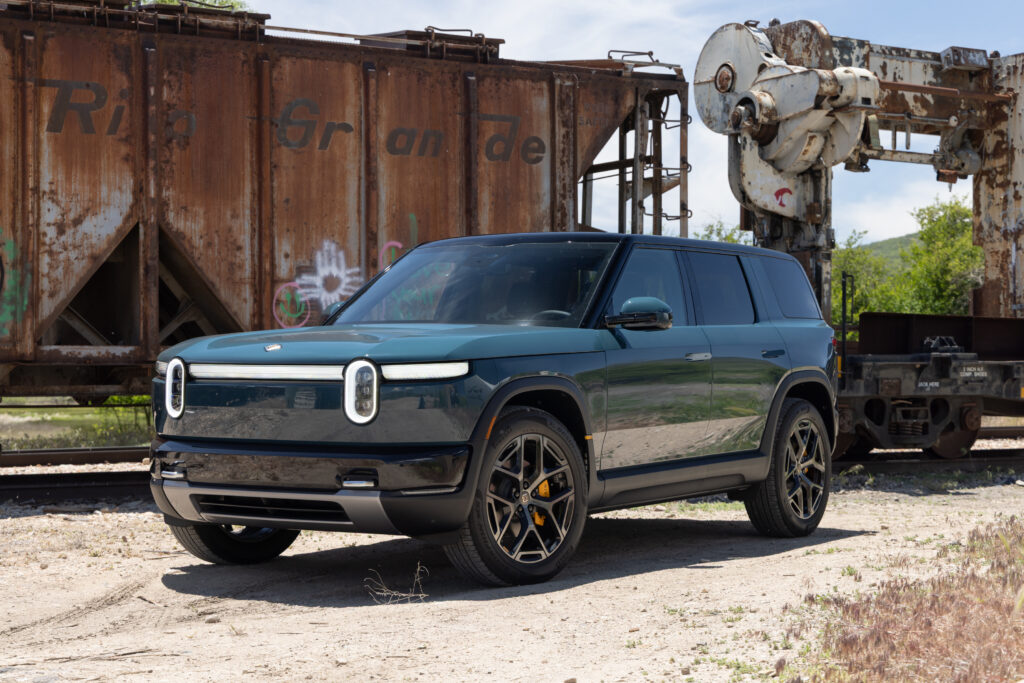
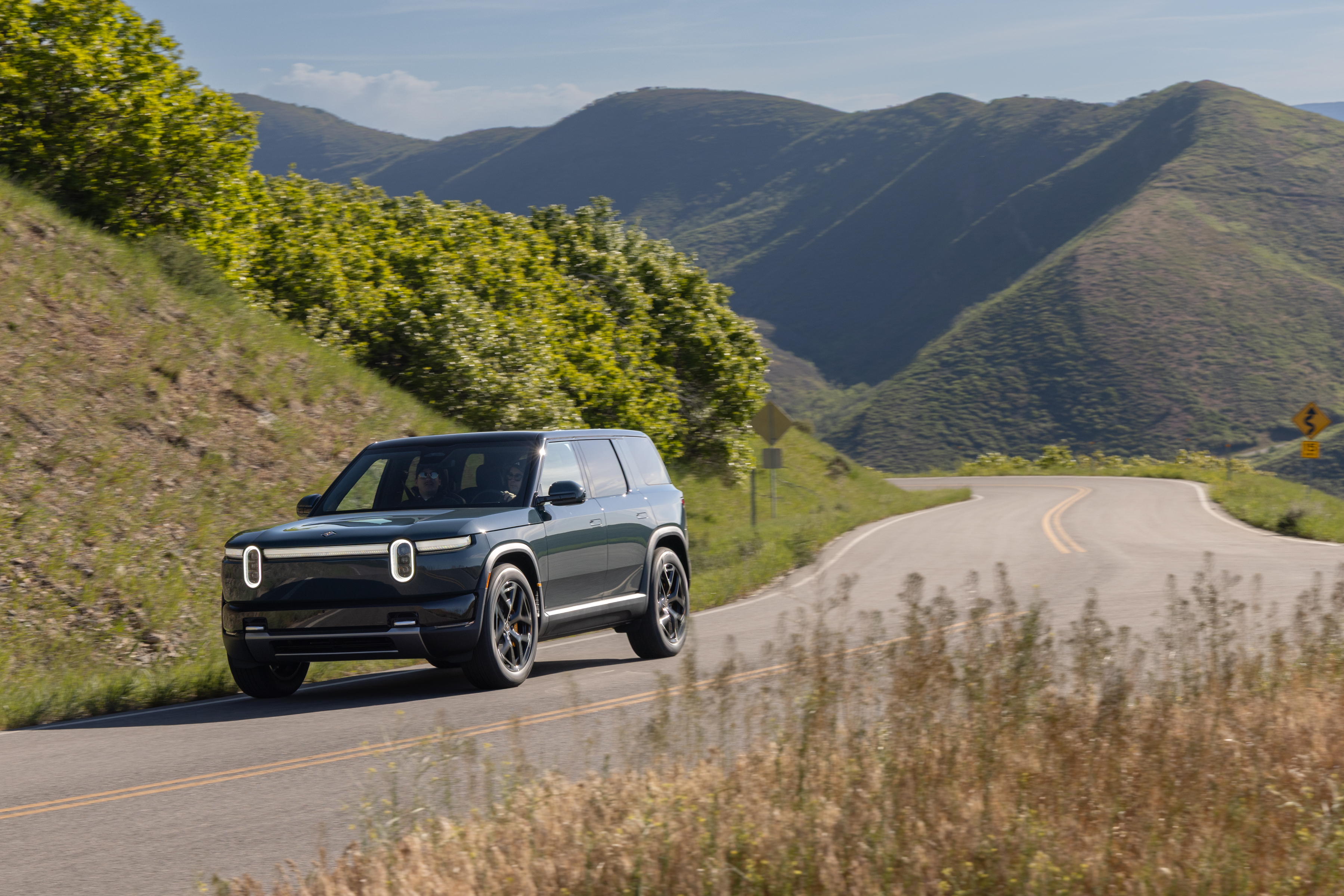
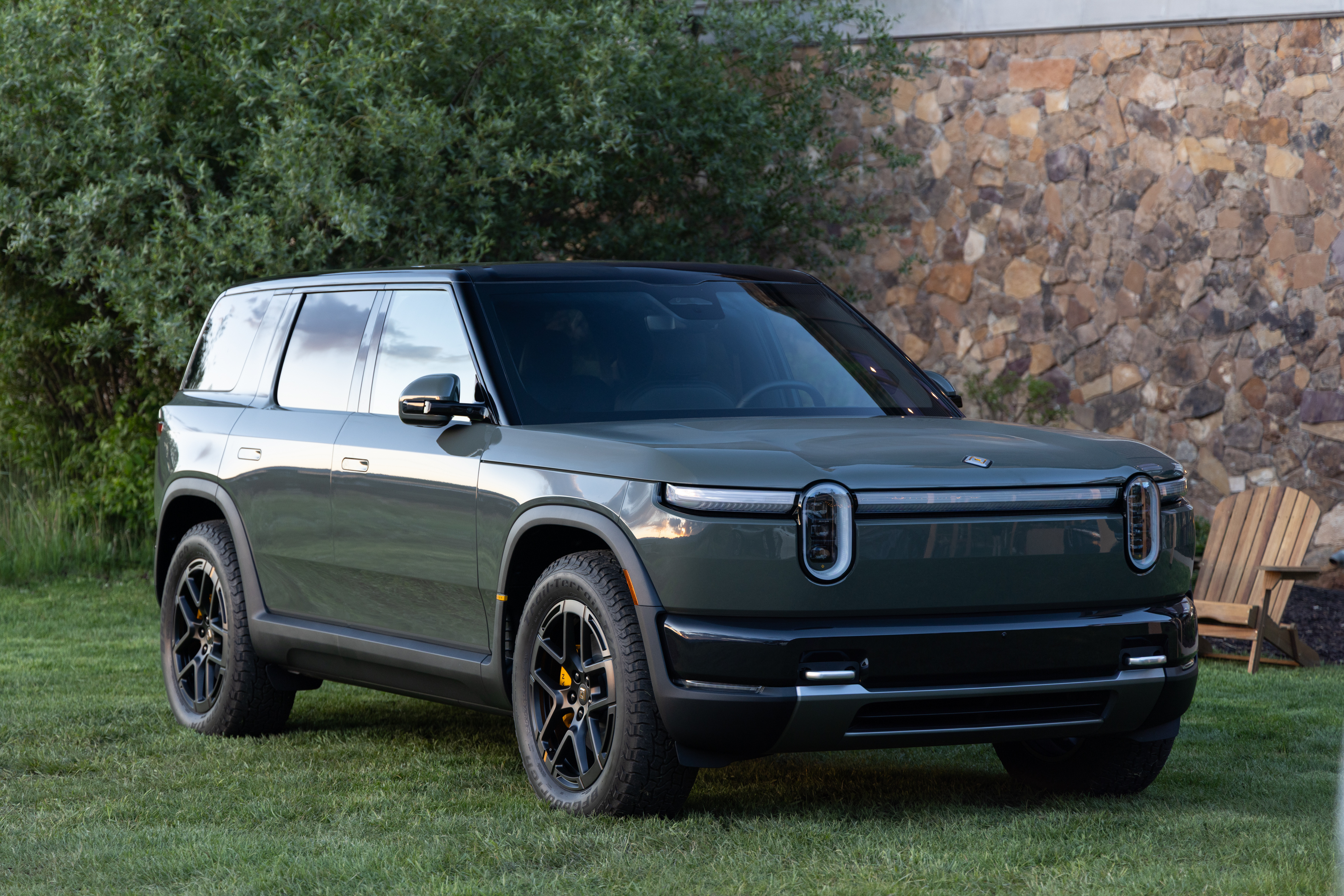
The R2 almost perfectly matches the dimensions of today's best-selling US cars. This dedicated two-row model, versus the R1’s three-row S or pickup truck T, measures 185.9 inches (4,722 mm) long, or about 1 inch (25.4 mm) longer than a Honda CRV. The R1’s instantly recognizable profile and design language carry through, but unique packaging requirements dictated nifty design solutions.
In person, the R2 surprised me with a smaller presence than expected—the length, width, and height seem nearer to Toyota Rav4 size at 180.9 inches (4,595 mm) long. The optical illusion may stem from Rivian using a semi-monocoque and sandwich battery layout rather than a true skateboard, providing more than 9 inches (229 mm) of additional wheelbase than the Rav4.
The family resemblance with the larger R1S is strong.
Credit:
Michael Teo Van Runkle
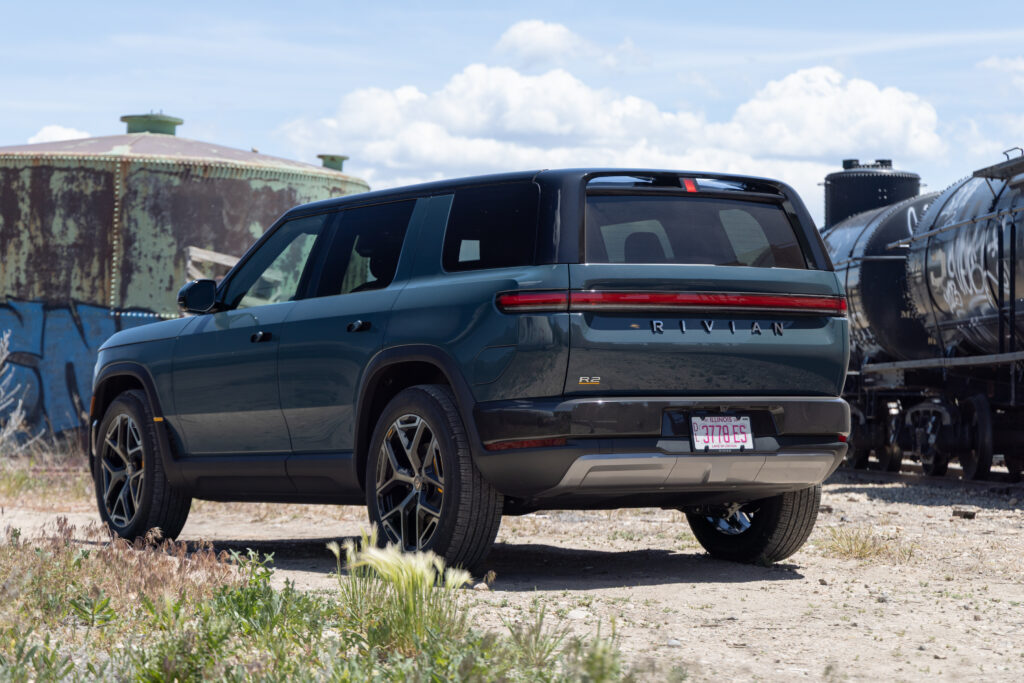
The R2 makes do with just two rows of seats, not three.
Credit:
Michael Teo Van Runkle
Depending on the drive mode, an R1 sits around 8 inches (203 mm) taller, while a Tesla Model Y measures 1 inch longer and just under 3 inches (76 mm) shorter. As befitting Rivian’s off-roady ethos, the R2’s ground clearance matches a base Jeep Wrangler Sport or Sahara at 9.6 inches (244 mm).
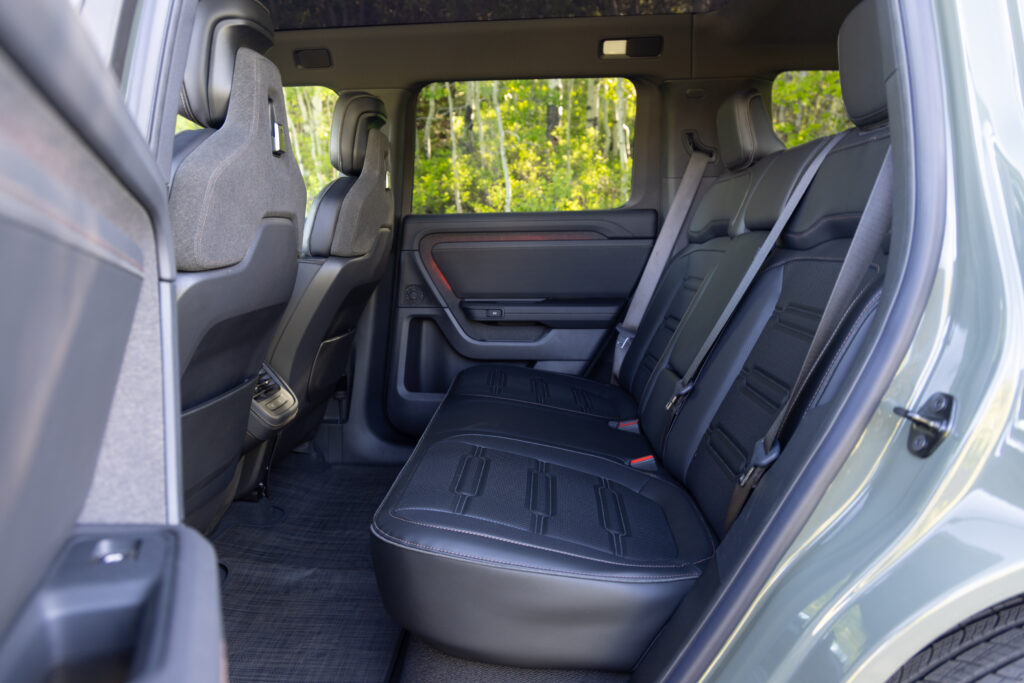
That extended wheelbase allowed Rivian to stretch the second-row legroom versus the R1 while also affording enough space within the passenger doors to fully roll the window glass down. The low beltline, especially compared to the many “coupe”-style SUVs and crossovers on the market, combines with an upright profile to make aerodynamics seem like something of an afterthought.
But subtle smoothing elements—notably the horizontal headlight line, raked windshield, and camouflaged rear spoiler—all help the boxy design achieve a surprisingly slippery 0.3 coefficient of drag. Combined with an 88 kWh battery, the best EPA-estimated range reaches up to 345 miles (555 km) for the eventual single-motor RWD Long Range model, which will hit the market in early 2027.
In Utah, every R2 arrived in Launch Edition spec, which means 330 miles (531 km) of range despite dual motors and a beefy 656 horsepower (482 kW) and 609 lb-ft of torque (826 Nm). These respectable, if not spectacular, targets helped Rivian save on battery costs and weight.
Less wiring, slower charging, cost saving
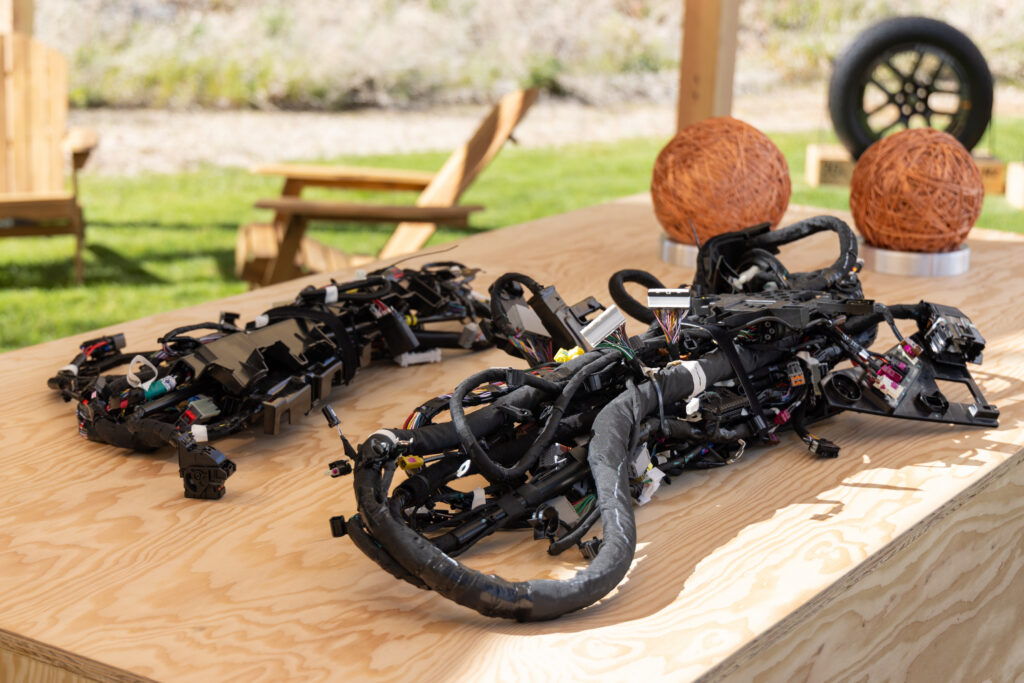
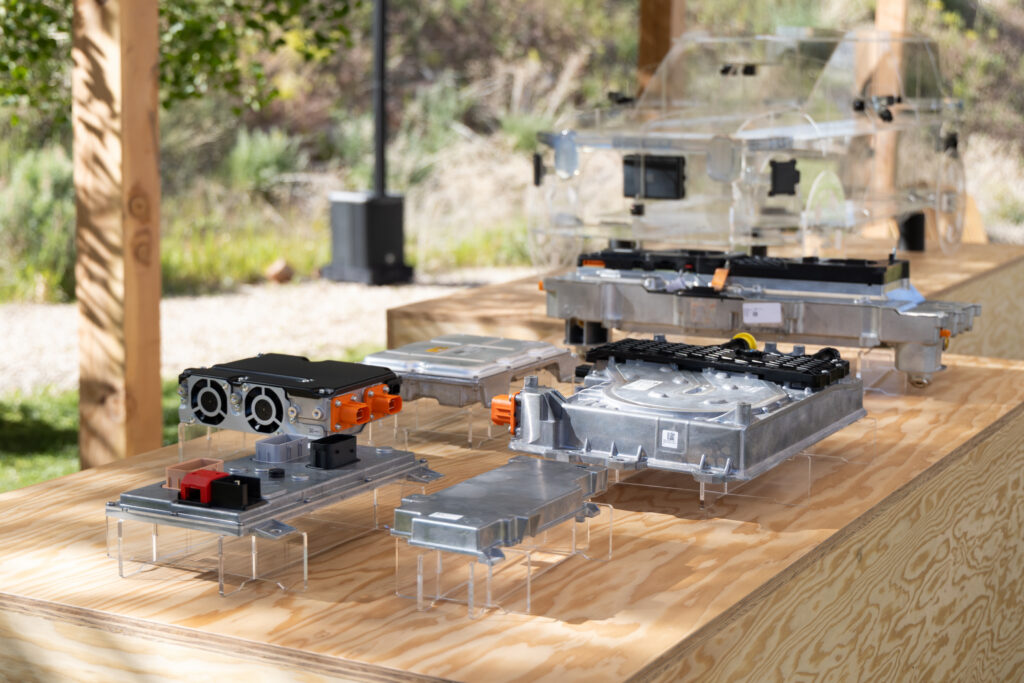
One notable way to reduce cost and weight also helped to simplify the R2’s new OS 2.0 for the infotainment system. For context, the original R1 cut down from 17 ECUs to just 7 for the Gen 2 facelift, which resulted in removing 1.6 miles (2.6 km) of copper wiring. For the R2, another 2.3 miles (3.7 km) of wiring harness evaporate, including 60 percent fewer incline connectors—all told, the wiring refinements alone save 44 lbs (20 kg).
Rivian wiring looms.
Credit:
Michael Teo Van Runkle
Rivian ECUs.
Credit:
Michael Teo Van Runkle
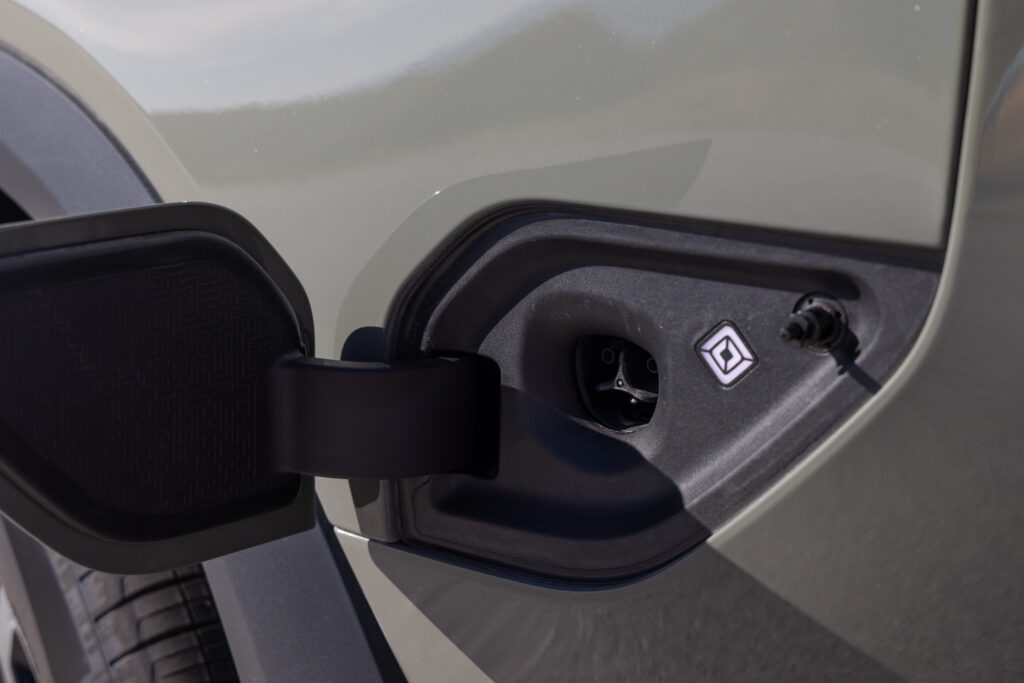
Another cost-saving measure comes as more of a surprise. Rather than switching to an 800 V architecture to improve charge rates, Rivian stuck with 400 V and adopted the NACS charge port (a CCS adapter will come standard in CARB states or optional in the gear store). This move further reduced the final customer price enough that the most affordable R2 will start at less than $45,000. On the other hand, 400 V does restrict the max charging rate to just 230 kW, good enough for a middling 10–80 percent DC fast charge time of 29 minutes.
The relatively average charge rate should also help extend battery longevity—a plus, given that the R2’s specs cater more generally to daily driving than the adventure lifestyle. Still, adopting the R2 for a commuter car will likely require a Level 2 home or work charger, which makes the newfound ability to charge up to 11 kW bidirectionally to home, other vehicles, or any load all the more attractive.
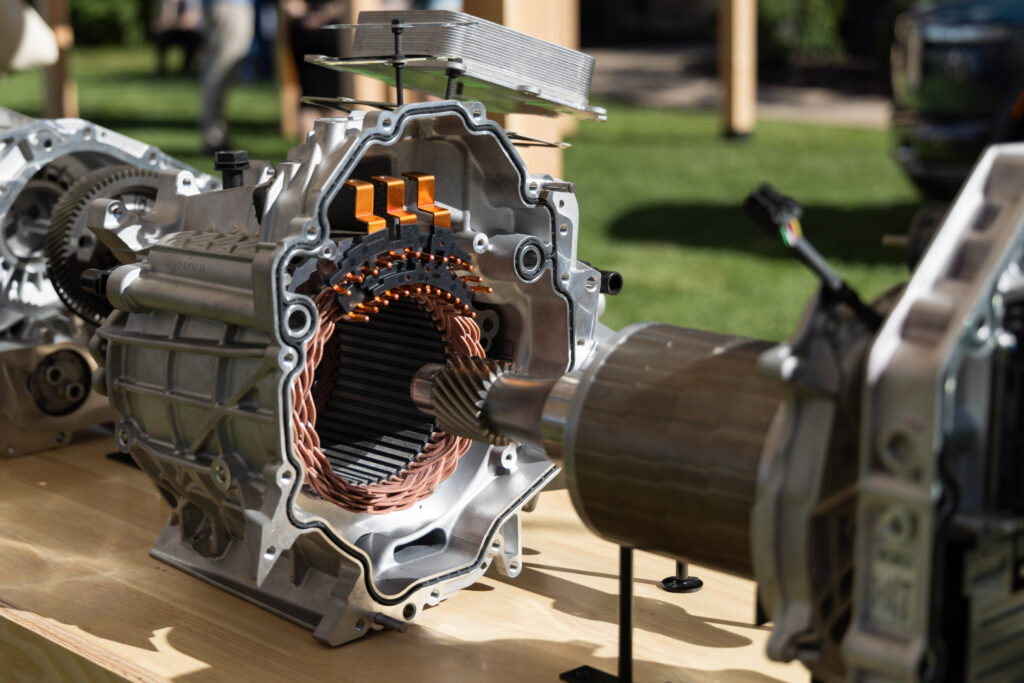
The Launch Edition R2s in Utah employed a duo of “Maximus” permanent-magnet radial-flux motors—critically, not shared with the R1—that use a side-mounted inverter, direct oil cooling, and a single-piece rotor and input gear. The front motor gets a full disconnect for highway efficiency, another contrast with the R1, which attempted to maximize range by effectively switching to front-wheel-drive in moments of low demand.
Hopping between three different R2s over the course of the day prevented a real chance to test range estimates other than by rough math, and the onboard readout varied widely from 2.0 mi/kWh (3.2 km/kWh) while pushing hard to well over double that at lower speeds. Determining real-world efficiency will have to wait for a full review.
A Rivian drive unit on display.
Credit:
Michael Teo Van Runkle
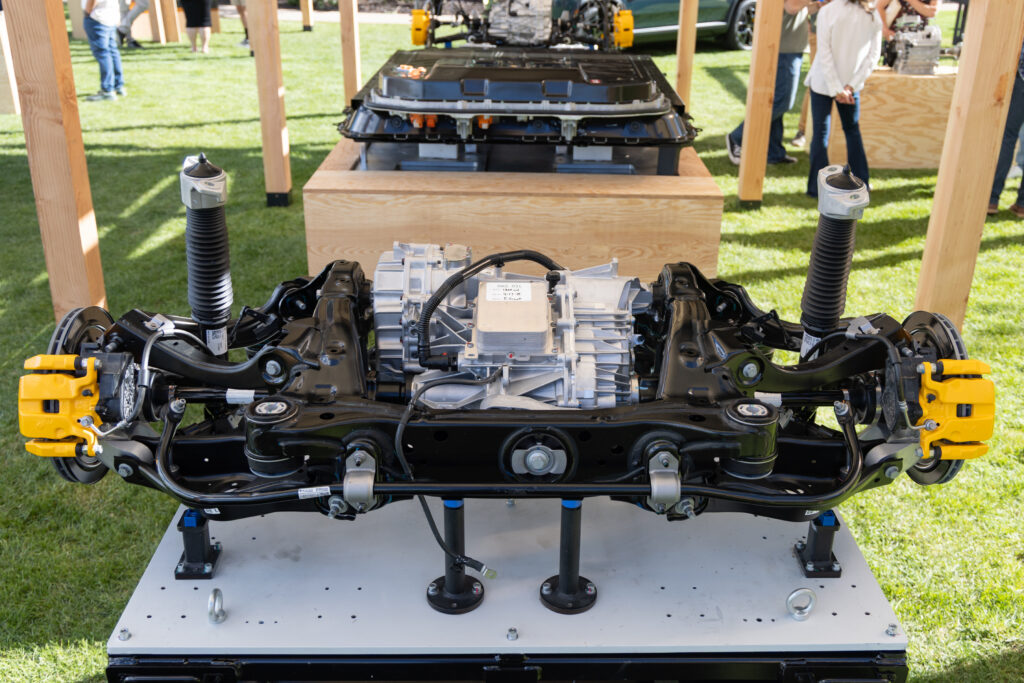
Rivian suspension components.
Credit:
Michael Teo Van Runkle
But power and range skepticism never fit into the Rivian narrative—instead, my main critiques for the R1’s multiple iterations always focused on the steering, suspension, and frustrating user interface. Happily, as soon as I jumped into the R2 for the on-road portion of the day, all those concerns flew out the window.
Again, at least partially to cut costs, the R2 abandons the R1’s hydraulic roll control system, which caused stiffness, unnecessary clunking, and inconsistent response in almost any driving scenario. The R1 seemed to fight the steering wheel, with a strangely mechanical resistance that combined terribly with excessive electric assist and resulted in an off-putting sensation for an SUV or truck whose price tag can easily climb into six figures.
A better driving experience
The R1 used a ball-screw and electro-hydraulically assisted steering rack, but the R2 saves 6.6 pounds (3 kg) with a new dual-pinion rack and electric assist motor. The assist architecture changes greatly with load; naturally, the larger and heavier R1 needs to handle more and therefore also weighs more. By contrast, the R2’s steering, though still on the lighter end of the spectrum as expected of a daily driver, noticeably improves steering feel, precision, and weighted resistance to turning.
Almost more importantly, the R2 relies on real sway bars to manage side-to-side body roll rather than the hydraulic setup, which might work well for lightweight McLarens, but because the R1 weighs as much as 7,148 pounds (3,242 kg), it requires excessive pressures to actually control mass. Those pressures border on turning hydraulic fluid into a solid, which, especially when paired with larger wheels and narrower tire sidewalls, prevents any semblance of a smooth ride, even on the best asphalt.
With a smaller footprint, lower profile, and improved engineering, the R2 sheds around a ton of weight (quite literally, though depending on R1 spec) down to a relatively svelte 4,998 pounds (2,267 kg) for the dual-motor variants. That’s less than many internal-combustion-powered crossovers and SUVs, even.
The suspension is much less complicated than the R1, and that's a good thing.
Credit:
Michael Teo Van Runkle
Though the R1 might corner flatter and quicker than an R2, the sway bar setup allows the semi-active and adjustable shock dampers to more steadily aid in both absorbing road imperfections and managing weight transfer. This means the R2 can ride over every tarmac surface—rougher asphalt, speed bumps, and wavy corners—with more compliance and comfort. And even with some additional lean, squat, or pitch versus the supercar stability of the R1, the R2’s suspension and steering unlock more confidence while unleashing all 656 hp.
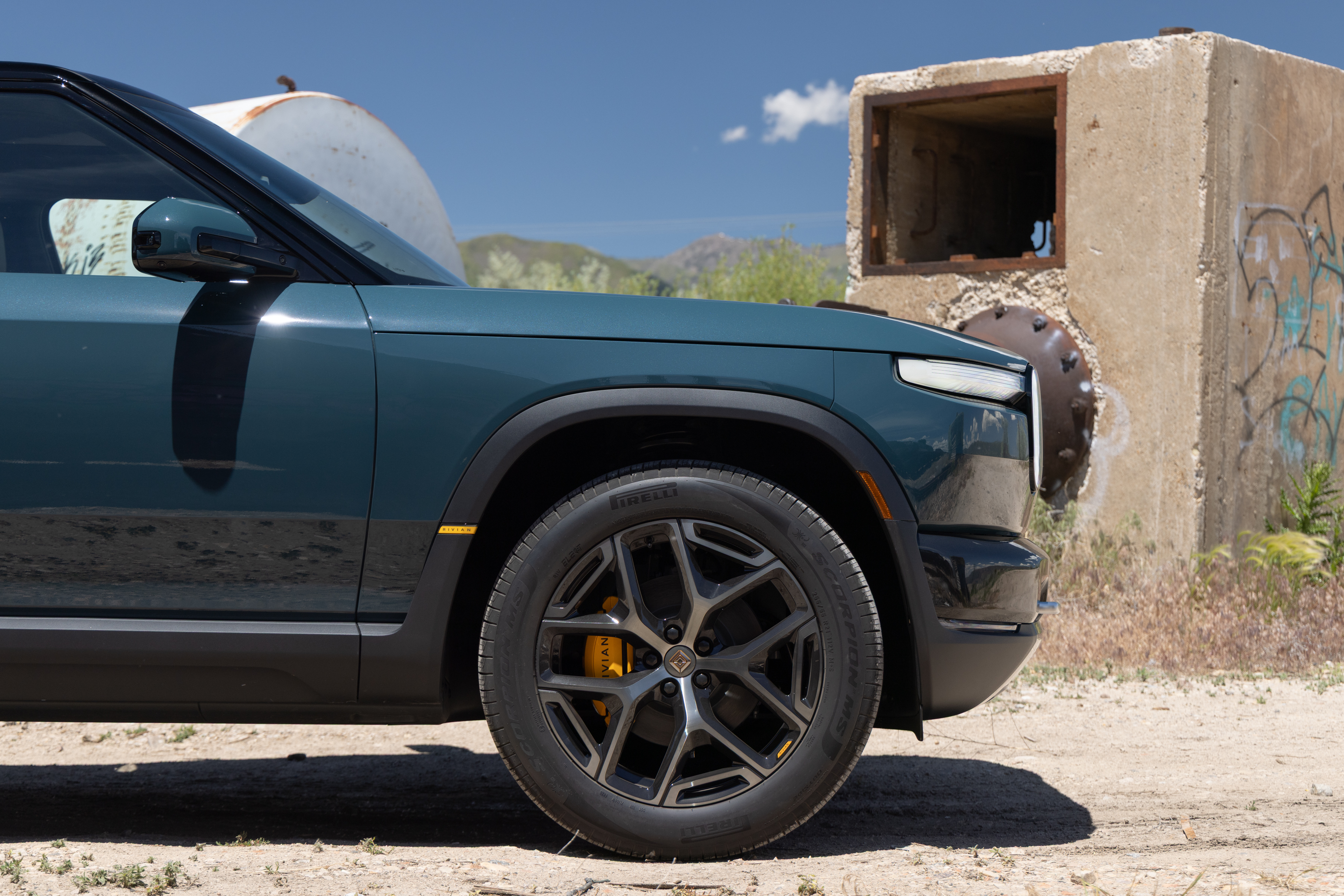
While clearly not tuned to deliver the brutal gut-punch of higher-performance EVs (like the Tesla Plaid, Lucid Air Sapphire, or Rivian R1 Quad), the easily accessible power delivery eclipses all but the sportiest ICE and hybrid crossovers (Porsche Macan, BMW X3 M Comp, Maserati Grecale Trofeo). There are no fake engine or futuristic electric motor noises here, either. The low CoG and perfect weight distribution then pair with that instantaneously available torque, the suspension lean, and steering precision to make exploring the limits of the standard Pirelli Scorpion all-season tires a joy.
Simply put, the little R2 absolutely rips.
The trade-off, as expected, comes in the form of reduced capability while off-roading, namely in wheel travel. Rivian reps declined to confirm or deny a more hardcore variant that may or may not employ a disconnecting front sway bar, but in the meantime, the R1 definitely takes the off-roading cake—but only in terms of all-out capability.
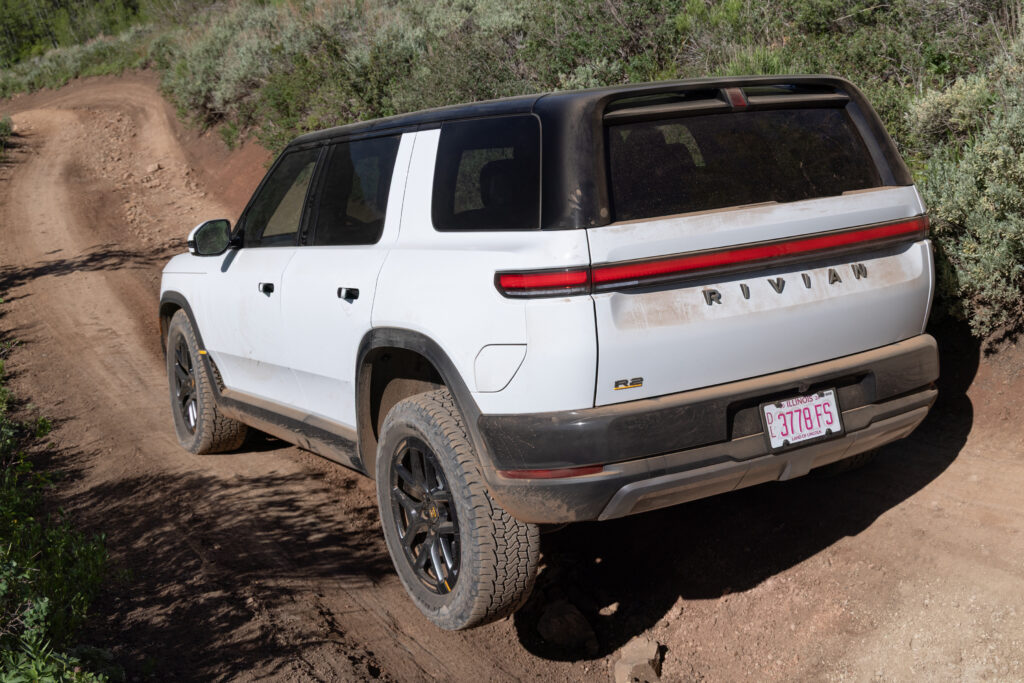
The R2 rides smoother and softer without the adjustable ride height and individual corner control. And even if that 9.6 inches (244 mm) of ground clearance to match a Jeep does come courtesy of independent four-wheel suspension rather than a solid rear axle, the R2’s short overhangs translate to relatively solid approach and departure angles of 25 and 26 degrees.
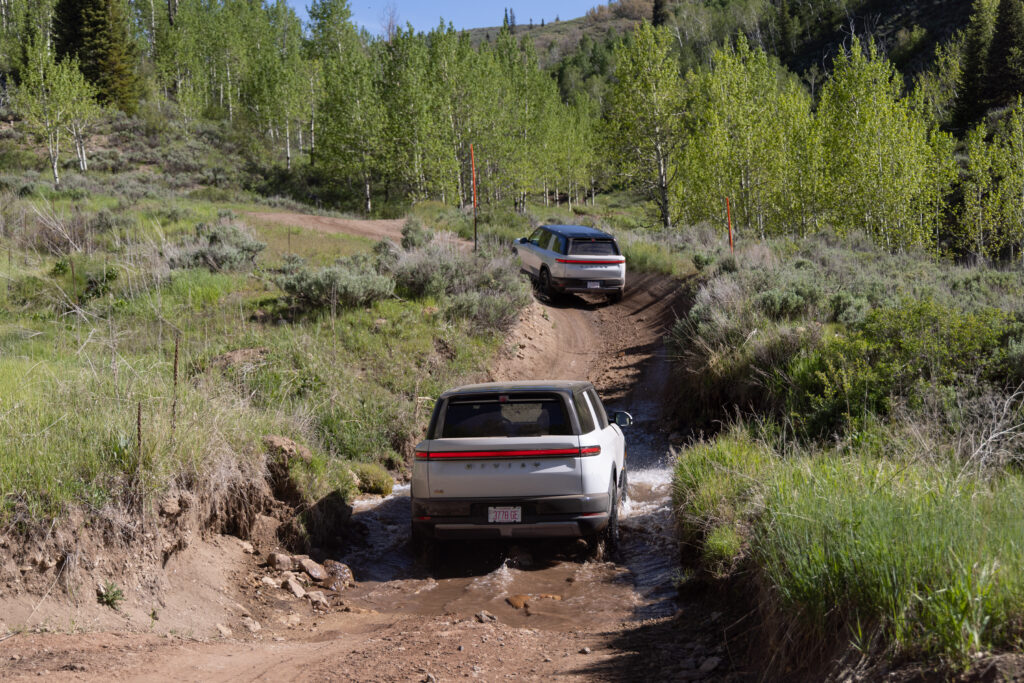
As is usually the case with a Rivian drive, we got our tires muddy.
Credit:
Michael Teo Van Runkle
It's not quite as capable off-road as an R1, but it will handle the rough stuff.
Credit:
Michael Teo Van Runkle
I never needed to worry about scraping while climbing or descending, though the modest breakover angle of 20.6 degrees meant I had to focus a bit on preventing the smooth underbody from dragging over elephant tracks or through larger ruts. Off-roading the R2 also revealed Rivian’s next step in traction control programming. Where the R1 tended to spin wheels and roast tires on dirt or rocks, the R2 trundled up small shelf aspects and rugged terrain without nearly as much slip.
Of course, weight savings help here as much as the BFGoodrich Trail-Terrain tires that Rivian aired down to 25 psi for our excursion off the pavement. But as I flipped through all the various off-road modes, including an option to play with stability control settings, I rarely revved up or juiced the motors enough to break loose—unless I was playing around in Rally Mode and trying to prompt lateral slides on purpose.
Now with brake-by-wire
With regenerative braking fully active in off-road modes, the R2 effectively turns one-pedal driving into a nearly perfect hill-descent control system. I say “nearly,” though, because if I let my speed go over about 4 or 5 miles per hour, the system would loosen up and start to coast a bit faster. This transition happened at a few awkward moments, and the release phase needs a bit of further refinement.
Any touch of the brake pedal adds friction brakes, regardless of drive mode, because Rivian blends regen and friction braking. But the R2 also introduces true hydraulic brake-by-wire versus the R1’s electrically boosted hydraulic system that physically links the pedal to the pads at all times.
Big wheels, plenty of clearance.
Credit:
Michael Teo Van Runkle
Where the R1 required more pedal travel, the R2’s braking feels firmer and more consistent with physical effort. A rubber block constructed of two different durometer elastomers in series replicates the curve of braking force versus travel perfectly, and in the event of an electrical failure, a full push to the “floor” engages a purely hydraulic backup. Unlike the R1, therefore, the R2’s braking system is now OTA-updatable. That brings us to the new user interface, a major detail for the R2.
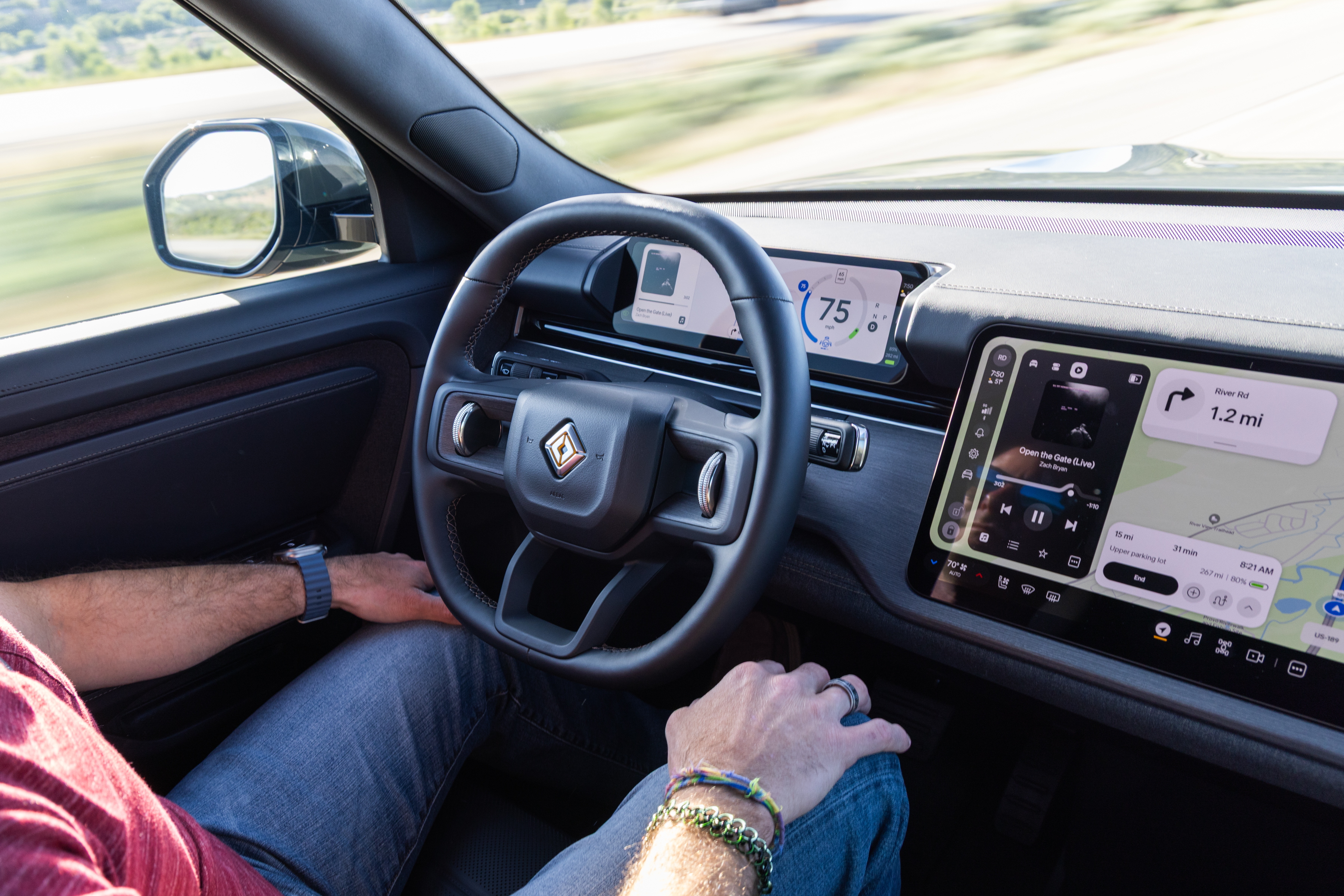
Rivian still calls the R2 a “software-defined vehicle” but increasingly also an “AI-defined vehicle.” The R2 boasts the highest amount of computing power of any car on sale today, with 200 TOPS (trillions of operations per second) dedicated to the infotainment system alone. Though the media drive came before the rollout of Rivian’s forthcoming AI assistant, which will arrive later this summer, I tested the latest Universal Hands-Free (UHF) semi-autonomous driving feature, which Rivian claims has been used more than 3.5 million times for more than 14 million miles (22.5 million km).
UHF on the gen-two R1 employed 55 megapixel cameras, but the R2 steps up to 65 megapixels. The same features carry over, and in fact, the software can’t seem to tell whether it’s being used in an R1 or R2. Rather than showing a graphic representation of following distance, fiddling with the cruise control settings on the gear selector stalk can bring up a “Spicy” mode that happily tailgates enormous semi trucks. The system cannot change lanes automatically to avoid slower traffic, even after activating the turn signals, but a true point-to-point update will supposedly arrive later this year to better match Tesla’s Full Self-Driving mode.
Universal Hands Free is Rivian's partially automated driving system.
Credit:
Michael Teo Van Runkle
How's the interface?
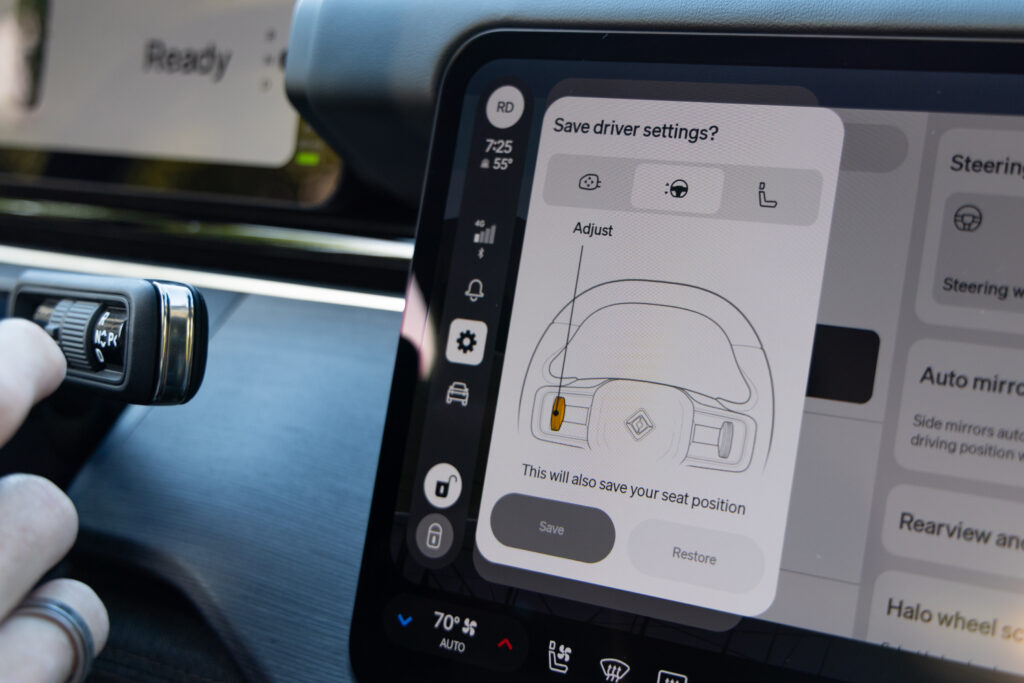
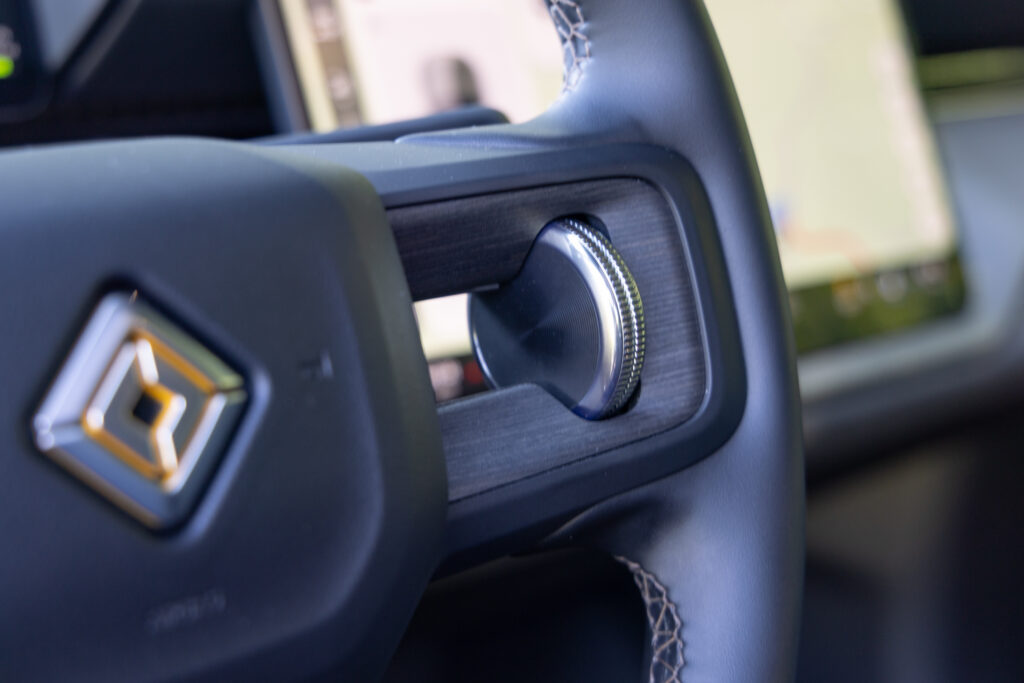
For now, the R2 also benefits mightily from the introduction of true physical controls, dubbed “Halo” dials, on the steering wheel. These two electroplated, injection-molded plastic spinners perform all the expected functions for adjusting seat, mirror, and steering wheel positions; changing infotainment volume; or selecting drive modes.
But unlike other automakers, Rivian also allows the halo dials to toggle fore and aft in a similar fashion to paddle shifters—and even tilt inward and outward laterally to make gauge screen widget selections. This allows for changing the climate fan speed, display backgrounds, song selection, and much more—though the programming purposefully changes each response based on the context of what’s currently happening, which felt more inconsistent than convenient.
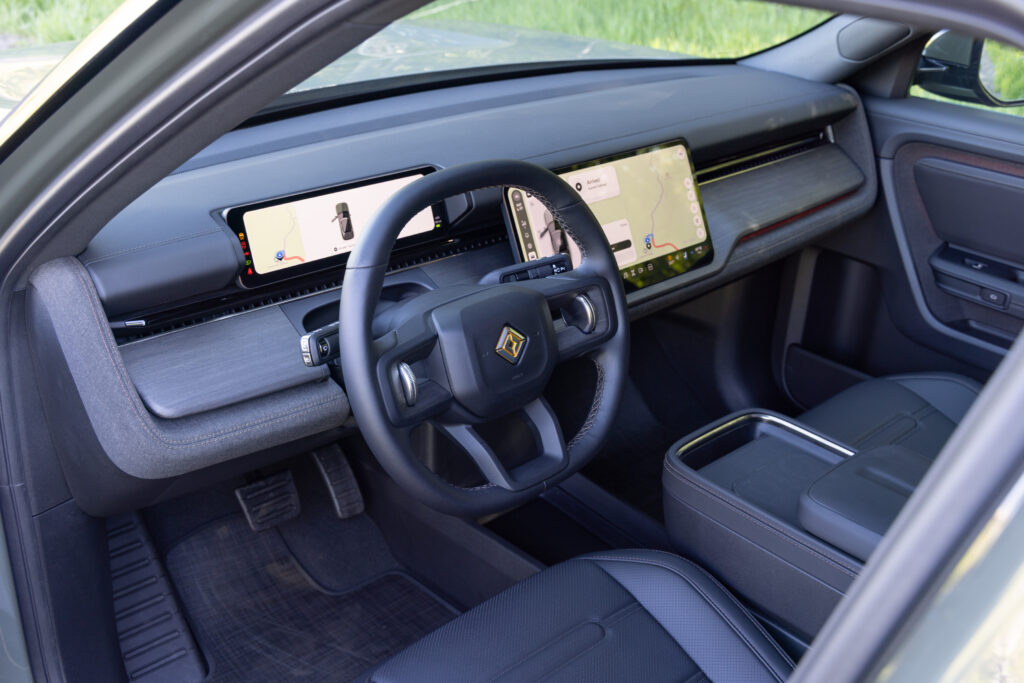
Plenty of changes still require dipping into the central touchscreen, too, though a more widescreen-style horizontal aspect ratio with the main status bar moved to the left (closer to the driver’s hand) also helps here. As a surprise, rather than ditching the electrically adjustable climate vent fan direction, which probably costs and weighs more than simple physical sliders, the R2 sticks with the same system as the R1—legitimately an annoyance and one that borders on dangerous. In response to questions about this choice, the only justifications seemed to be a cleaner dash design and the popularity of saved driver profile settings.
Again, the settings button in the status bar responds with “smart” interpretation of input intentionality rather than opening the same page every time. Other than that, the Halo wheels look metal but are actually plastic, and the side clicks feel much less substantial than the discrete roller actuation. Though better than a Tesla’s tiny balls, the Rivian solution lacks the premium tactility of a Lucid Air’s dials (once more, cost savings come into play).
The R2 cabin.
Credit:
Michael Teo Van Runkle
The R2 relies on its touchscreen.
The new thumb wheels.
Credit:
Michael Teo Van Runkle
The back seat.
Credit:
Michael Teo Van Runkle
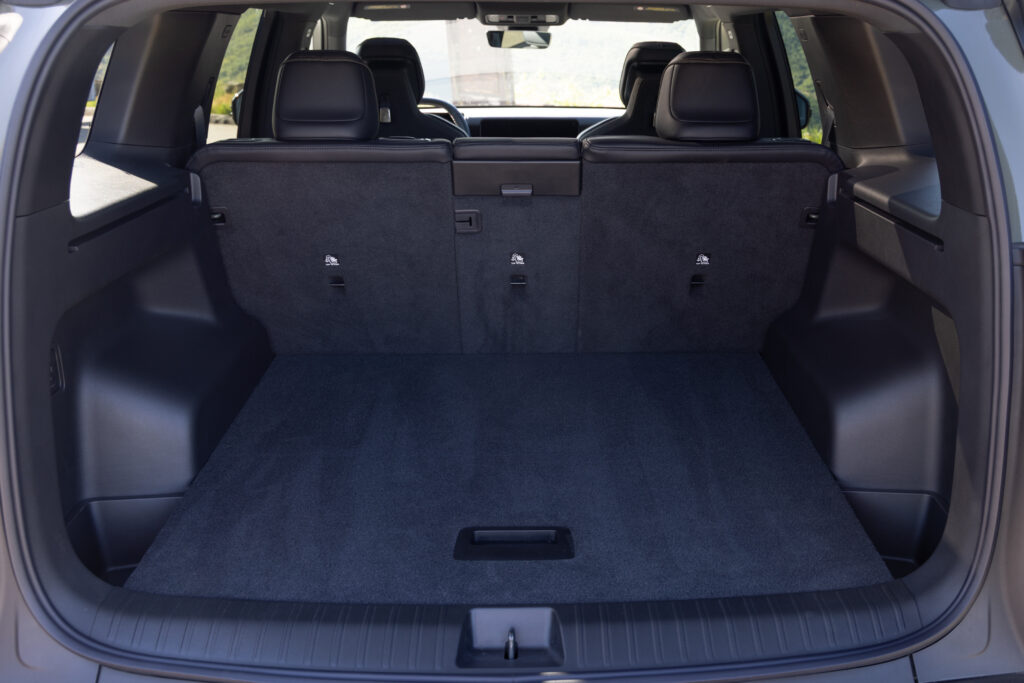
Here's the cargo area.
Credit:
Michael Teo Van Runkle
A native NACS port.
Credit:
Michael Teo Van Runkle
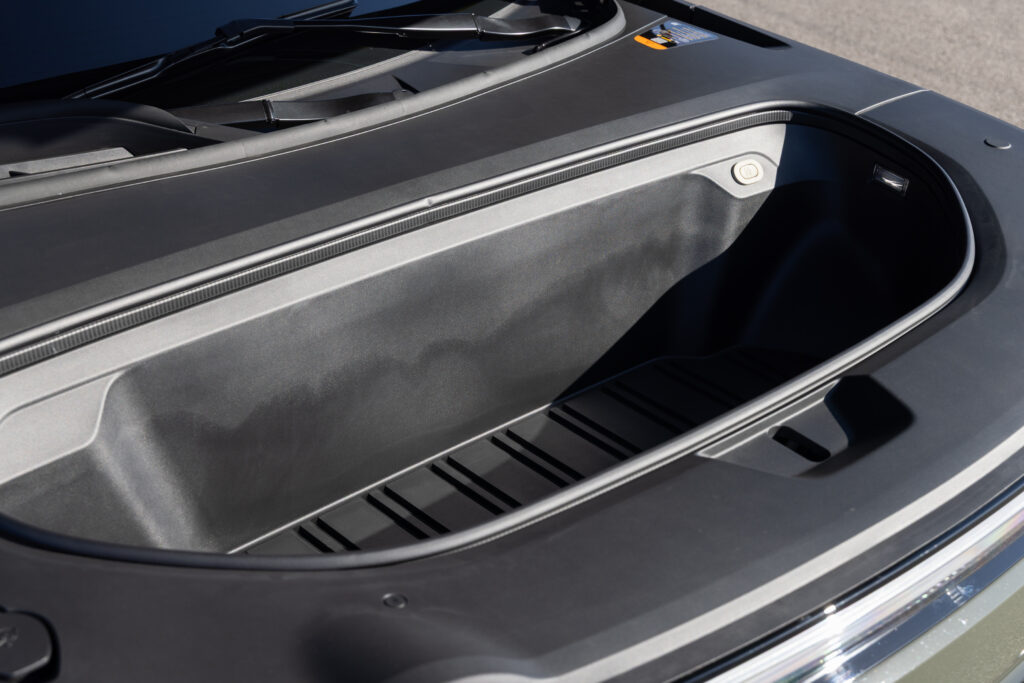
Here's the frunk.
Credit:
Michael Teo Van Runkle
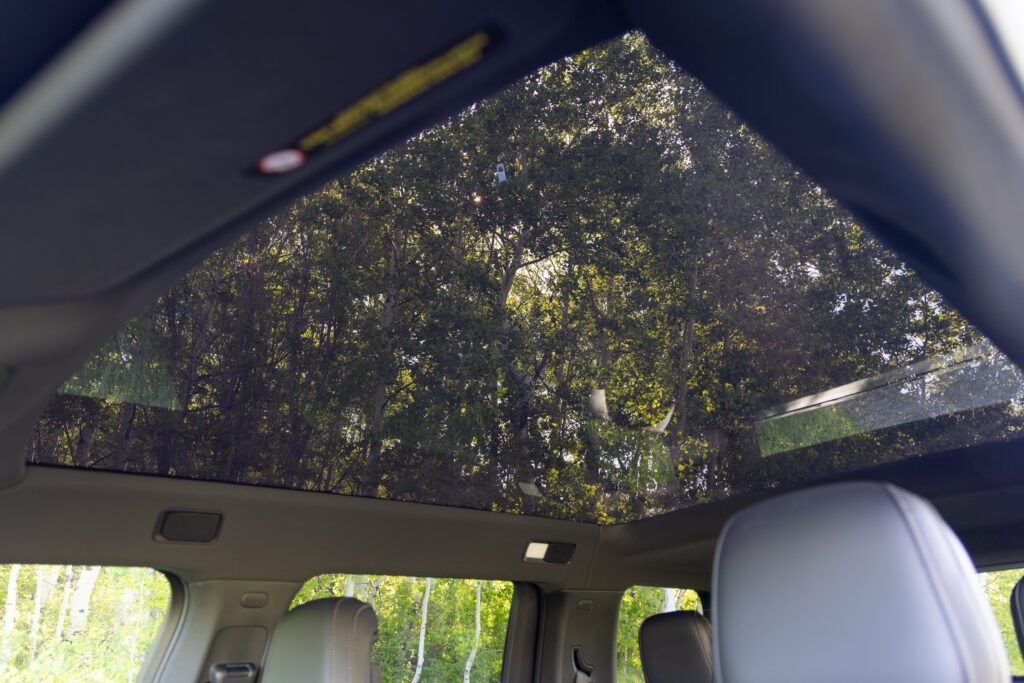
At some point, a not-glass roof will be an option.
Credit:
Michael Teo Van Runkle
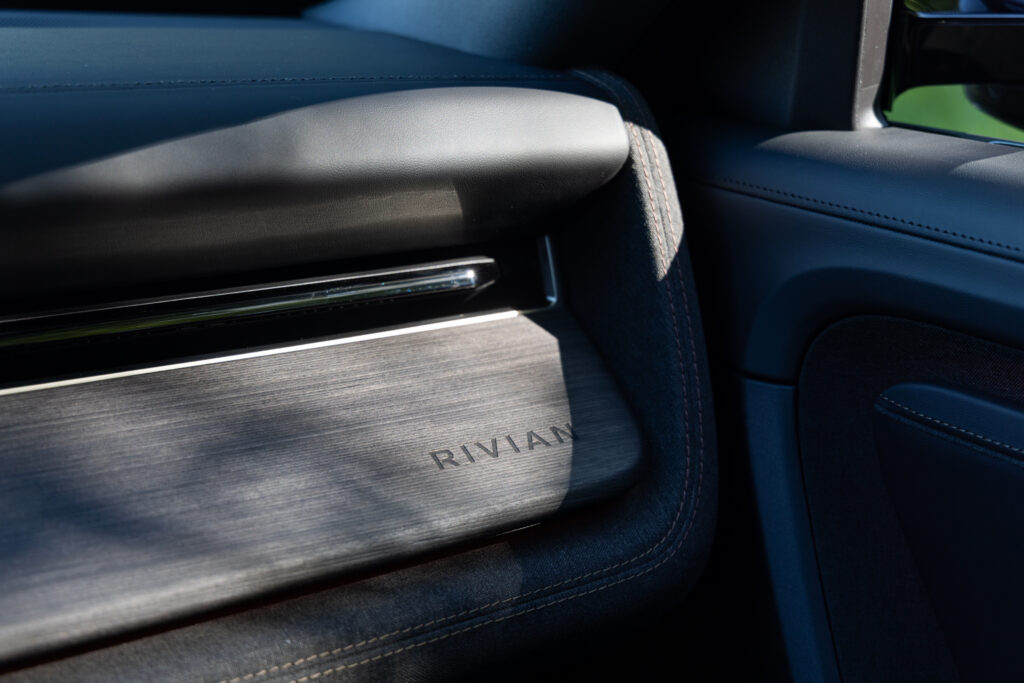
Open grain wood for the dash.
Credit:
Michael Teo Van Runkle
I appreciate the ability to change drive modes without taking my hands off the steering wheel, but I wish Sport mode firmed up the steering. And for that aspirational adventure lifestyle, Rivian should offer the BFGoodrich Trail-Terrain tires on the smallest 19-inch wheels rather than the 20-inchers as currently.
Those all-terrains eat 23 miles (37 km) of range versus the Pirelli Scorpion all-seasons, though, so only dedicated off-roaders need to worry about such details. And in fairness, airing down to tackle more difficult trails makes much less sense in the R2 than the R1.
On the other hand, everyone should hope for the eventual availability of a solid roof to replace the fully glass ceiling currently available across the R2 lineup. I hate sun glare and the obvious climate control inefficiency of glass above my head in an EV, no matter the tint or silver layer Rivian employs to improve insulation.
Still, despite these finer criticisms, considering the impressive performance, premium design, and shockingly low price, the R2 clearly shows how much Rivian has learned and evolved since launching the R1 for model year 2022.
Some fun customer feedback details include not one but two gloveboxes and dual speakers moved to the center console rather than the doors—both to make way for larger water bottle pockets and to reduce NVH (noise, vibration, and harshness) by allowing the subwoofers to force-bind in sync with each other.
The R2’s improvements will be carried back to the third generation of the R1 and then continue trickling out to the eventual R3 and R3X. For now, the R2 stands out as one of the best new cars of the year, thanks to delivering exactly what Rivian customers want from an everyday EV. It also improves sustainability, with 25 percent of the total vehicle mass produced from recycled or biologically derived materials.
Not bad for a sophomore effort, Rivian.
Credit:
Michael Teo Van Runkle
Rivian still believes that the future of 100 percent electric vehicles represents the endgame for the entire automotive industry, even amid widespread backtracking from legacy automakers toward more internal-combustion and hybrid models. Though the road to reach that horizon still looks long, the R2 deserves to bring Rivian to the masses and ever closer to bringing that vision for the future to fruition. That's especially true given the price point and even more so as an appealing alternative to the Model Y, against which the R2 absolutely reigns supreme.
Denver is known for a lot of things. Its Taiwanese population is not one of them.
But about a decade ago, Taiwan moved its regional “consulate” to the Mile High City from Kansas City, Missouri. The reason was more about pragmatism than symbolism — Denver has a more robust airport — but Debby Huang, who leads the Taipei Economic and Cultural Office, said it has allowed her to build deep relationships in Colorado and share her country’s story with Coloradans.
“The most important job for me is to help more Americans better understand Taiwan and what Taiwan’s challenges are in the international society,” she said.
Chief among those challenges is the threat China poses to Taiwan.
We interviewed Huang at her office in downtown Denver to learn more about her office’s work and her path into diplomacy.
A view of the Taipei skyline with the iconic Taipei 101 skyscraper, the tallest building in Taiwan, in Taipei, Taiwan on Dec. 22, 2022. (AP Photo/Chiang Ying-ying)
The following has been edited for clarity and length.
The Colorado Sun: People have probably heard about consulates before, but maybe not of an economic and cultural office. So can you explain the difference and talk about what your office’s mission is?
Debby Huang: Taiwan, Republic of China — we don’t have a formal relationship with the United States. So that’s why we call ourselves the Taipei Economic and Cultural Office in Denver. We have many offices in different cities. We all function like consulates. We can issue visas and Taiwanese people come to our office. They can apply for passports. We also have the privileges of other countries’ diplomats. We enjoy immunity and tax exemptions. Our license plates are special. We have diplomatic car plates.
The Sun: What attracted the Taiwanese government to Denver?
Huang: I think the reason we moved here probably has to do with Denver International Airport. We cover six states: Colorado, Missouri, Kansas, Nebraska, South Dakota and North Dakota. All of them can be reached nonstop from Denver. In the past three months, me and my colleagues have traveled to the other five states overseen by our office. Other than that, I think my colleagues probably visited here and saw the beauty of the Rocky Mountains.
The Sun: What are the most important issues for Taiwan in this region?
Huang: We try to enhance the relationship between Taiwan and these states. We visit with governors or lieutenant governors, or state senators and state representatives. We will talk to the chambers of commerce. We want to find out the strengths of the different states and try to connect those with Taiwan’s development. We want to connect Taiwan and the states to see what we can do together and attract more investment. We want to encourage American businessmen to invest in Taiwan, and also encourage Taiwan’s businessmen to invest in the United States as well. The most important job for me is to help more Americans better understand Taiwan and what Taiwan’s challenges are in the international society. Ten or 20 years ago, when people asked me where I’m from, I would say Taiwan and they would confuse Taiwan with Thailand. The semiconductor production we have has changed that.
The Sun: What are you trying to make sure Americans know about Taiwan?
Huang: We enjoy freedom and human rights in Taiwan. But we still only have 12 allies in the world. We cannot participate in any international organizations, like the United Nations and World Health Organization. We want to contribute. We have the most advanced medical technology, and our Taiwan national university is one of the best hospitals in the world. We know that most Americans support Taiwan. We have bipartisan support; not just in Congress, we also have bipartisan support on the state level, too.
Debby Huang, who leads the Taipei Economic & Cultural Office in Denver, poses for a portrait in her office on May 4, 2026, in downtown Denver, Colorado. (Jesse Paul, The Colorado Sun)
The Sun: In your time leading this office, what’s the biggest or the best connection you’ve made — either economically or educationally — between Taiwan and Colorado or any of the other states in your region.
Huang: In Colorado, we just signed a memorandum of understanding with the state government in January. It means that we are all trying very hard to enhance the relationship with Colorado. Last year, a delegation from a Taiwanese company visited Kansas to explore investment opportunities. I hope that we can have more Taiwanese delegations come to visit Colorado or Missouri or Kansas or my other states.
The Sun: What is the Taiwanese community like in Colorado? Is it very big?
Huang: Compared to New York, Miami, San Francisco, Los Angeles, the Taiwanese community here is relatively small. But we do have one community group — a Taiwanese chamber of commerce.
The Sun: You’ve been in Colorado for about a year. What’s your favorite place in the state?
Huang: The Rocky Mountains. I really like Bear Lake in Rocky Mountain National Park.
The Sun: How did you get into public service on behalf of your country?
Huang: Taiwan is excluded by many countries and also many international organizations. So I wanted to do my part to promote Taiwan. Every public civil servant in the Ministry of Foreign Affairs, we all know we have a difficult job. I hope to let more people know what challenges we have. I want to emphasize, though, that we are not just asking for help. We also are doing our part. Our president announced that we would enhance our national defense spending up to 5% in 2030 from 3% of our GDP in this year. We believe that we can have peace through strength. We encourage people in Taiwan to be ready in case someday China attacks.
Arleigh-burke class guided-missile destroyer USS Kidd transits the Taiwan Strait during a routine transit, Aug. 27. (U.S. Navy Photo by Mass Communication Specialist 3rd Class Kaylianna Genier)
The Sun: Where were you before you came to Colorado?
Huang: I was in New York from 2004 to 2010 and then I was in Taiwan for four years before going to Malaysia for five and a half years and then I went back to Taiwan again.
The Sun: If there was one thing you wanted Coloradans to know about Taiwan, what would it be?
Huang: I would encourage them to visit Taiwan. We have more than just semiconductors. I’m proud of Taiwan’s perseverance. Colorado is like seven and a half times larger than Taiwan. Colorado’s population is almost 6 million, but Taiwan has a population of 23 million. You wouldn’t forget food in Taiwan, as well.
I've told this story at conferences - but due to the general situation I thought I'd retell it here.
A few years ago I was doing policy research in a housing benefits office in London. They are singularly unlovely places. The walls are brightened up with posters offering helpful services for people fleeing domestic violence. The security guards on the door are cautiously indifferent to anyone walking in. The air is filled with tense conversations between partners - drowned out by the noise of screaming kids.
In the middle, a young woman sits on a hard plastic chair. She is surrounded by canvas-bags containing her worldly possessions. She doesn't look like she is in a great emotional place right now. Clutched in her hands is a games console - a PlayStation Portable. She stares at it intensely; blocking out the world with Candy Crush.
Or, at least, that's what I thought.
Walking behind her, I glance at her console and recognise the screen she's on. She's connected to the complementary WiFi and is browsing the GOV.UK pages on Housing Benefit. She's not slicing fruit; she's arming herself with knowledge.
The PSP's web browser is - charitably - pathetic. It is slow, frequently runs out of memory, and can only open 3 tabs at a time.
But the GOV.UK pages are written in simple HTML. They are designed to be lightweight and will work even on rubbish browsers. They have to. This is for everyone.
Not everyone has a big monitor, or a multi-core CPU burning through the teraflops, or a broadband connection.
The photographer Chase Jarvis coined the phrase "the best camera is the one that’s with you". He meant that having a crappy instamatic with you at an important moment is better than having the best camera in the world locked up in your car.
The same is true of web browsers. If you have a smart TV, it probably has a crappy browser.
If your laptop and phone both got stolen - how easily could you conduct online life through the worst browser you have? If you have to file an insurance claim online - will you get sent a simple HTML form to fill in, or a DOCX which won't render?
What vital information or services are forbidden to you due to being trapped in PDFs or horrendously complicated web sites?
Are you developing public services? Or a system that people might access when they're in desperate need of help? Plain HTML works. A small bit of simple CSS will make look decent. JavaScript is probably unnecessary - but can be used to progressively enhance stuff. Add alt text to images so people paying per MB can understand what the images are for (and, you know, accessibility).
Go sit in an uncomfortable chair, in an uncomfortable location, and stare at an uncomfortably small screen with an uncomfortably outdated web browser. How easy is it to use the websites you've created?
I chatted briefly to the young woman afterwards. She'd been kicked out by her parents and her friends had given her the bus fare to the housing benefits office. She had nothing but praise for how helpful the staff had been. I asked about the PSP - a hand-me-down from an older brother - and the web browser. Her reply was "It's shit. But it worked."
I think that's all we can strive for.
Here are some stats on games consoles visiting GOV.UK
“I chatted briefly to the young woman afterwards. She'd been kicked out by her parents and her friends had given her the bus fare to the housing benefits office. She had nothing but praise for how helpful the staff had been. I asked about the PSP - a hand-me-down from an older brother - and the web browser. Her reply was ‘It's shit. But it worked.’
 Log in





 reply
reply



 The suspension is much less complicated than the R1, and that's a good thing.
Credit:
Michael Teo Van Runkle
The suspension is much less complicated than the R1, and that's a good thing.
Credit:
Michael Teo Van Runkle
 Big wheels, plenty of clearance.
Credit:
Michael Teo Van Runkle
Big wheels, plenty of clearance.
Credit:
Michael Teo Van Runkle
 Universal Hands Free is Rivian's partially automated driving system.
Credit:
Michael Teo Van Runkle
Universal Hands Free is Rivian's partially automated driving system.
Credit:
Michael Teo Van Runkle
 Not bad for a sophomore effort, Rivian.
Credit:
Michael Teo Van Runkle
Not bad for a sophomore effort, Rivian.
Credit:
Michael Teo Van Runkle